

Race vehicle identification plates - 16
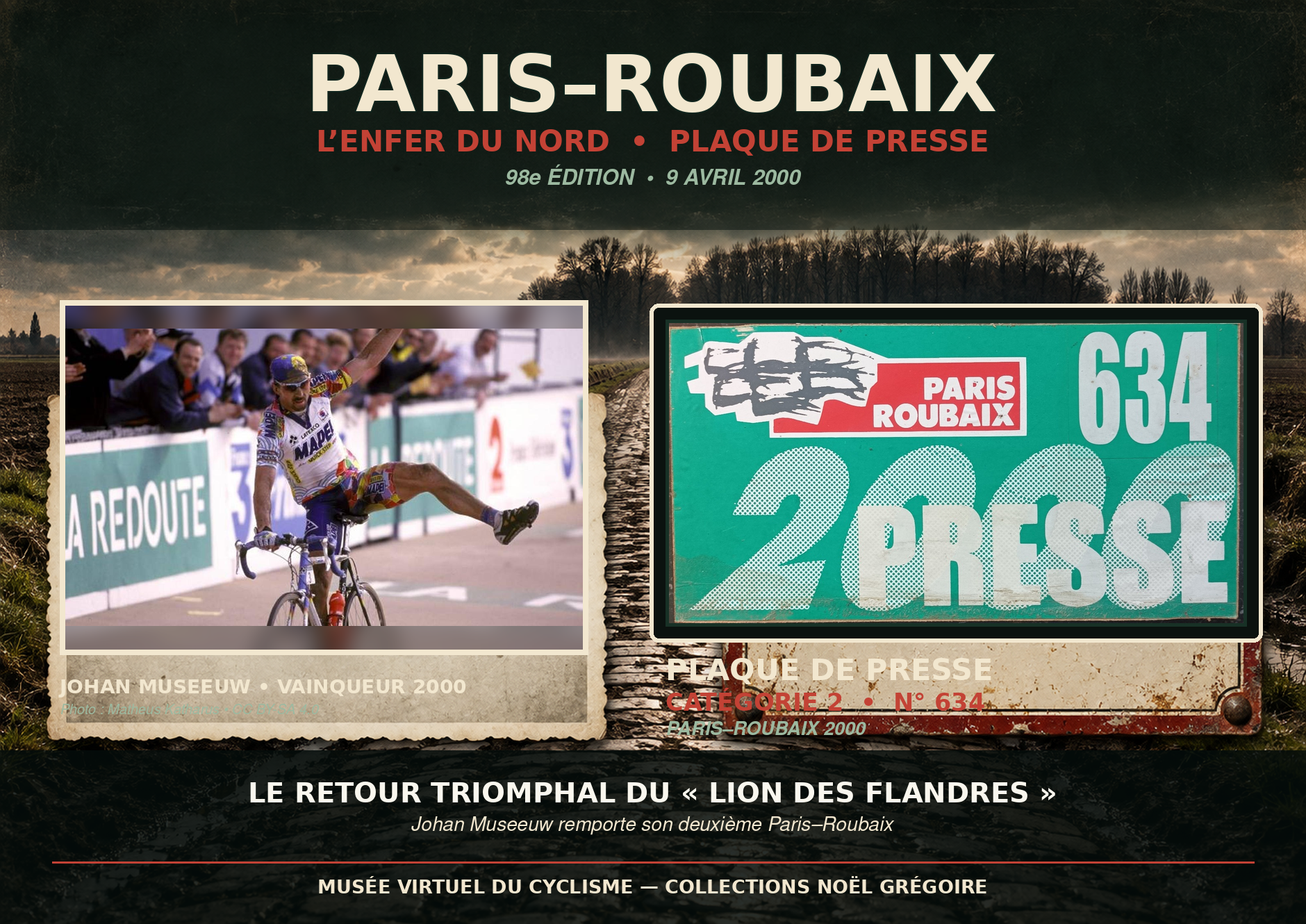
ITEM N° 711
Paris–Roubaix 2000 press vehicle badge
This badge relates to Paris–Roubaix 2000, the ninety-eighth edition of the famous classic nicknamed ‘Hell of the North’, which took place on 9 April over a distance of 272 kilometres between Compiègne and the Roubaix velodrome.
The item features the Paris–Roubaix emblem alongside the number 634 and the words ‘2 Presse’. It was likely used to identify an accredited vehicle belonging to the press convoy responsible for covering the race. Its green colour, bold lettering and signs of wear bear witness to its practical role at the heart of the event.
The 2000 edition was won by the Belgian Johan Museeuw, riding for the Mapei–Quick Step team. After a solo breakaway 38 kilometres from the finish, the ‘Lion of Flanders’ won in 6 hours 47 minutes, fifteen seconds ahead of Peter Van Petegem and Erik Zabel.
This victory held particular symbolic significance. Having suffered a serious knee injury during the 1998 Paris–Roubaix, Museeuw had feared for the future of his career. As he crossed the finish line in 2000, he raised his leg and pointed to his knee, celebrating both his victory and his return to the very highest level. He thus claimed his second Paris–Roubaix victory, ahead of a third triumph in 2002.
On display in the Virtual Cycling Museum – Noël Grégoire Collections, this plaque is a valuable record of the media coverage of Paris–Roubaix. It preserves the memory of an edition marked by Johan Museeuw’s sporting comeback and by one of the most iconic images in the modern history of the classic.
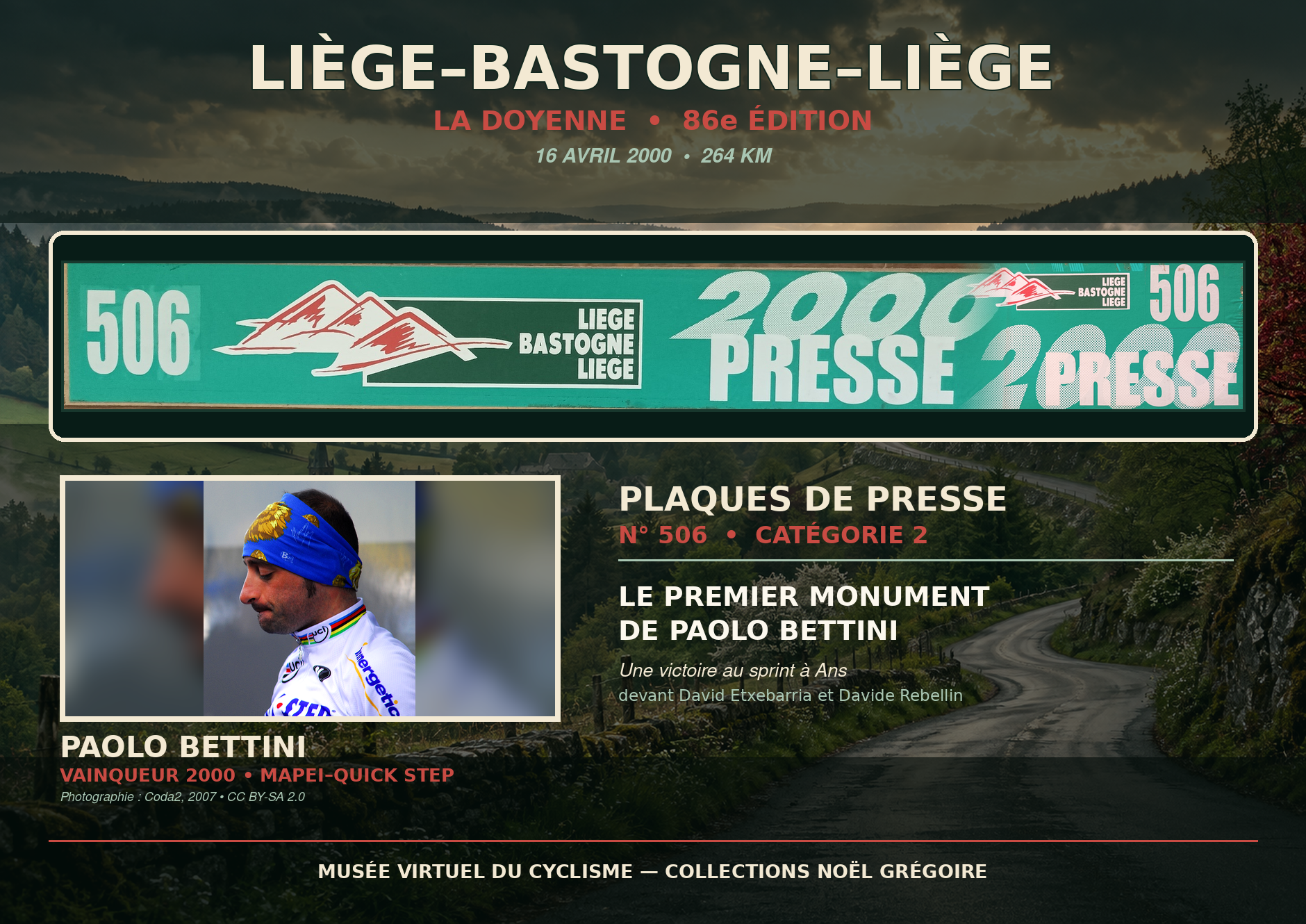
ITEM N° 712
Press vehicle number plates from Liège–Bastogne–Liège 2000
This number plate relates to Liège–Bastogne–Liège 2000, the eighty-sixth edition of the famous classic race nicknamed ‘La Doyenne’, held on 16 April over a distance of 264 kilometres between Liège, Bastogne and Ans.
The plate bears the number 506. The longer plate displays the year ‘2000’ and the word ‘Presse’, whilst the second plate reads ‘2 Presse’. Both feature the race’s former emblem, depicting the characteristic hills of the Belgian Ardennes.
This plate was used to identify an accredited vehicle belonging to the press convoy. The number 506 allowed for its identification, whilst the number 2 could correspond to an accreditation category or a specific sector of the organisation.
The 2000 edition was won in Ans by the Italian Paolo Bettini, riding for the Mapei–Quick Step team. He won in a sprint finish after 6 hours, 28 minutes and 32 seconds of racing, ahead of the Spaniard David Etxebarria and his compatriot Davide Rebellin. This victory marked the first Monument of his career and the first of his two wins in Liège–Bastogne–Liège, ahead of his subsequent triumph in 2002.
Featured in the Virtual Cycling Museum – Noël Grégoire Collections, this collection bears witness to the media coverage of ‘La Doyenne’ at the turn of the 21st century. It also preserves the memory of the emergence of Paolo Bettini, future Olympic champion and two-time world champion.
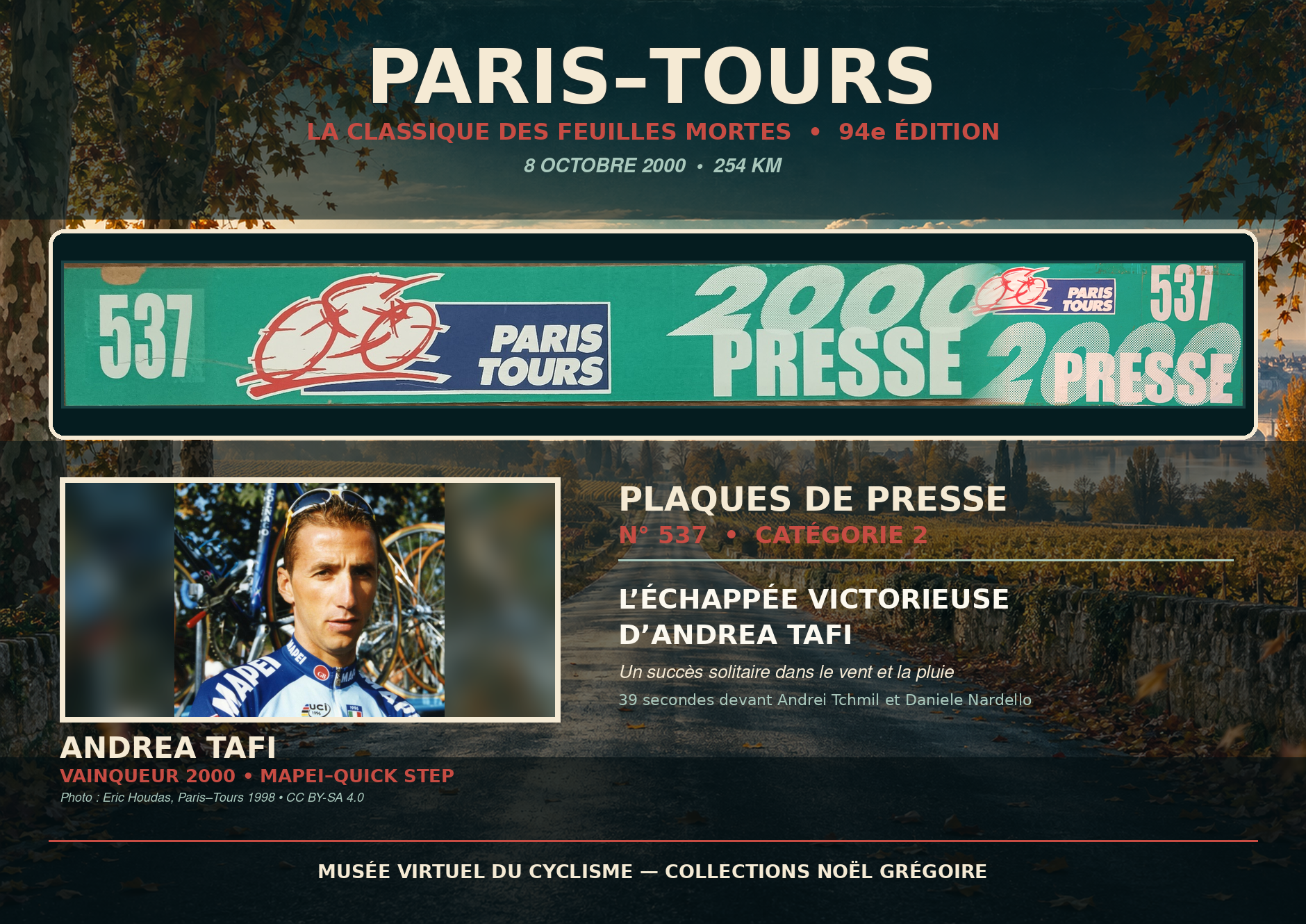
ITEM N° 713
Paris–Tours 2000 press vehicle number plate
This number plate relates to Paris–Tours 2000, the ninety-fourth edition of the famous French classic, held on 8 October over a distance of 254 kilometres between Saint-Arnoult-en-Yvelines and Tours. Held in autumn, the race is traditionally known as ‘the Classic of the Falling Leaves’.
Green in colour, the plate bears the year ‘2000’, the word ‘Presse’, the number 537 and the category 2 designation. It also features the former Paris–Tours emblem, consisting of a cyclist racing at full speed in front of the race’s name.
Fixed to an accredited vehicle, it enabled it to be identified within the press convoy. The number 537 presumably referred to the vehicle, whilst the number 2 corresponded to an accreditation category defined by the organisers. Signs of wear and tear bear witness to its actual use during the race.
The 2000 edition was won by the Italian Andrea Tafi, riding for the Mapei–Quick Step team. Taking advantage of challenging weather conditions, characterised by wind and rain, he attacked 23 kilometres from the finish and won solo after 6 hours 38 minutes 14 seconds of racing. Andrei Tchmil and Daniele Nardello completed the podium, 39 seconds behind.
On display in the Virtual Cycling Museum – Noël Grégoire Collections, this plaque is a valuable record of the media coverage of Paris–Tours. It preserves the memory of the attacking victory by Andrea Tafi, one of the greatest classics specialists of his generation.
