

Race vehicle identification plates - 15
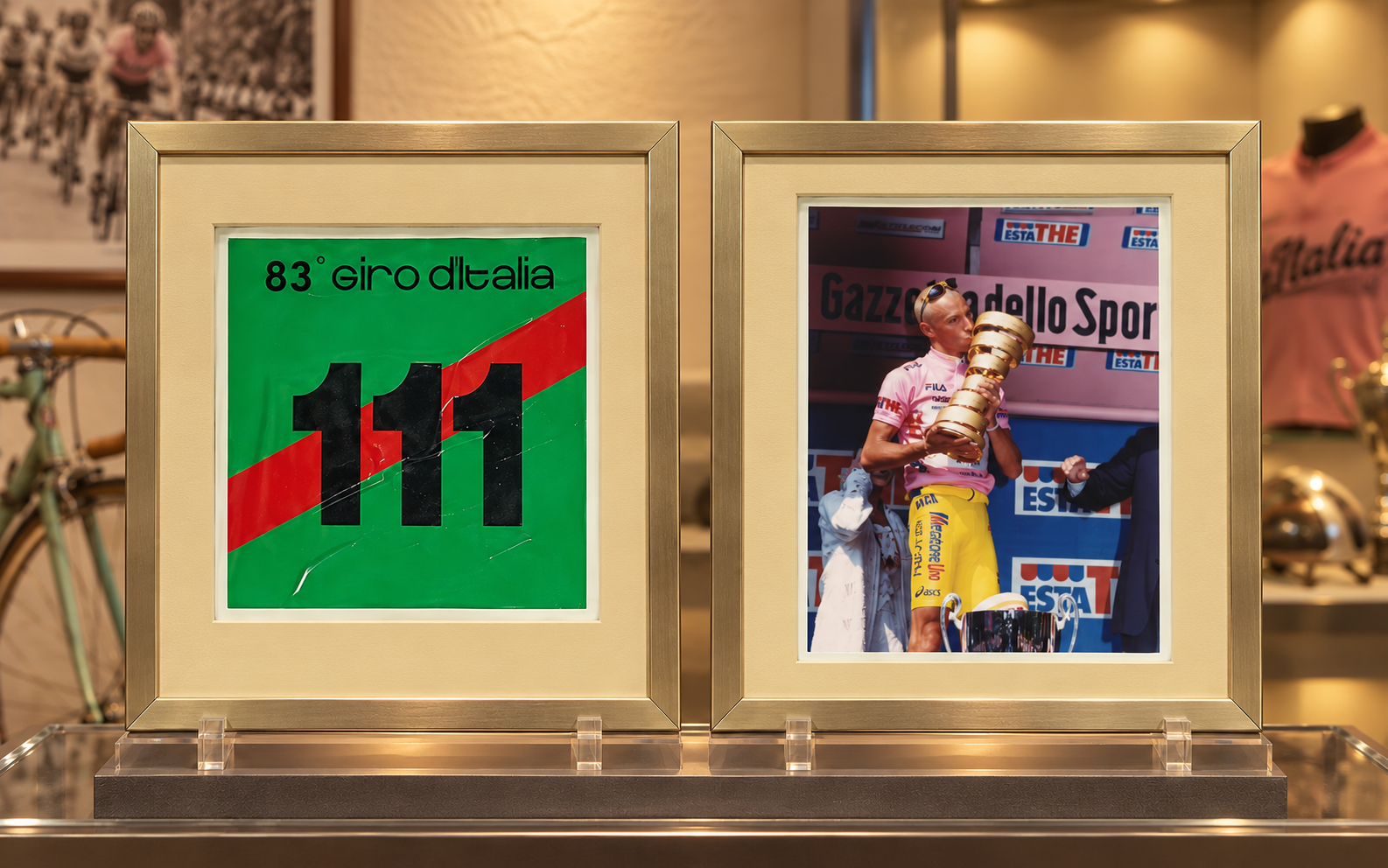
ITEM N° 700
Press vehicle number plate from the 2000 Giro d’Italia
This number plate relates to the 2000 Giro d’Italia, the eighty-third edition of the Tour of Italy, which took place from 13 May to 4 June between Rome and Milan. It identified a vehicle belonging to the press convoy accompanying the race.
The item bears the inscriptions ‘83° Giro d’Italia’, ‘13 Maggio – 4 Giugno’ and ‘Stampa’. The number 111 enabled the vehicle to be identified within the organisation. The emblems of La Gazzetta dello Sport and Fiat bear witness to the vital role played by the media and automotive partners in the running of the event.
This edition was won by the Italian Stefano Garzelli, riding for the Mercatone Uno–Albacom team. He finished 1 minute 27 seconds ahead of Francesco Casagrande and 1 minute 33 seconds ahead of Gilberto Simoni in the general classification.
Garzelli secured the pink jersey for good during the mountain time trial between Briançon and Sestrières, held on the eve of the finish. This victory, the most prestigious of his career, cemented his status as one of the finest Italian riders of his generation.
On display in the Virtual Cycling Museum – Noël Grégoire Collections, this plaque is a valuable testament to the Giro’s media coverage. It preserves the memory of the 2000 edition and Stefano Garzelli’s triumph on the roads of Italy.
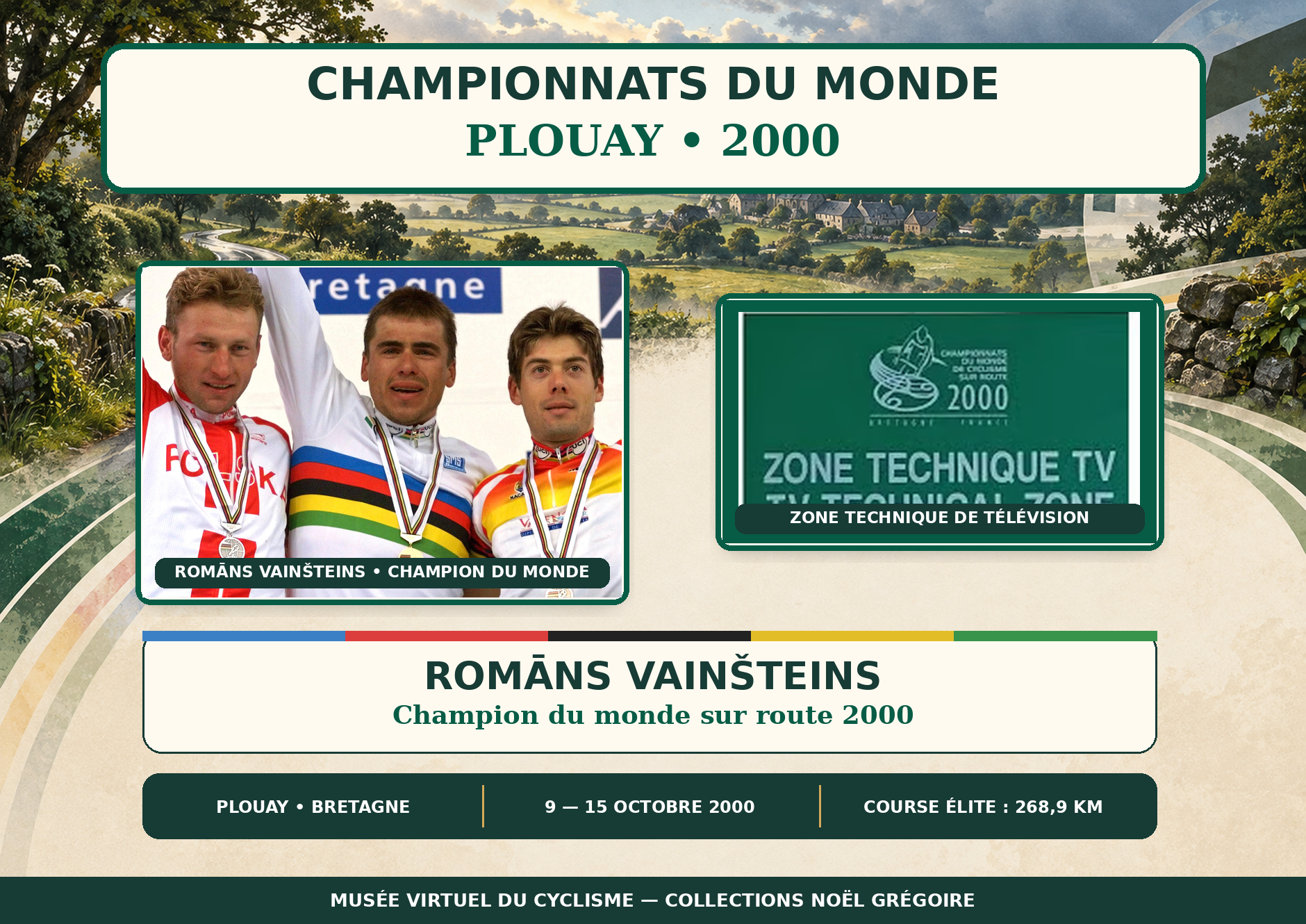
ITEM N° 701
Sign from the TV technical zone at the 2000 World Cycling Championships
This sign comes from the Road World Cycling Championships held in Plouay, Brittany, from 9 to 15 October 2000. It was used to mark out and demarcate an area reserved for the technical teams responsible for the television broadcast of the competition.
Against a green background, the sign features the official emblem of the championships alongside the bilingual inscription ‘Zone technique TV – TV Technical Zone’. The use of both French and English helped technicians and international media present at the venue to find their way around.
This signage bears witness to the extensive organisation required for the audiovisual coverage of a world championship. Cameras, production vehicles, transmission equipment and production teams enabled the various events to be broadcast to a vast international audience.
The men’s road race was won by the Latvian Romāns Vainšteins, who triumphed in a sprint finish at the end of a 268.9-kilometre course. He finished ahead of the Pole Zbigniew Spruch and the defending champion, the Spaniard Óscar Freire.
On display in the Virtual Cycling Museum – Noël Grégoire Collections, this sign offers a rare glimpse behind the scenes of the media coverage at the World Championships in Plouay. It serves as a reminder that major cycling competitions also rely on the behind-the-scenes work of the technicians who ensure they are broadcast and preserved in the collective memory.
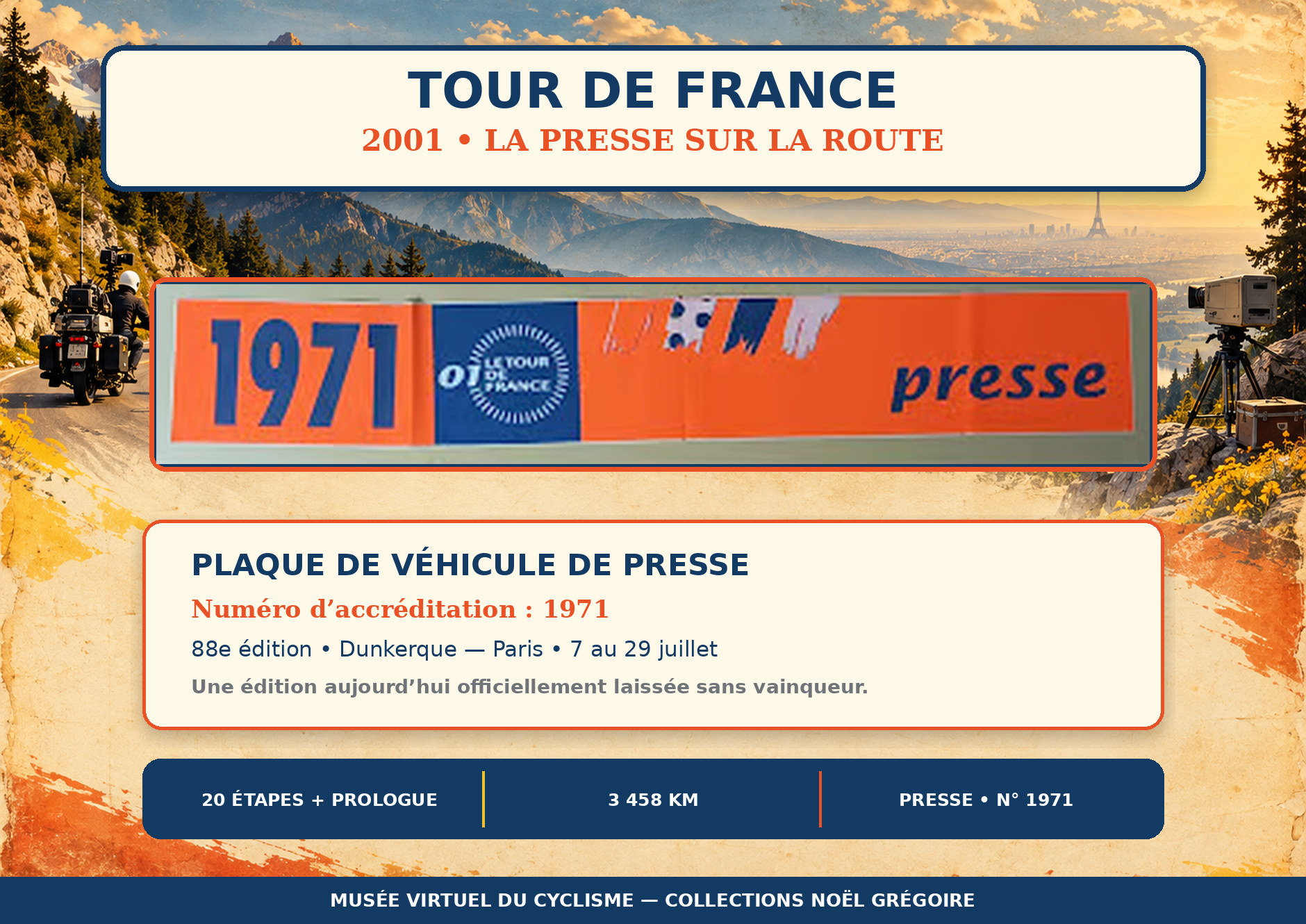
ITEM N° 702
Press vehicle number plate from the 2001 Tour de France
This number plate relates to the 2001 Tour de France, the eighty-eighth edition of the Grande Boucle, which took place from 7 to 29 July over a route of approximately 3,458 kilometres between Dunkirk and Paris.
The item bears the number 1971, the year ‘01’, the Tour de France emblem and the word ‘press’. It was used to identify an accredited vehicle belonging to the media convoy responsible for following the race on a daily basis.
These plates allowed authorised journalists, photographers and technicians to travel along the route and gain access to the various restricted areas. They were therefore essential elements of the Tour’s organisation and media coverage.
Originally awarded to Lance Armstrong, the 2001 edition was stripped from his list of victories following sanctions imposed for doping. Like the Tours from 1999 to 2005, it is now officially considered to have no winner.
On display in the Virtual Cycling Museum – Noël Grégoire Collections, this badge bears witness to the journalistic behind-the-scenes action of the Grande Boucle. It also preserves the memory of an edition whose final classification holds a special place in the history of the Tour de France.
