

Race vehicle identification plates - 17
ITEM N° 714
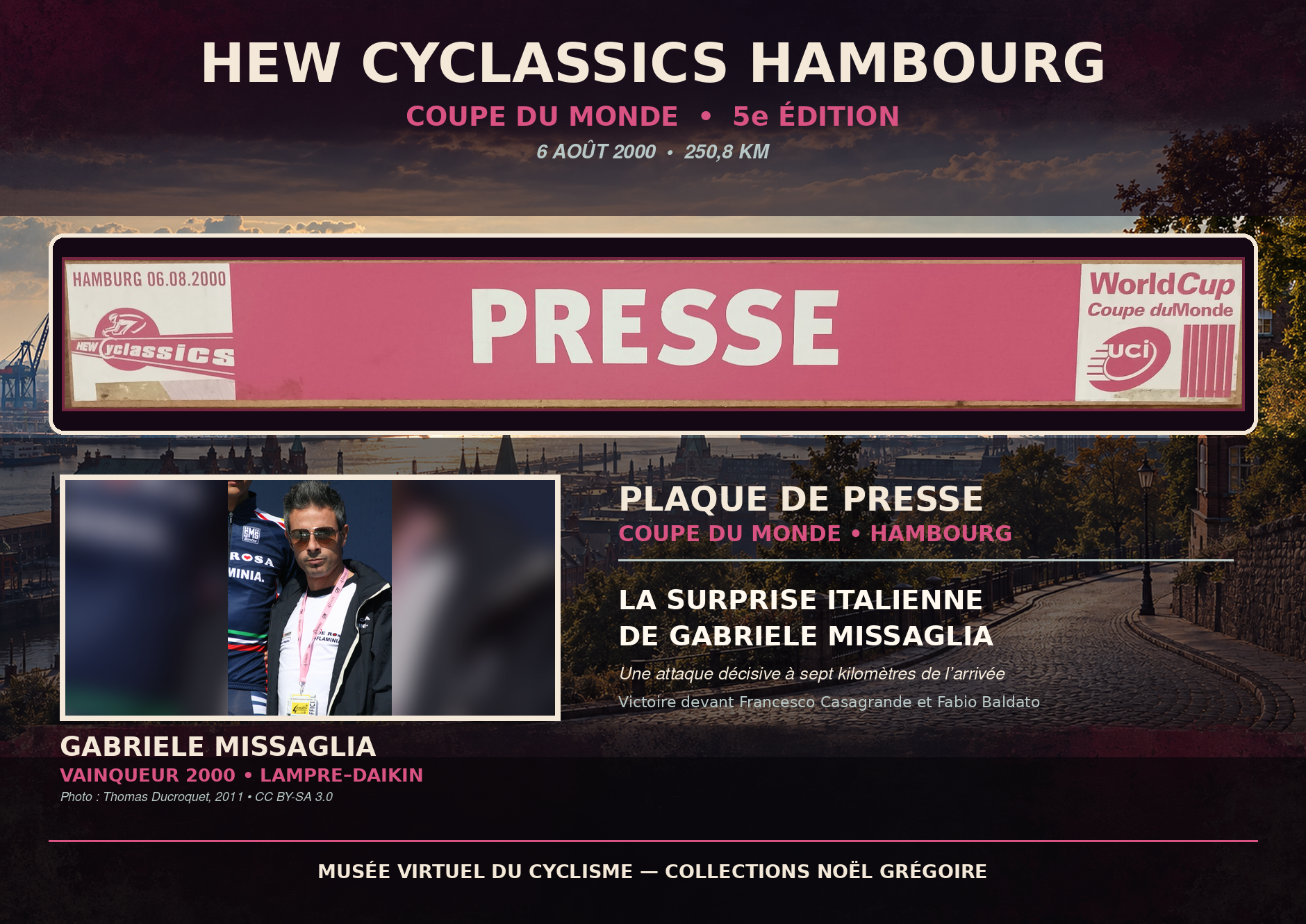
Press vehicle badge for the HEW Cyclassics Hamburg 2000
This badge relates to the HEW Cyclassics 2000, the fifth edition of the Hamburg classic, held on 6 August over a 250.8-kilometre route around the major German port city. At the time, the event formed part of the Road Cycling World Cup.
The pink plate bears the word ‘Press’ in the centre. At either end are the date and venue — ‘Hamburg 06.08.2000’ — as well as the emblems of the HEW Cyclassics, the World Cup and the International Cycling Union.
Affixed to an accredited vehicle, it identified media representatives authorised to travel within the race convoy. Its large horizontal format and particularly legible lettering met the organisers’ practical requirements for control and security.
The 2000 edition was won by the Italian Gabriele Missaglia, riding for the Lampre–Daikin team. Seven kilometres from the finish, he broke away with Francesco Casagrande before beating his compatriot in a very close sprint. Fabio Baldato took third place, two seconds later.
On display in the Virtual Cycling Museum – Noël Grégoire Collections, this plaque bears witness to the media coverage of a race that was then in full swing. It commemorates the greatest success of Gabriele Missaglia’s career and a remarkable Italian one-two-three in Hamburg.
ITEM N° 715
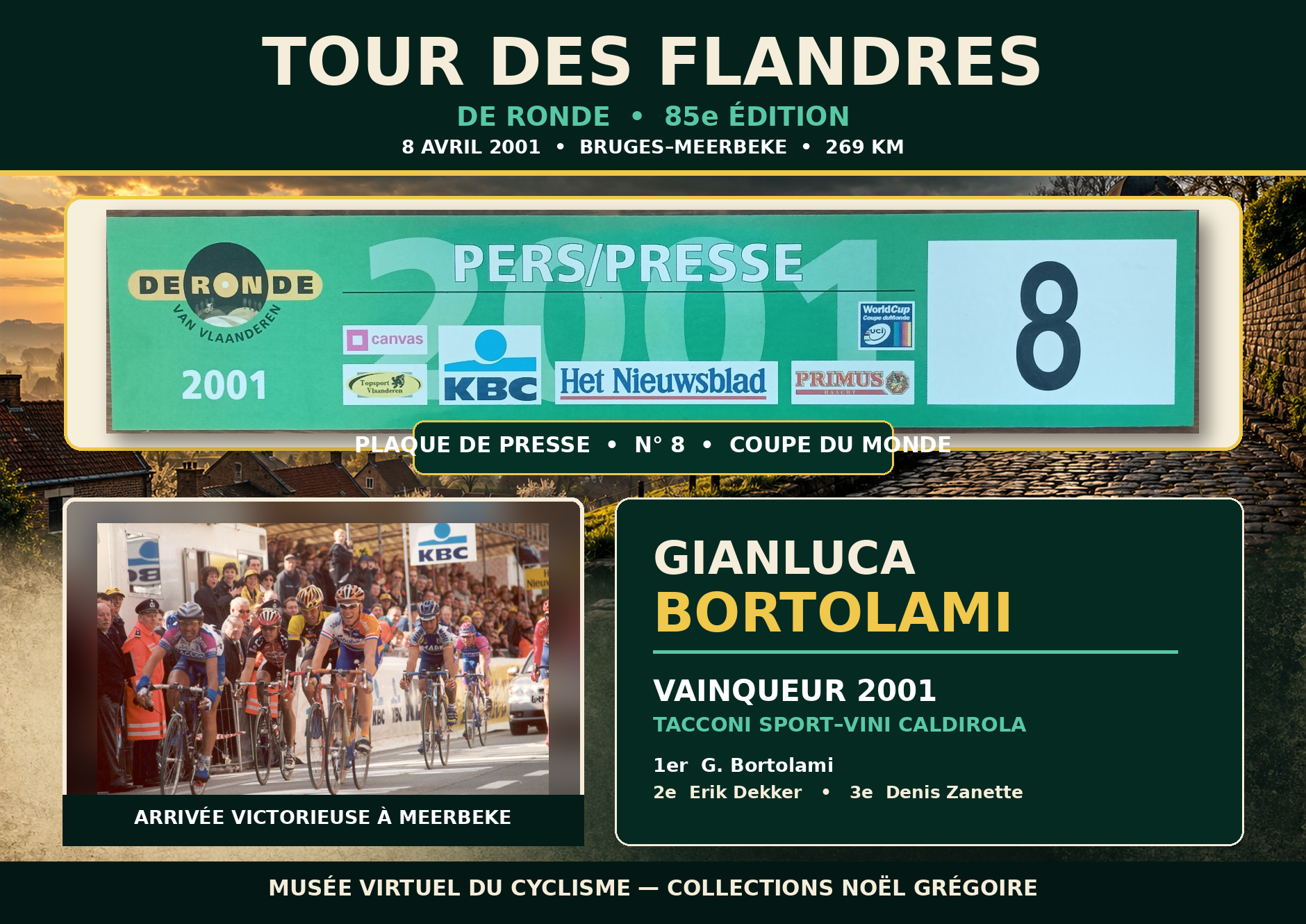
Press plaque from the 2001 Tour of Flanders
This plate relates to the 2001 Tour of Flanders, the eighty-fifth edition of the famous Flemish classic, held on 8 April over a distance of 269 kilometres between Bruges and Meerbeke. Part of the World Cup calendar, the race included climbs such as the Oude Kwaremont, the Paterberg, the Mur de Grammont and the Bosberg.
Bearing the words ‘De Ronde van Vlaanderen’, ‘Pers/Press’ and the number 8, this long green plaque was intended to identify an accredited press vehicle. It also features the emblems of the UCI World Cup and several of the race’s media and commercial partners, including Het Nieuwsblad, Canvas, KBC, Primus and Topsport Vlaanderen.
The race was won by the Italian Gianluca Bortolami, riding for the Tacconi Sport–Vini Caldirola team. Part of a breakaway group of eight riders, he won the sprint finish in Meerbeke ahead of the Dutchman Erik Dekker and his compatriot Denis Zanette, after a race lasting 6 hours, 10 minutes and 23 seconds.
This victory ranks among the greatest achievements of Bortolami’s career. Having already won the World Cup in 1994 and finished second in Paris–Roubaix in 1996, the Lombard rider thus added his name to the roll of honour of one of cycling’s five Monuments.
On display in the Virtual Cycling Museum – Noël Grégoire Collections, this plaque bears witness to the organisation of the press vehicles and the significant media coverage of the Tour of Flanders. It also preserves the memory of Gianluca Bortolami’s unexpected victory on the roads and cobbled hills of Flanders.
ITEM N° 716
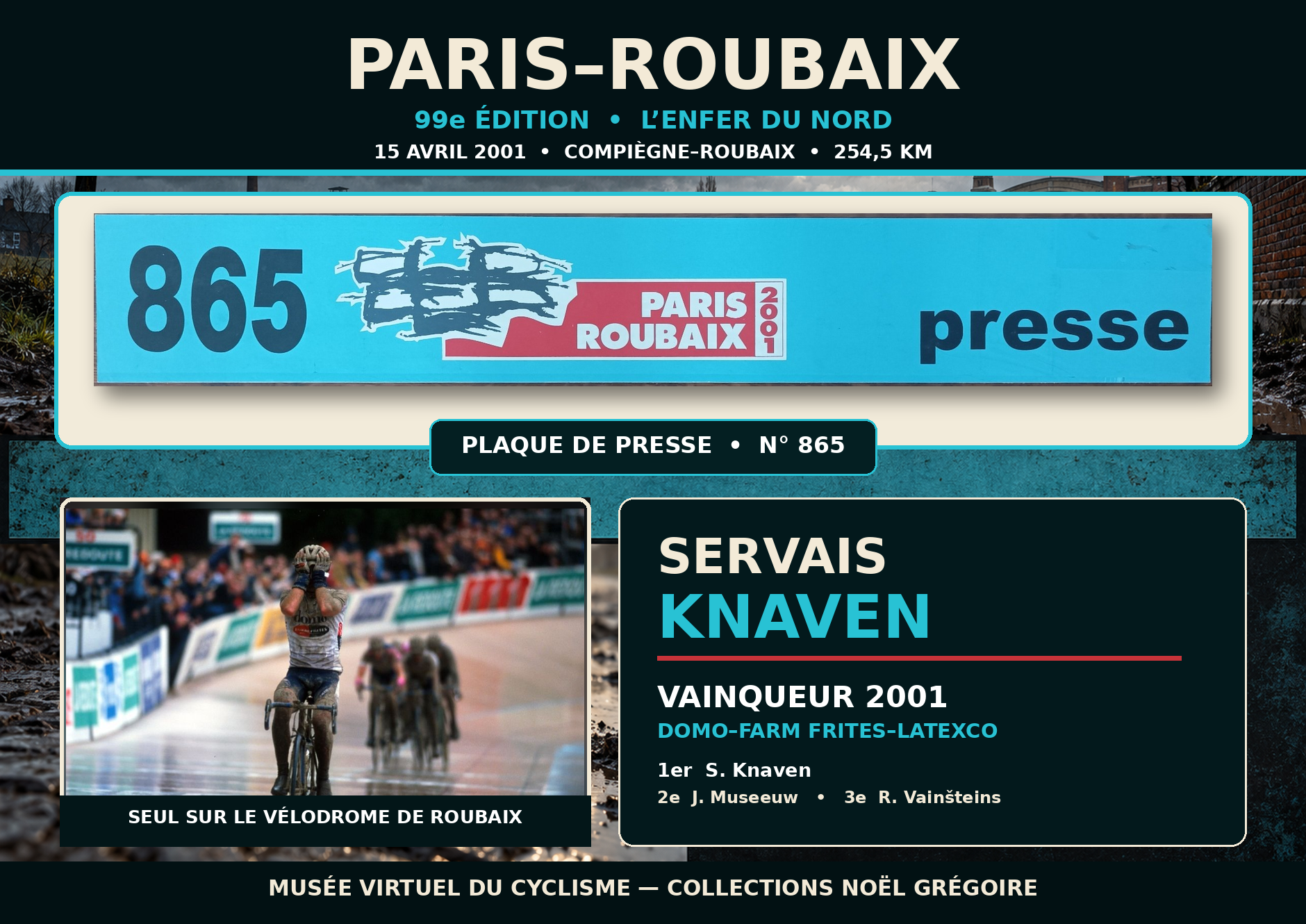
Paris–Roubaix 2001 press plaque
This plaque relates to Paris–Roubaix 2001, the ninety-ninth edition of the famous classic known as ‘Hell of the North’. Held on 15 April between Compiègne and Roubaix, the race covered a distance of 254.5 kilometres, featuring numerous cobbled sections made particularly challenging by the rain and mud.
Turquoise in colour, the plate bears the Paris–Roubaix 2001 logo, the word ‘press’ and the number 865. It was intended to identify an accredited vehicle belonging to the media and authorised to travel within the race organisation’s convoy. Its elongated shape allowed the number to be read quickly by race officials and security staff.
This edition was won by the Dutch rider Servais Knaven, a member of the Domo–Farm Frites–Latexco team. After launching an attack around ten kilometres from the finish, Knaven entered the Roubaix velodrome alone and won in 6 hours 45 minutes, 34 seconds ahead of Johan Museeuw.
The Domo–Farm Frites team put in an exceptional team performance by taking all three podium places: Servais Knaven finished ahead of Johan Museeuw and Romāns Vainšteins. This one-two-three finish remains one of the most memorable team performances in the recent history of Paris–Roubaix.
On display in the Virtual Cycling Museum – Noël Grégoire Collections, this plaque bears witness to the media organisation of Paris–Roubaix and the vital role played by press vehicles. It also preserves the memory of a gruelling race, marked by mud-covered cobbles and the greatest victory of Servais Knaven’s career.
