

Race vehicle identification plates - 13
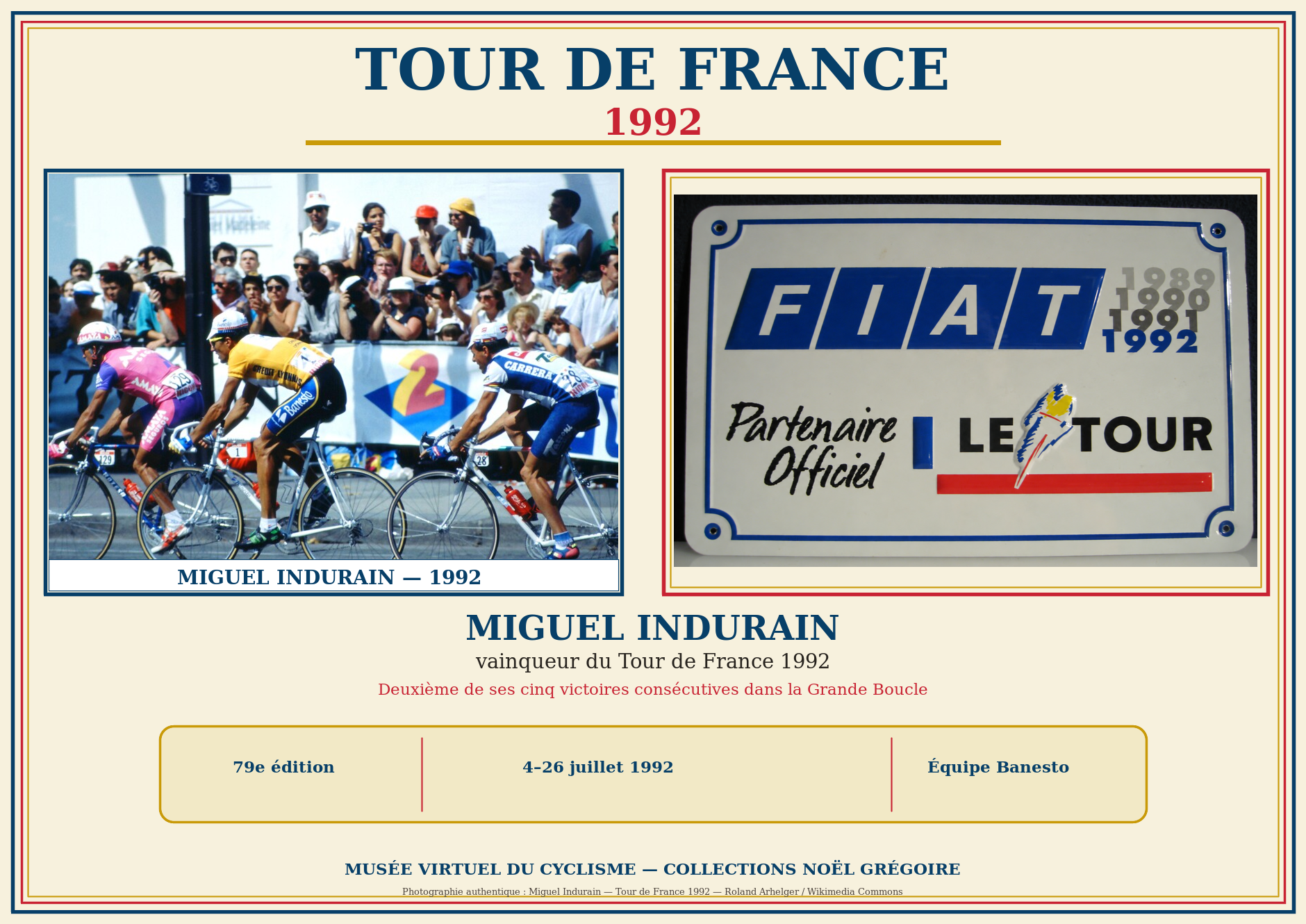
ITEM N° 697
Official FIAT vehicle number plate 1992 Tour de France
This number plate relates to the 1992 Tour de France, the seventy-ninth edition of the Grande Boucle, which took place from 4 to 26 July over a route of approximately 3,983 kilometres. It was likely fitted to a vehicle belonging to the organisers or one of the event’s official partners.
The item bears the FIAT logo as well as the words ‘Official Partner’ and ‘Le Tour’, accompanied by the old emblem featuring a cyclist. The four years – 1989, 1990, 1991 and 1992 – mark the successive years during which the Italian car manufacturer was associated with the race. The year 1992, printed in blue, refers to the edition corresponding to this plate.
Sturdy and fitted with four mounting points, this plate was designed to be fitted to an official vehicle. It enabled the vehicle to be immediately identified as belonging to the Tour organisation and facilitated its movement within the peloton, the technical convoy or restricted areas.
The 1992 edition was won by the Spaniard Miguel Indurain, leader of the Banesto team. He topped the general classification ahead of the Italian Claudio Chiappucci, who finished 4 minutes 35 seconds behind, and Gianni Bugno, who came third, 10 minutes 49 seconds behind.
This victory was the second of five consecutive Tour de France titles won by Miguel Indurain between 1991 and 1995. It capped an exceptional season during which the champion from Navarre achieved his first Giro d’Italia–Tour de France double.
On display in the Virtual Cycling Museum – Noël Grégoire Collections, this plaque bears witness to the vital role played by partner vehicles in the organisation of the Tour. It also commemorates Miguel Indurain’s second victory and the beginning of his dominance over the Grande Boucle.
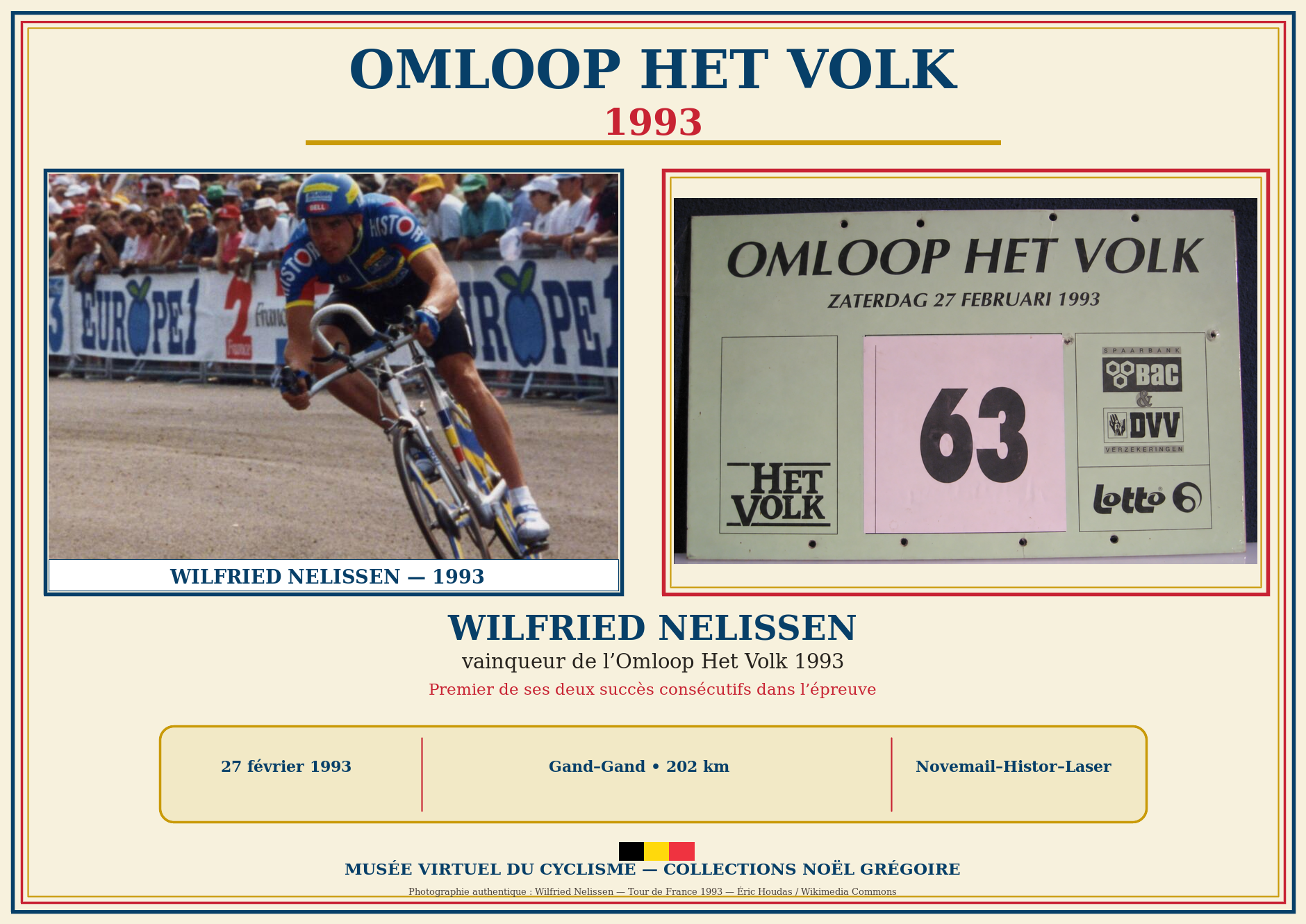
ITEM N° 698
Vehicle number plate – Omloop Het Volk 1993
This number plate relates to the 1993 Omloop Het Volk, a major Belgian opening classic held on Saturday 27 February over a 202-kilometre route from Ghent to Ghent. This race is now known as the Omloop Het Nieuwsblad.
The plate bears the title ‘Omloop Het Volk’, the date of the race and the number 63, assigned to one of the accredited vehicles or personnel. Its various perforations allowed the plate to be attached to a vehicle belonging to the organisers, the press or the support convoy accompanying the race.
The design features the logo of the organising daily newspaper *Het Volk* as well as those of several partners: BAC Bank, DVV Insurance and the Belgian National Lottery. It illustrates the importance of support from the press and Belgian businesses in the organisation of major cycling races.
The 1993 edition was won by the Belgian sprinter Wilfried Nelissen, a member of the Novemail–Histor–Laser Computer team. He finished ahead of the German Olaf Ludwig and his compatriot Eric Vanderaerden in a bunch sprint.
This victory was the first of Wilfried Nelissen’s two consecutive wins in the Omloop Het Volk. The Belgian champion triumphed again in 1994, confirming his power and speed in the early-season classics.
On display in the Virtual Cycling Museum – Noël Grégoire Collections, this plaque bears witness to the practical organisation of the race and preserves the memory of a particularly brilliant period in Wilfried Nelissen’s career.
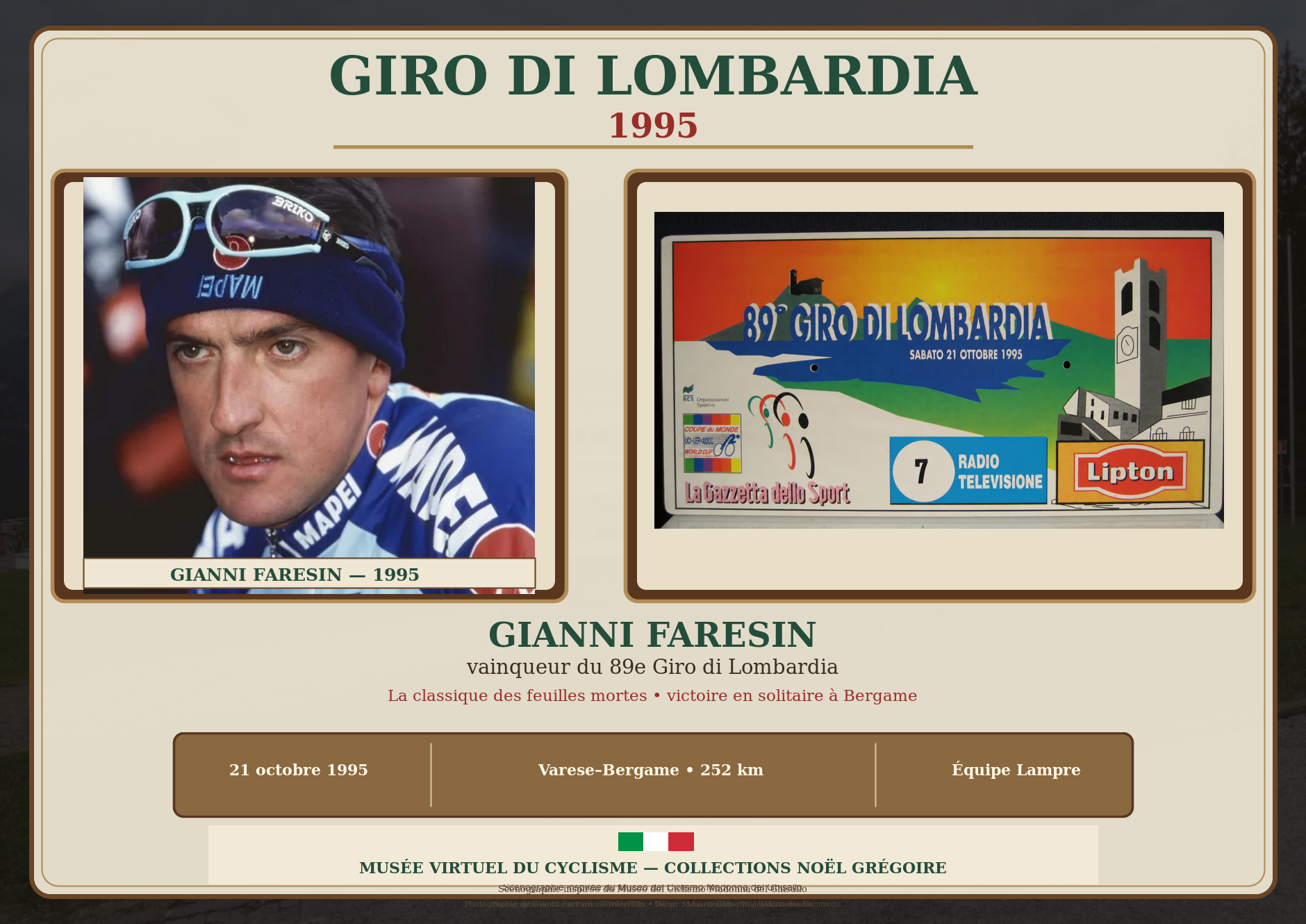
ITEM N° 699
Vehicle number plate – 89th Giro di Lombardia 1995
This number plate relates to the 89th Giro di Lombardia, held on Saturday 21 October 1995. Nicknamed the ‘classic of the falling leaves’, this prestigious Italian race was, that year, the eleventh and final round of the Road Cycling World Cup.
Its design directly evokes the landscapes of Lombardy and the region’s architectural heritage. In particular, it features a depiction of the Sanctuary of the Madonna del Ghisallo, an iconic site in Italian cycling situated above Lake Como.
The plaque bears the emblems of RCS Organizzazioni Sportive, La Gazzetta dello Sport and the UCI World Cup. The number 7 and the words ‘Radio Televisione’ suggest that it likely identified a vehicle assigned to radio or television broadcasts of the race.
The race ran from Varese to Bergamo over a distance of 252 kilometres. The Italian Gianni Faresin, a member of the Lampre–Panaria team, launched a decisive attack around two kilometres from the finish and won solo.
Faresin crossed the line 19 seconds ahead of Daniele Nardello and Michele Bartoli. This victory in one of the five Monuments was the most prestigious success of his professional career.
On display in the Virtual Cycling Museum – Noël Grégoire Collections, this plaque brings together the sporting history of the Tour of Lombardy, the world of media vehicles and the heritage significance of Ghisallo, a true landmark in the history of Italian cycling.
