

Race vehicle identification plates - 12
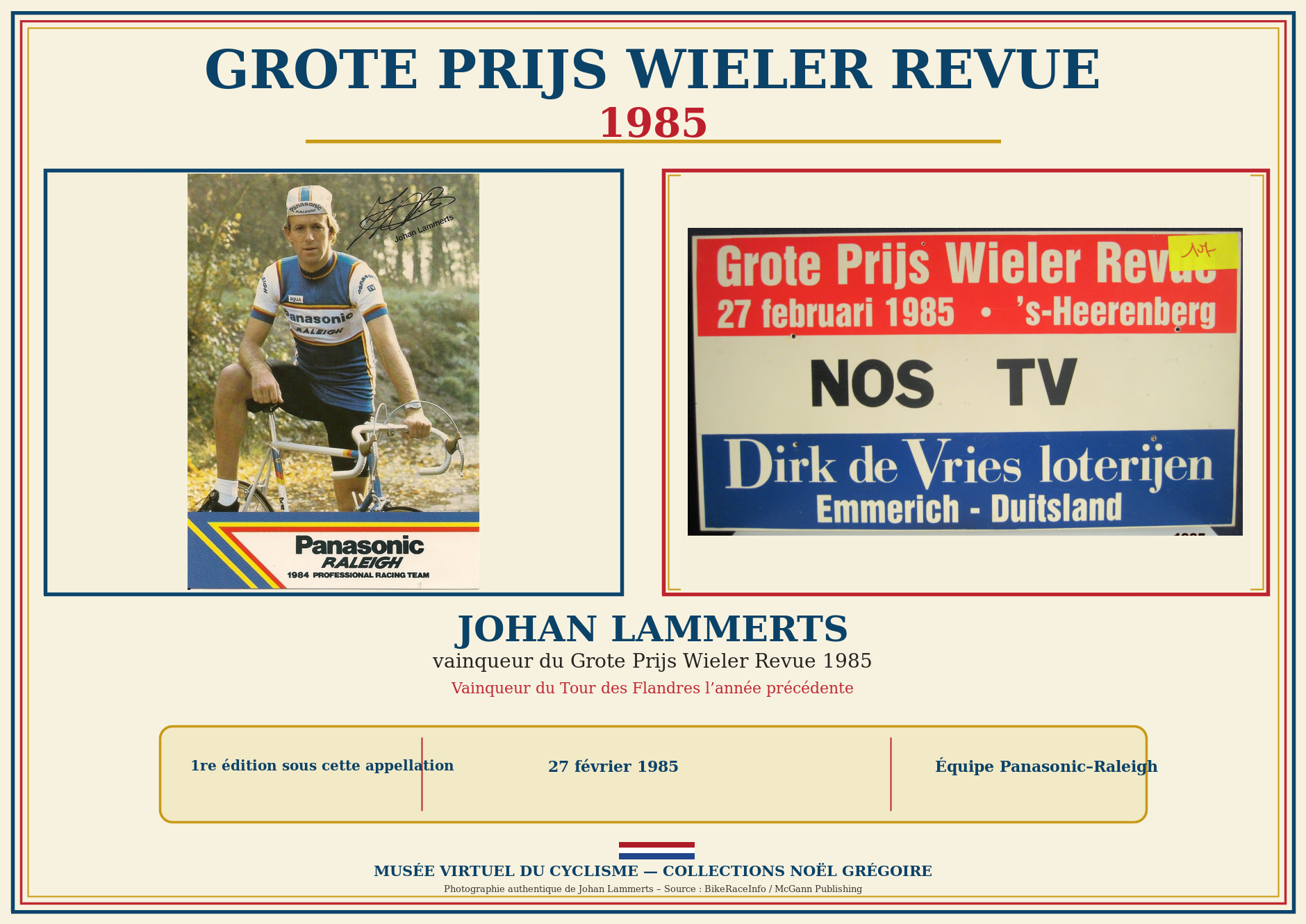
ITEM N° 694
Vehicle number plate from the 1985 G-P Wieler Revue
This number plate relates to the Grote Prijs Wieler Revue held on 27 February 1985 in ’s-Heerenberg, in the Dutch province of Gelderland.
The badge features a particularly striking design, dominated by three colours: red, white and blue. The upper section bears the name of the event, its date and the venue. The central section features the words ‘NOS TV’, whilst the lower section is dedicated to the company Dirk de Vries Loterijen, based in Emmerich, Germany.
The presence of four holes suggests that this plate was intended to be attached to an official vehicle, probably associated with Dutch television or one of the race’s partners. It served simultaneously as a means of identification, accreditation and advertising within the motorcade accompanying the race.
The race held on 27 February 1985 was the first edition organised under the name Grote Prijs Wieler Revue. It continued the tradition of the Ronde van de Achterhoek, a race held in the east of the Netherlands since 1969. The route for this inaugural edition covered 182 kilometres around ’s-Heerenberg.
Victory went to the Dutchman Johan Lammerts. A few months after his success at ’s-Heerenberg, Johan Lammerts also won the twentieth stage of the 1985 Tour de France, contested between Montpon-Ménestérol and Limoges. Having launched an attack in the final kilometres, he held off the peloton’s comeback and won by a margin of twenty-one seconds.
The reference to ‘NOS TV’ illustrates the growing importance of television in the organisation and media coverage of cycling competitions during the 1980s. The advertising inscription for the Dirk de Vries lottery also highlights the role played by regional and cross-border companies in the funding of Dutch races.
On display in the Virtual Cycling Museum – Noël Grégoire Collections, this plaque bears witness to the practical and media organisation of the Grote Prijs Wieler Revue. It preserves the memory of the first edition held under this name and of the victory of Johan Lammerts, one of the finest Dutch riders of his generation.
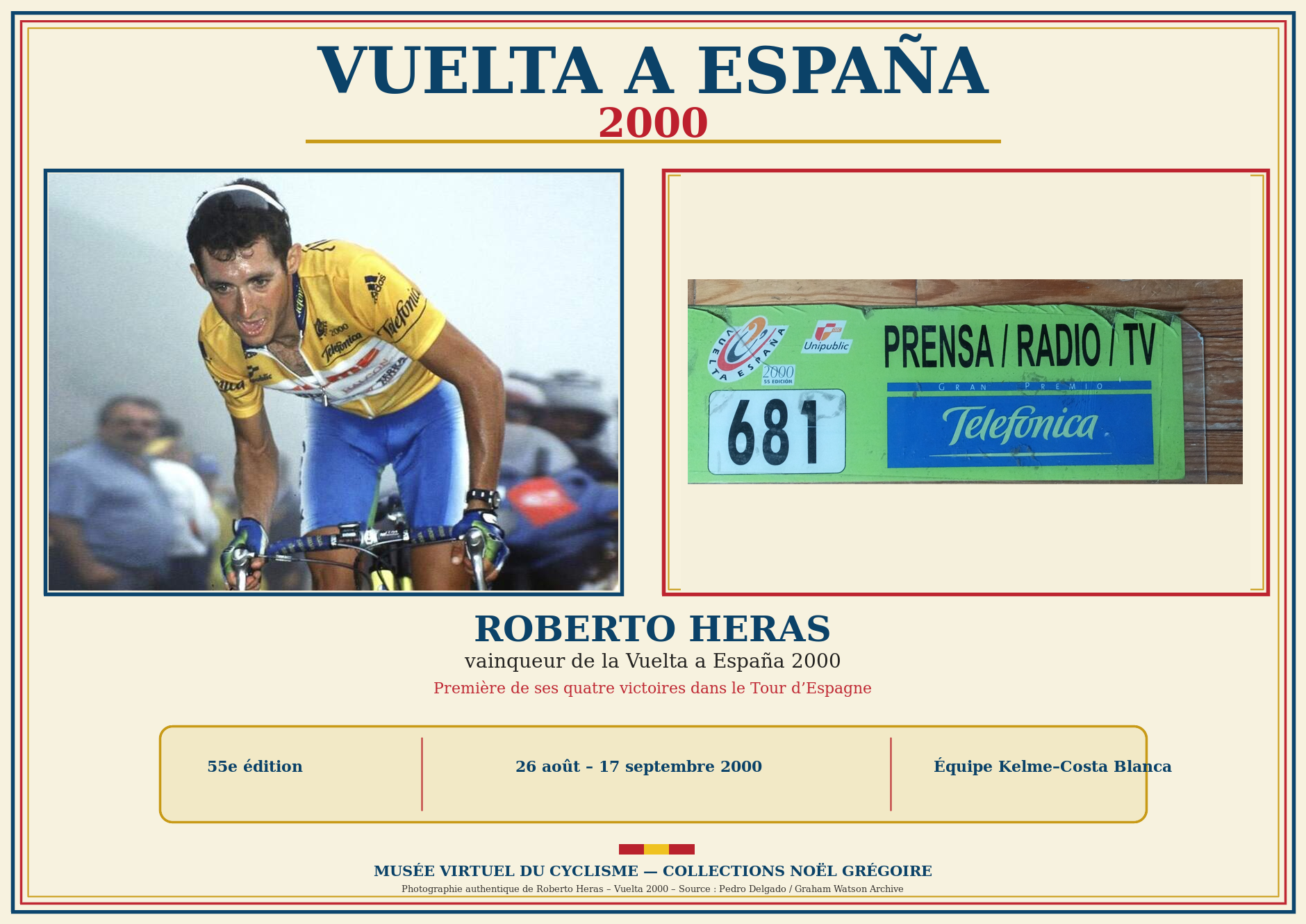
ITEM N° 695
Press–Radio–Television accreditation badge for the 2000 Vuelta a España
This badge relates to the 2000 Vuelta a España, the fifty-fifth edition of the Tour of Spain, which took place from 26 August to 17 September 2000. Starting in Málaga and finishing in Madrid, the race comprised a prologue and twenty stages covering approximately 2,904 kilometres.
The badge identified an accredited media vehicle or member accompanying the race. The inscription ‘PRENSA / RADIO / TV’ granted access to areas reserved for the press and to certain sections of the route controlled by the organisers.
The number 681 was the identification number for this accreditation. It enabled race officials and security staff to quickly recognise the vehicle or press team authorised to join the Vuelta’s support convoy.
The badge bears the Vuelta a España logo, the inscription ‘2000 – 55th edition’ and the logo of Unipublic, the event’s organising company. The right-hand side features the branding of Telefónica, then a major partner of the race.
Its fluorescent green background made the accreditation immediately visible. Preserved in a transparent sleeve, the badge shows creases, tears and marks bearing witness to its use during the race.
The 2000 edition was won by the Spaniard Roberto Heras, a member of the Kelme–Costa Blanca team. An excellent climber, he took the leader’s jersey at the Lagos de Covadonga and consolidated his victory by winning the penultimate stage at the summit of the Alto de Abantos.
Roberto Heras completed the Vuelta in 70 hours 26 minutes 14 seconds. He finished 2 minutes 33 seconds ahead of Ángel Casero and 4 minutes 55 seconds ahead of Pavel Tonkov. This first victory was followed by three more, in 2003, 2004 and 2005.
On display in the Virtual Cycling Museum – Noël Grégoire Collections, this plaque illustrates how the media caravan of a Grand Tour operates. It commemorates Roberto Heras’s first victory in the Vuelta and the growing importance of television in the broadcast of cycling.
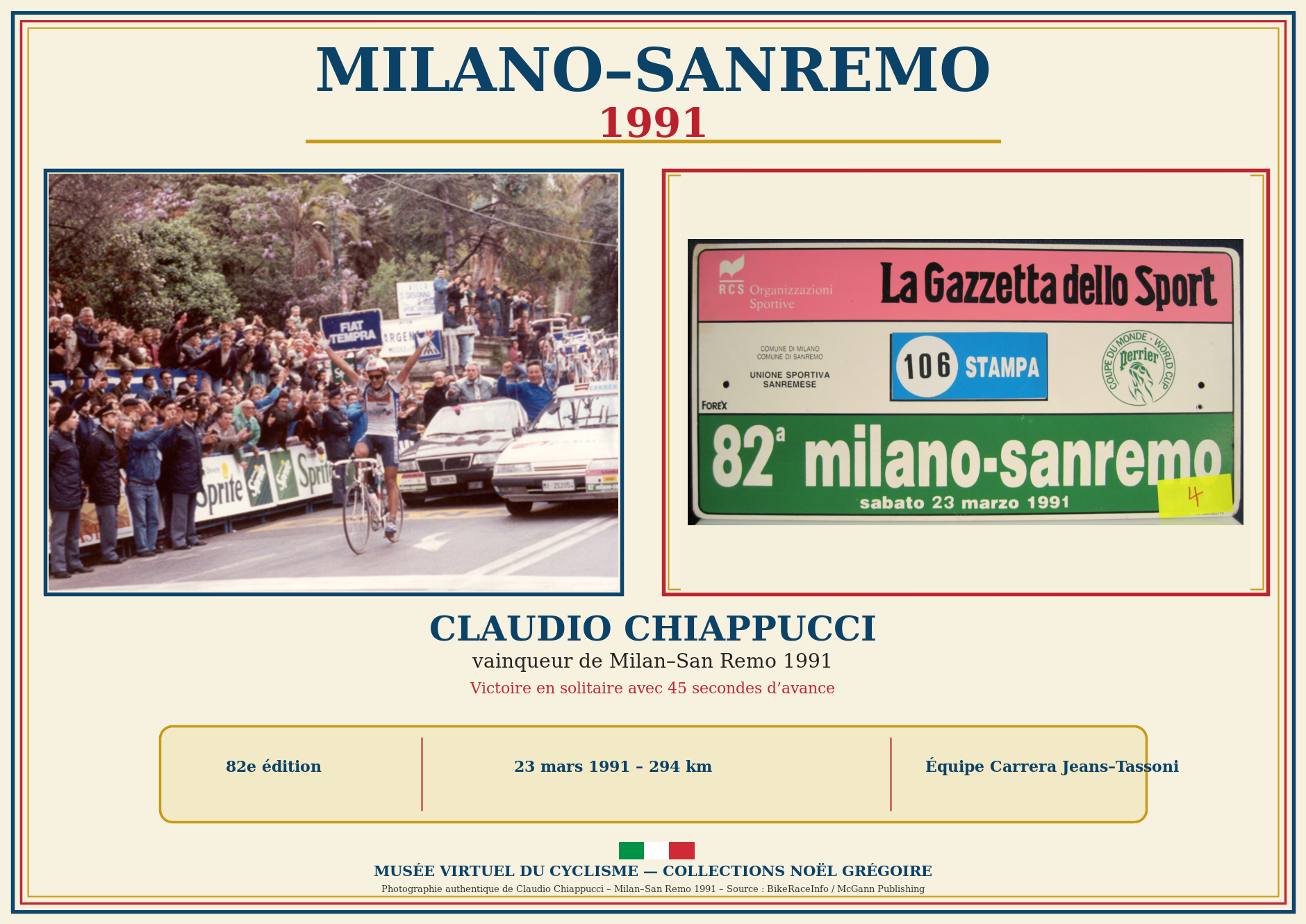
ITEM N° 696
Milan–San Remo 1991 press badge
This badge relates to the eighty-second edition of Milan–San Remo, held on Saturday 23 March 1991. Nicknamed ‘La Classicissima’, this great Italian classic ran from Milan to San Remo over a distance of 294 kilometres.
Bearing the number 106 and the Italian word ‘STAMPA’, this badge was intended to identify an accredited press vehicle or representative. It allowed the holder to join the official convoy and gain access to areas reserved for the media, notably at the start, the finish and in controlled sections of the route.
The item bears the logos of RCS Organizzazioni Sportive and *La Gazzetta dello Sport*, the Italian newspaper historically associated with the organisation of Milan–San Remo. It also bears the logos of the Comune di Milano, the Comune di Sanremo and the Unione Sportiva Sanremese.
The Perrier logo serves as a reminder that the race was then part of the Road Cycling World Cup. Established in 1989, this international competition brought together the season’s major classics and recognised the most consistent riders in the major one-day races.
The 1991 edition attracted 215 riders, 143 of whom were classified at the finish. It was won by the Italian Claudio Chiappucci. Nicknamed ‘El Diablo’, Chiappucci achieved one of the most memorable feats in the modern history of the sport that day. Launching his attack on the Col du Turchino, some 170 kilometres from the finish, he held off the peloton’s pursuit for several hours before outpacing his final breakaway companion on the Poggio.
Claudio Chiappucci crossed the finish line alone, 45 seconds ahead of the Dane Rolf Sørensen. The Belgian Eric Vanderaerden took third place, 57 seconds behind. This victory remains one of the most significant achievements of the Italian champion’s career.
On display in the Virtual Cycling Museum – Noël Grégoire Collections, this plaque bears witness to the media coverage of Milan–San Remo and the vital role of the press in reporting on the major classics. Above all, it preserves the memory of Claudio Chiappucci’s exceptional breakaway during the 1991 race.
