

Race vehicle identification plates - 11
ITEM N° 691
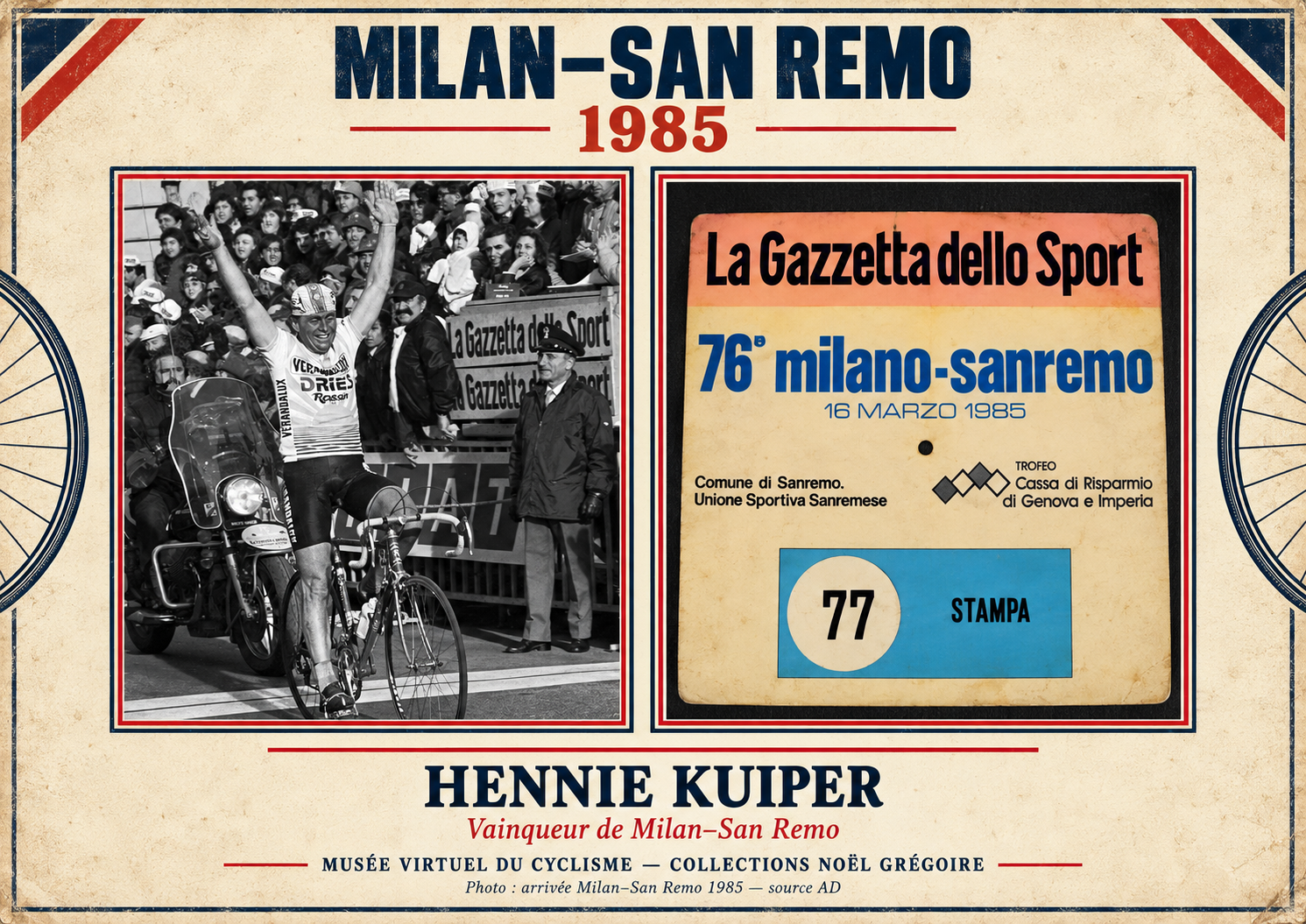
1985 Milan–San Remo press accreditation badge
This badge relates to the 1985 Milan–San Remo, the seventy-sixth edition of the famous Italian classic, held on 16 March over a distance of 294 kilometres. Nicknamed ‘La Primavera’ or ‘La Classicissima’, the race traditionally runs from Milan to the Ligurian town of Sanremo.
The item was intended for a member of the press or a press vehicle, as clearly indicated by the Italian word ‘STAMPA’. It bears the number 77 and features, at the top, the title of the sports daily *La Gazzetta dello Sport*, historically associated with the organisation and media coverage of major Italian cycling races.
The plate also bears the inscription ‘76ª Milano–Sanremo’ and the date 16 March 1985. The inscriptions ‘Comune di Sanremo’ and ‘Unione Sportiva Sanremese’ highlight the involvement of local authorities in hosting the race. It also refers to the Cassa di Risparmio di Genova e Imperia trophy. The number 77 was presumably used to identify the vehicle, the journalist or their position within the race’s official support structure.
This edition was won by the Dutchman Hennie Kuiper, a member of the Verandalux–Dries team. After being left behind by his young team-mate Teun van Vliet and the Italian Silvano Riccò on the climb up the Poggio, Kuiper caught up with the two men during the descent. He immediately maintained his effort and broke away at the front to reach the finish on Via Roma alone.
This victory rounded off Hennie Kuiper’s impressive list of classics wins. Having already won the Tour of Flanders and the Tour of Lombardy in 1981, followed by Paris–Roubaix in 1983, he added a fourth Monument to his career with Milan–San Remo. Of the five major classics, only Liège–Bastogne–Liège eluded him.
Featured in the Virtual Cycling Museum – Noël Grégoire Collections, this plaque bears witness to the media coverage of Milan–San Remo and the vital role played by the press in spreading the cycling legend. It also preserves the memory of Hennie Kuiper’s tactical and spectacular victory in one of the most prestigious classics on the international calendar.
ITEM N° 692
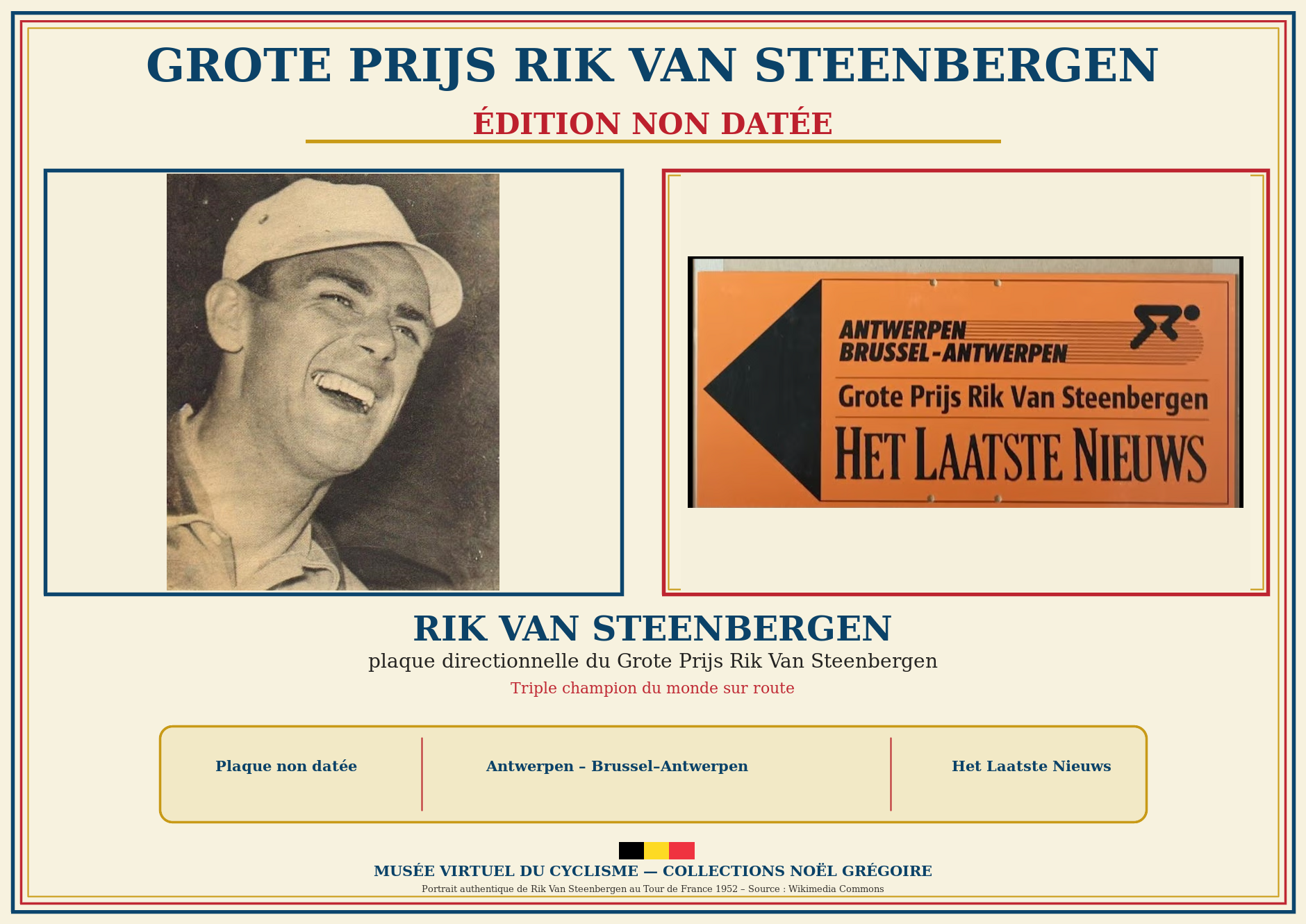
Signpost for the G-P Rik Van Steenbergen Antwerp–Brussels–Antwerp
This signpost refers to the ‘Grote Prijs Rik Van Steenbergen’, a Belgian cycling race organised in honour of one of the greatest champions in the history of cycling. Its bright orange colour, black lettering and large arrow pointing to the left meant it could be easily spotted from the vehicles in the procession and by the riders.
The words ‘Antwerp’ and ‘Brussels–Antwerp’ indicate the direction to follow on a route linking Brussels to Antwerp. This sign was likely installed at a junction or a change of direction to guide participants, official vehicles, support staff and members of the organising committee.
The sign also bears the name of the Flemish daily newspaper *Het Laatste Nieuws*, written in large letters at the bottom. The particularly prominent display of this newspaper’s name reflects the close ties between the press, the organisers and Belgian cycling events, the promotion of which relied heavily on their media partners.
The Grand Prix paid tribute to Rik Van Steenbergen, a great Belgian champion born in 1924 and who died in 2003. Nicknamed ‘Rik I’, he was a three-time world road champion, in 1949, 1956 and 1957, as well as a three-time Belgian champion. His list of victories includes, notably, two Tours of Flanders, two Paris–Roubaix, two Flèches Wallonnes, Milan–San Remo and Paris–Brussels.
As no year or race number is visible on this sign, it is not possible to link it with certainty to a specific edition of the race. Its typography, manufacture and graphic design nevertheless bear witness to the traditional signposting practices used in Belgian cycle races.
Featured in the Virtual Cycling Museum – Noël Grégoire Collections, this sign is a valuable record of the practical organisation of competitions. It serves as a reminder of the indispensable role of signposting, the historical importance of the press in Belgian cycling, and the legacy of Rik Van Steenbergen, a leading figure in international cycling.
ITEM N° 693
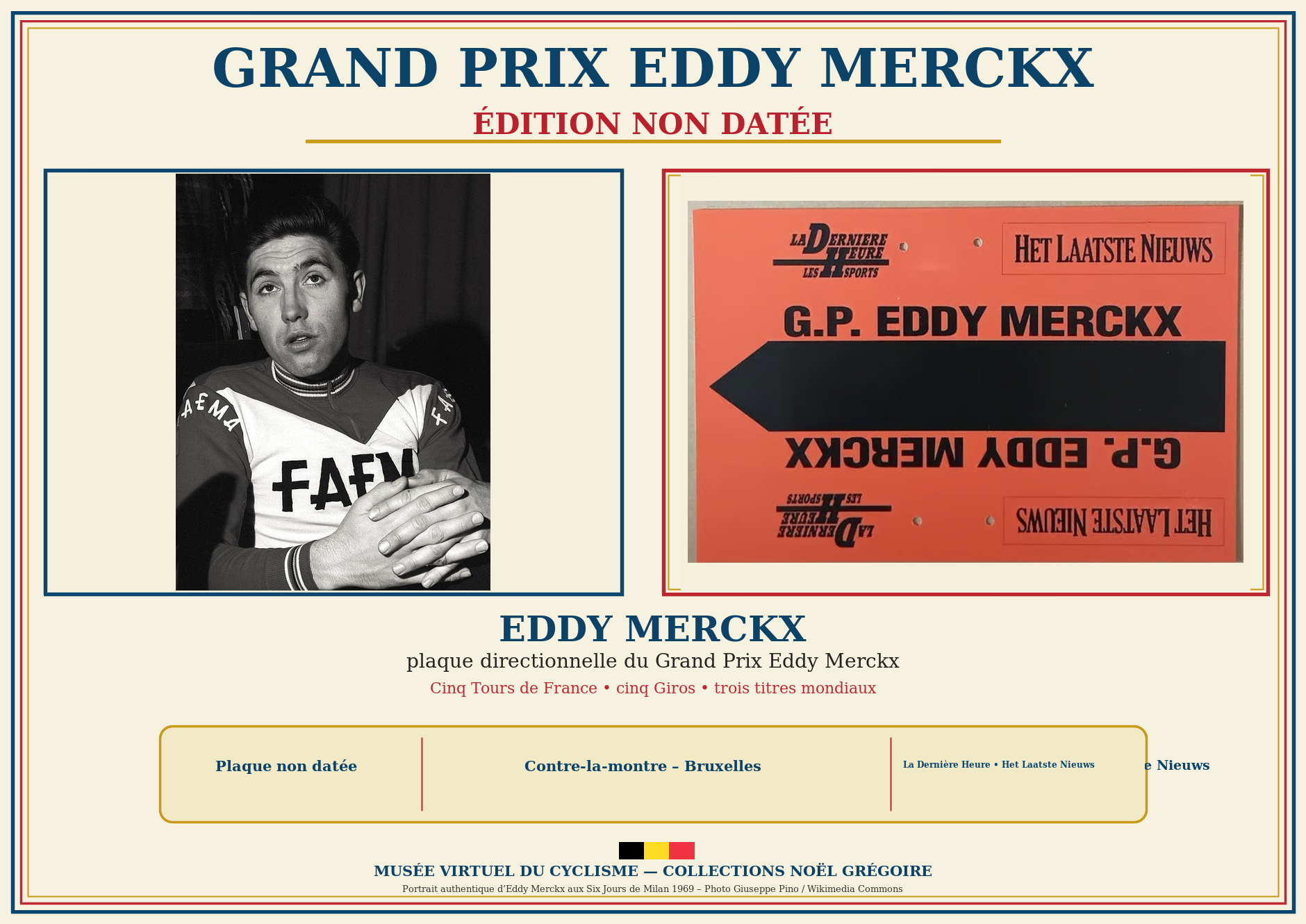
Signpost for the Eddy Merckx Grand Prix
This signpost relates to the Eddy Merckx Grand Prix, a Belgian cycling race held in the Brussels region between 1980 and 2004. Created in honour of Belgium’s most famous champion, the competition specialised in time trials and ran for twenty-five editions.
The sign stands out for its highly visible orange colour and its large black arrow. It was intended to be installed along the route to indicate the direction to be followed by riders, official vehicles, journalists and other members of the organising team.
The graphic design is reproduced twice, with the second instance printed upside down. This ingenious design allowed the sign to be turned over completely: the arrow would then point in the opposite direction, whilst the text would become legible again. A single sign could thus be used to indicate both a left-hand bend and a right-hand bend.
It bears the inscriptions ‘G.P. Eddy Merckx’, ‘La Dernière Heure–Les Sports’ and ‘Het Laatste Nieuws ’. The presence of these two newspaper titles, one French-language and the other Dutch-language, reflects the national character of the event as well as the vital role played by Belgian newspapers in promoting and organising cycling competitions.
The Grand Prix Eddy Merckx was first held in 1980. It was initially contested as an individual time trial. From 1998 onwards, the format was changed to a team time trial involving two riders. The Norwegian Knut Knudsen won the first two editions, whilst the last, held in 2004, was won by the Dutch duo Thomas Dekker and Koen de Kort.
As no year or edition number appears on this plaque, it is not possible to link it with certainty to a specific edition. Its reversible design, typography and colours nevertheless provide valuable insights into the signage methods used during Belgian cycle races.
On display in the Virtual Cycling Museum – Noël Grégoire Collections, this plaque evokes the practical organisation of a time trial, the historical influence of the sports press and the immense popularity of Eddy Merckx. It preserves the memory of a competition which, for twenty-five editions, bore the name of Belgium’s greatest cycling champion.
