

The pennants, scarves, plates & certficates - 13
ITEM N°180
LEMAN Eric (B)
(17.07.1946)
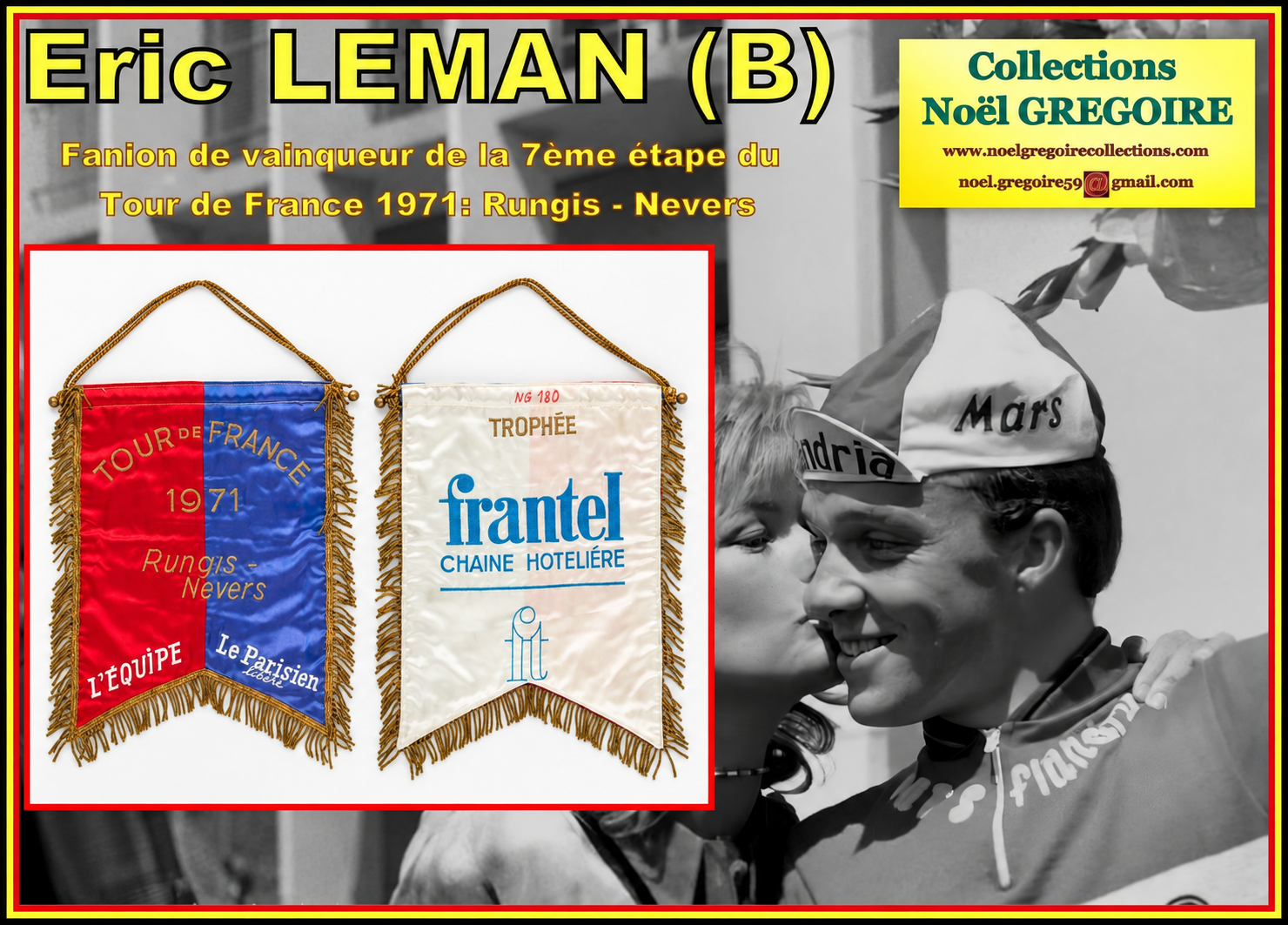
His winner’s pennant from the 7th stage of the 1971 Tour de France: Rungis–Nevers
Born on 17 July 1946 in Ledegem, West Flanders, Éric Leman was a professional cyclist from 1968 to 1977. A powerful sprinter and outstanding specialist in the Flemish classics, he is regarded as one of the finest Belgian cyclists of his generation.
On 4 July 1971, Éric Leman won the 7th stage of the Tour de France, contested between Rungis and Nevers over a distance of 257.5 kilometres. He crossed the line in a time of 6 hours 45 minutes 33 seconds, ahead of the Dutchman Gerben Karstens and the Belgians Walter Godefroot and Cyrille Guimard. This stage, the longest of the 1971 race, ended with a slightly uphill sprint through the streets of Nevers. Éric Leman made the most of his power and burst of speed to edge out his main rivals. This victory was already his third stage win in that Tour. He had previously won the Mulhouse–Basel stage, followed by the first sector of the Roubaix–Amiens stage. His three victories established him as one of the leading sprinters of this 58th edition of the Tour de France.
The pennant shown here commemorates his victory between Rungis and Nevers. The front, divided between red and blue, bears the embroidered inscriptions ‘Tour de France 1971’ and ‘Rungis–Nevers’. The names of *L’Équipe* and *Le Parisien Libéré*, newspapers associated with the organisation and media coverage of the race, appear at the bottom. The white reverse side is dedicated to the Frantel Trophy, named after a hotel chain partnering with the Tour de France. The presence of this brand highlights the importance of the promotional prizes awarded to the winners and key figures in the race. Made of satin and edged with gold fringing, this double-sided pennant is a true ceremonial award. It was intended to serve as a memento of the stage winner and the finishing town.
Éric Leman’s list of achievements includes five stage victories in the Tour de France. He remains best known for his three victories in the Tour of Flanders, won in 1970, 1972 and 1973, a feat that ranks him amongst the great specialists of this classic race.
The photograph shows Éric Leman in the colours of the Belgian Flandria–Mars team, moments after one of his victories.
This pennant is a valuable memento of Éric Leman’s remarkable campaign in the 1971 Tour de France and his victory in the longest stage of that edition.
ITEM N° 437
LEMAN Éric (B)
(17.07.1946)
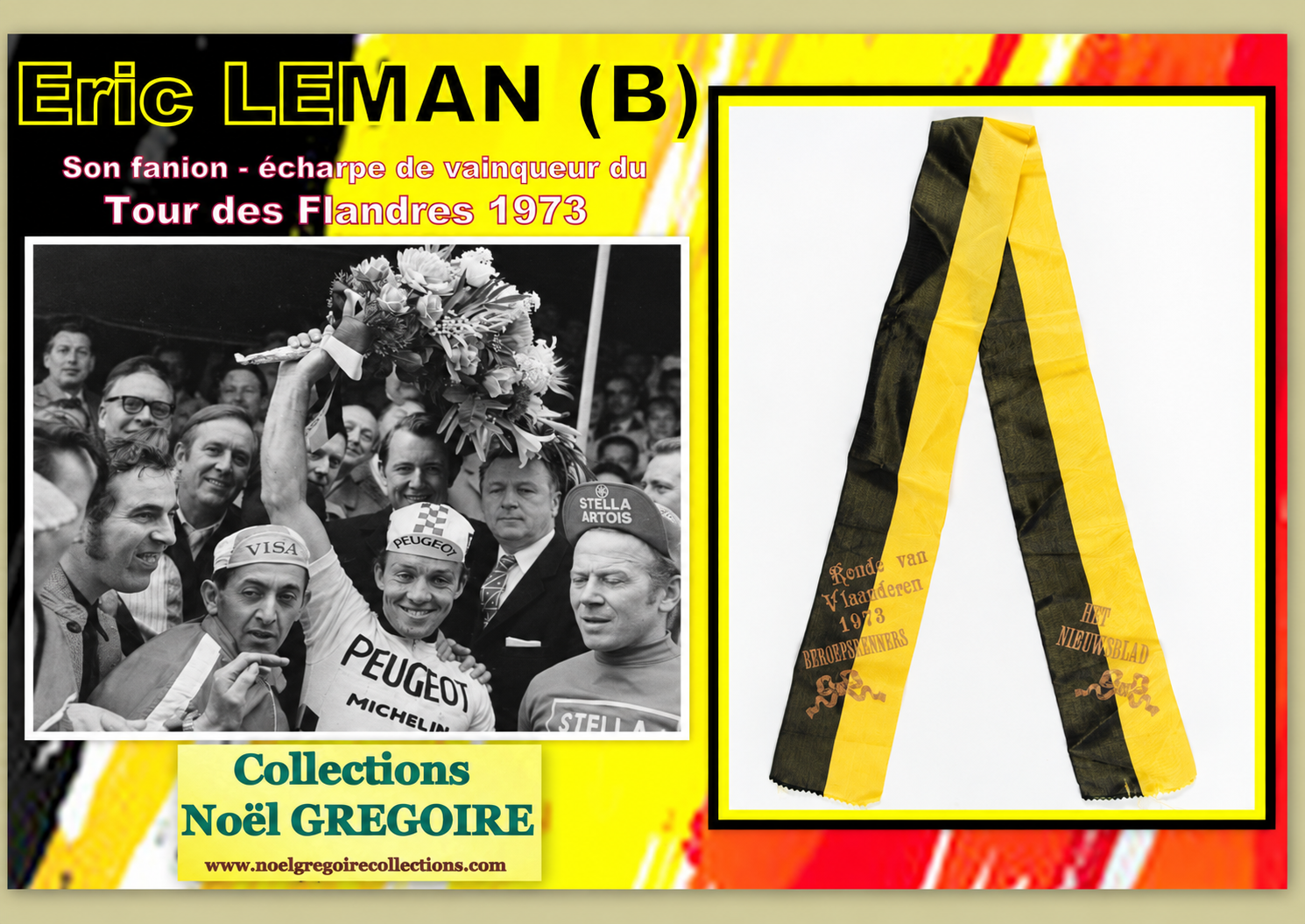
His winner’s sash from the 1973 Tour of Flanders
Éric Leman was a professional cyclist from 1968 to 1977. A fast sprinter, powerful and particularly at ease on the challenging roads of northern Belgium, he established himself as one of the great specialists in the Flemish classics.
In 1973, riding for the Peugeot–BP–Michelin team, Éric Leman won the Tour of Flanders for the third time in his career. He had already won this prestigious classic in 1970 and 1972. This third victory confirmed his exceptional mastery of the ‘Ronde’. Thanks to this hat-trick, Éric Leman joined the very exclusive circle of riders to have won the Tour of Flanders at least three times, one of the most gruelling monuments in international cycling.
The scarf shown here was presented to the champion to commemorate his 1973 victory. It features the yellow and black colours of Flanders and bears the Flemish inscription ‘Ronde van Vlaanderen 1973 – Beroepsrenners’, which means ‘Tour of Flanders 1973 – Professional cyclists’. The inscription ‘Het Nieuwsblad’ recalls the historic role of the Flemish press in organising and promoting major Belgian cycling events. This newspaper has long been closely associated with Flanders’ cycling heritage. Made from satin fabric, the scarf consists of wide black and yellow stripes. Its gold lettering and decorative fringes make it a ceremonial item intended to honour the winner and perpetuate the memory of his triumph.
The photograph shows Éric Leman, wearing the Peugeot jersey, holding aloft his winner’s bouquet amidst the crowd. Several leading figures from Belgian cycling appear around him at the end of this historic day.
In addition to his three Tour of Flanders victories, Éric Leman won five stages of the Tour de France, including three in the 1971 edition alone. His list of achievements bears witness to the qualities of a rider capable of excelling in both the classics and the bunch sprints of the Grand Tours.
This sash is a precious memento of Éric Leman’s third victory in the Tour of Flanders and of the place he occupies amongst the great champions in the history of Flemish cycling.
ITEM N° 523
MAGNE Antonin (F)
(15.02.1904 – 08.09.1983)
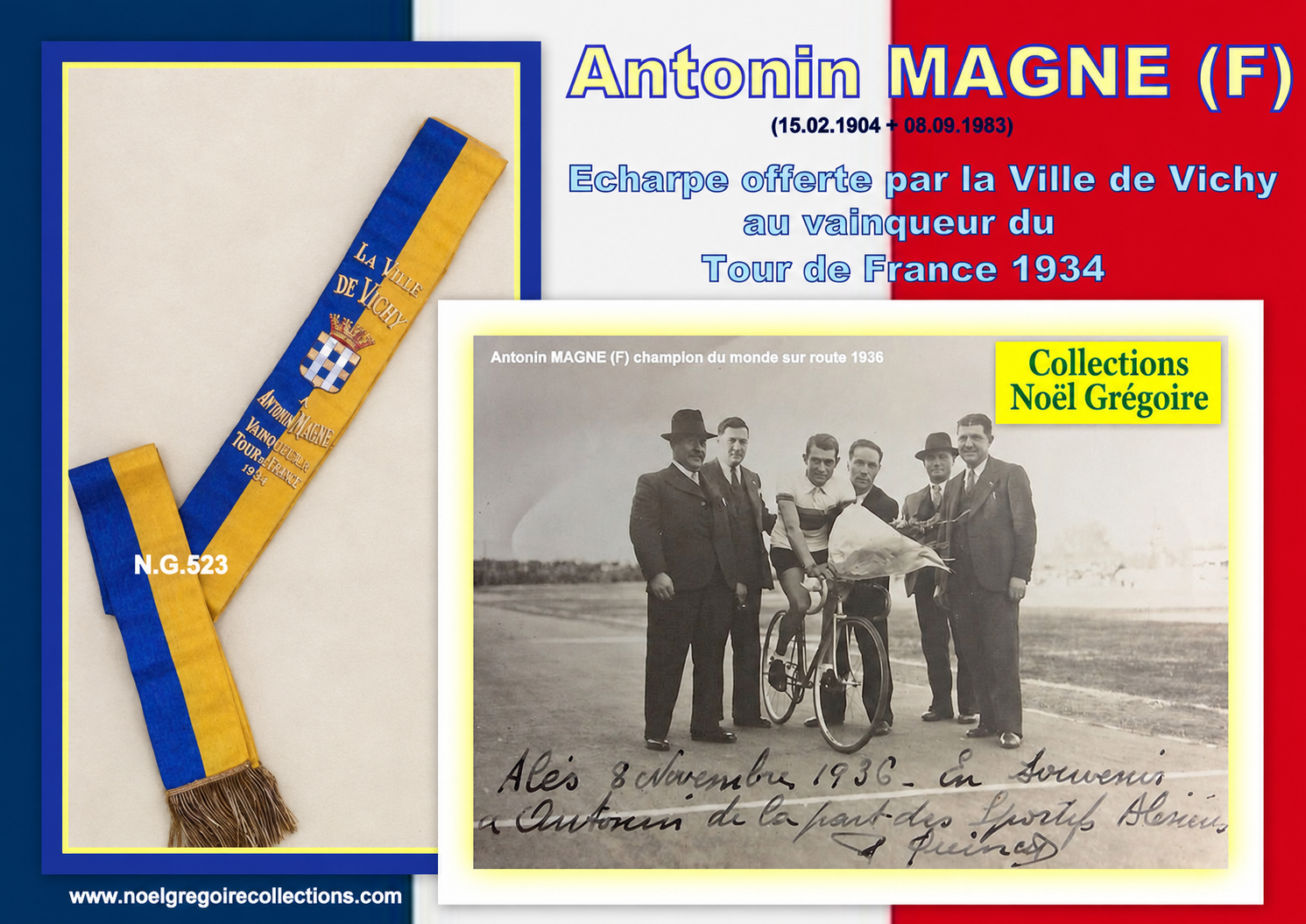
His commemorative sash, presented by the City of Vichy to the winner of the 1934 Tour de France
Born on 15 February 1904 in Ytrac, in the Cantal department, Antonin Magne was one of the greatest French champions of the interwar period. Nicknamed ‘Tonin the Wise’ due to his seriousness, consistency and tactical acumen, he enjoyed a brilliant professional career from 1927 to 1939.
Having already won the Tour de France in 1931, Antonin Magne lined up at the start of the 1934 race as captain of the French team. He claimed the yellow jersey at the end of the second stage and held onto it until the final finish at the Parc des Princes. His victory was secured in particular by his success in the first major individual time trial in the history of the Tour, contested between La Roche-sur-Yon and Nantes. In the final general classification, he finished more than twenty-seven minutes ahead of the Italian Giuseppe Martano, whilst his compatriot Roger Lapébie completed the podium.
The sash presented here was presented by the City of Vichy in honour of the winner of the 1934 Tour de France. It bears the name of Antonin Magne, a reference to his victory and the municipal coat of arms of Vichy. Made from blue and yellow satin fabric, it is finished with gold fringes. Its colours, embroidery and coat of arms make it a ceremonial item intended to officially celebrate the French champion’s triumph. The town of Vichy already had ties with Antonin Magne, winner of the Paris–Vichy race in 1930. This sash thus bears witness to the spa town’s attachment to cycling and to France’s sporting greats.
Antonin Magne added to his prestigious list of achievements by becoming the professional road world champion in Bern in 1936. He also won the Grand Prix des Nations on three occasions.
After his racing career, he became a respected team manager. In particular, he managed Louison Bobet and Raymond Poulidor, to whom he passed on his rigour, his experience and his famous motto: ‘Glory is never found where virtue is not.’
The photograph featured in the montage was taken after the 1934 Tour de France. Dated 8 November 1936 in Alès, it commemorates Antonin Magne, who had become world road champion that same year.
This sash is a remarkable testament to the tributes paid in French towns to the two-time Tour de France winner and one of the most highly regarded champions of his era.
