

The pennants, scarves, plates & certficates - 12
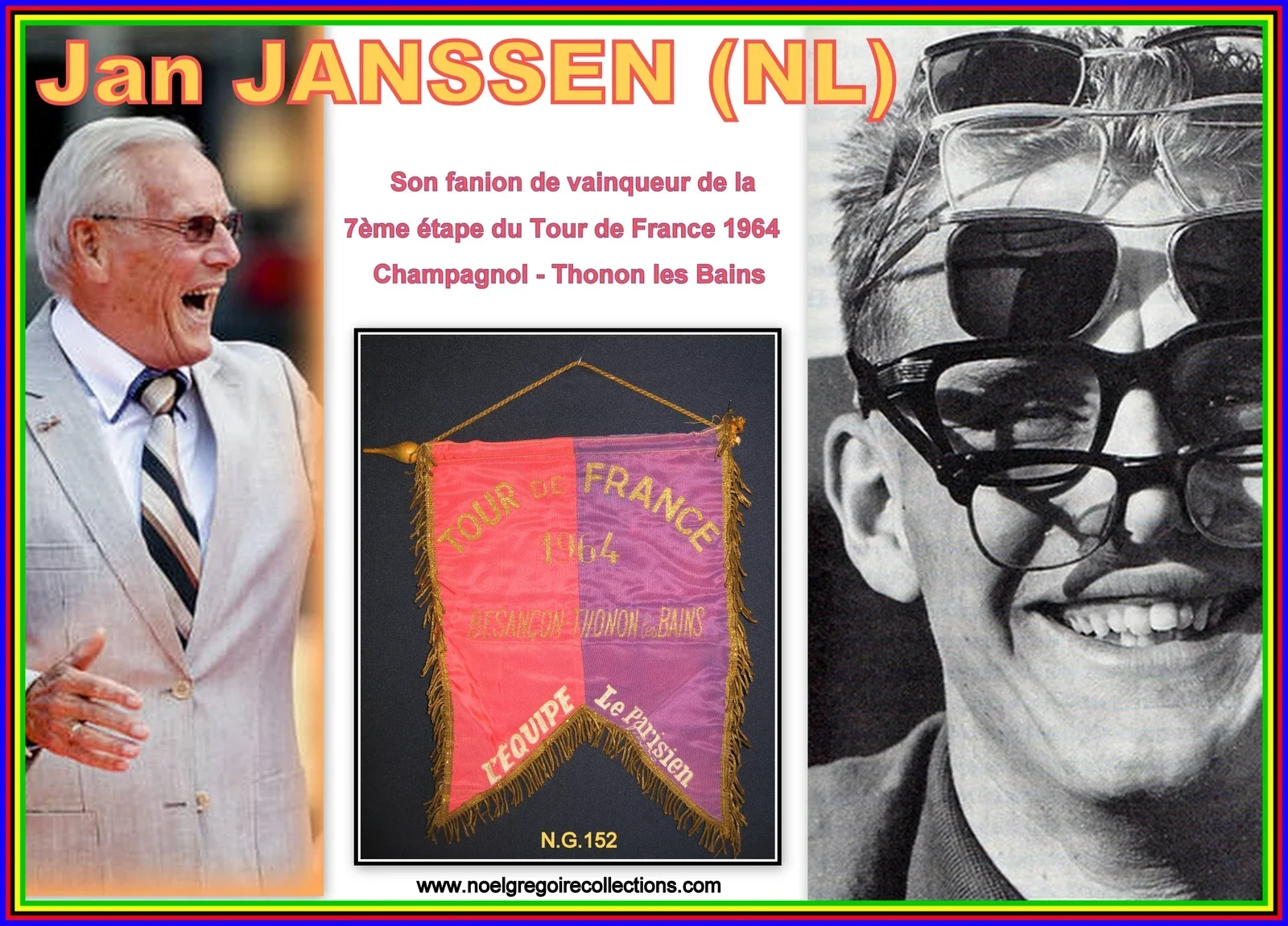
ITEM N°152
JANSSEN Jan (NL)
(19.05.1940)
His winner’s pennant from the 7th stage of the 1964 Tour de France
Jan Janssen was one of the greatest Dutch champions in the history of cycling. A professional from 1962 to 1973, he stood out for his versatility, consistency and remarkable sprinting ability.
Road World Champion in 1964, he won the Vuelta a España in 1967 and then made history the following year by becoming the first Dutchman to win the Tour de France. He also won Paris–Roubaix in 1967.
During the 1964 Tour de France, Jan Janssen won the 7th stage, contested on 28 June over 195 kilometres and finishing in Thonon-les-Bains. He beat the Belgian Willy Bocklant and the Briton Vic Denson in the sprint.
The item on display is the pennant presented to Jan Janssen to mark this stage victory. Made from red and purple satin fabric, it is adorned with gold embroidery and edged with fringes. The pennant bears the inscriptions ‘Tour de France 1964’ and ‘Besançon–Thonon-les-Bains’, as well as the names of the newspapers L’Équipe and Le Parisien, which were closely associated with the organisation of the Tour de France at the time. The inscription on the item should, however, be distinguished from certain official records, which refer to this stage as Champagnole–Thonon-les-Bains. This discrepancy may stem from a change in the starting point or from a name used at the time the pennant was made.
During that same edition, Jan Janssen won a second stage between Monaco and Hyères. He also topped the final points classification, confirming as early as 1964 his place amongst the best sprinters in the international peloton.
The photograph on the right shows Jan Janssen wearing the colours of the Pelforth–Sauvage–Lejeune team, for which he competed in the 1964 Tour de France. The central photograph shows him several decades later at an event dedicated to the history of cycling.
On display in the Virtual Cycling Museum – Noël GREGOIRE Collections, this pennant commemorates Jan Janssen’s first stage victory in the 1964 Tour de France, a few weeks before he was crowned world road champion.
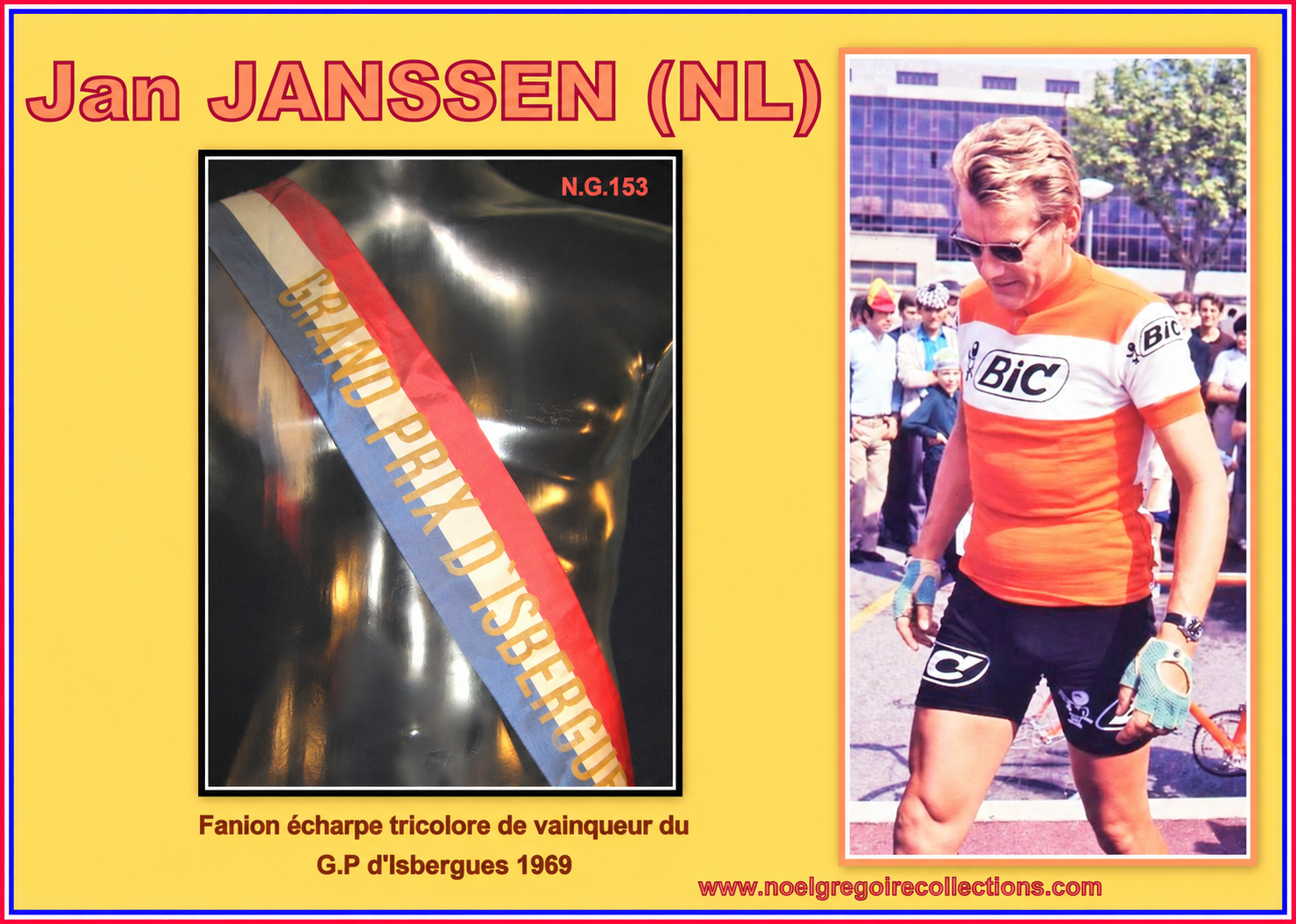
ITEM N° 153
JANSSEN Jan (NL)
(19.05.1940)
His tricolour winner’s sash from the 1969 Isbergues Grand Prix
A native of Nootdorp, Jan Janssen was one of the greatest Dutch champions in the history of cycling. A professional from 1962 to 1973, he stood out for his versatility, consistency and remarkable sprinting ability.
World Road Champion in 1964, Jan Janssen won the Vuelta a España in 1967. The following year, he made history by becoming the first Dutch rider to win the general classification of the Tour de France.
During his eight appearances in the Tour de France, he won seven stages and the points classification three times. His list of achievements also includes the 1967 Paris–Roubaix, as well as numerous victories in the classics and stage races.
On 21 September 1969, riding for the Bic team, Jan Janssen won the Grand Prix d’Isbergues. He finished ahead of the Belgian Noël Van Tyghem and his compatriot Jos De Schoenmaecker.
The item on display is the tricolour sash presented to Jan Janssen on the occasion of this victory. Made from fabric in red, white and blue, it bears the inscription ‘Grand Prix d’Isbergues’ in gold lettering. The material, the folds and the signs of age on the sash attest to its authenticity. Preserved in its original condition, this item serves as a reminder of the ceremonial awards presented to the winners of major cycling events.
The photograph shows Jan Janssen wearing the orange and white jersey of the Bic team. It places the item in the context of the 1969 season and depicts the champion a few months after his triumph in the Tour de France.
On display in the Virtual Cycling Museum – Noël GREGOIRE Collections, this scarf serves as a memento of Jan Janssen’s victory at the 1969 Grand Prix d’Isbergues and of an exceptional career at the pinnacle of international cycling.
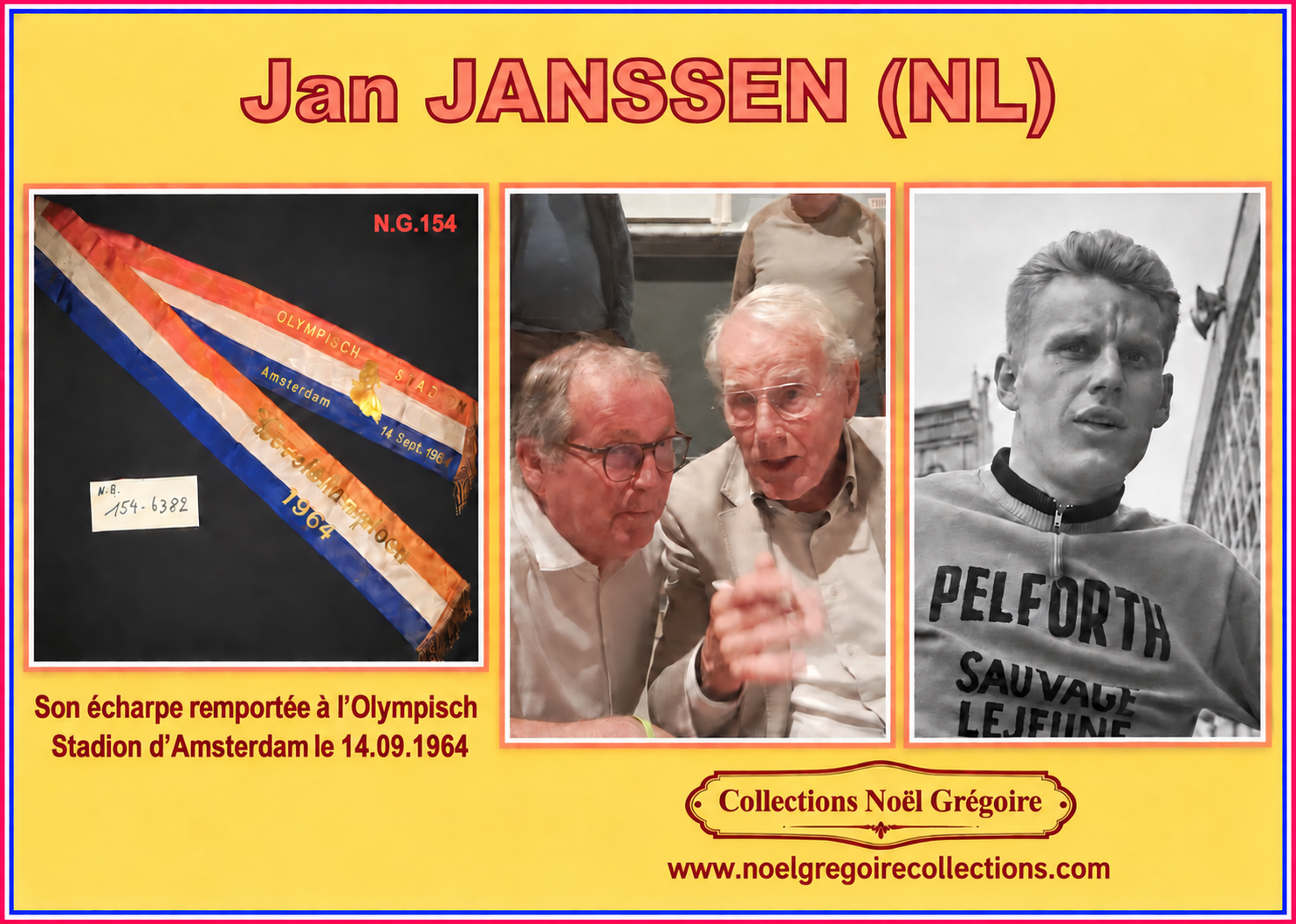
ITEM N° 154
JANSSEN Jan (NL)
(19.05.1940)
He was presented with his honorary sash at the Olympisch Stadion in Amsterdam on 14 September 1964
Jan Janssen was born on 19 May 1940 in Nootdorp, the Netherlands. A professional from 1962 to 1973, he was one of the most well-rounded riders of his generation, capable of excelling in the classics, sprints and major stage races.
On 6 September 1964, on the gruelling circuit at Sallanches, he won the professional road world championship ahead of the Italian Vittorio Adorni and the Frenchman Raymond Poulidor. At the age of 24, Jan Janssen thus became the first Dutchman to be crowned professional road world champion. On 14 September 1964, eight days after this historic victory, a grand tribute ceremony was held at the Olympisch Stadion in Amsterdam. The new world champion was introduced there and cheered by the Dutch public.
The tricolour sash on display here was presented to Jan Janssen during this official reception. It bears, in particular, the gold inscriptions ‘Olympisch Stadion’, ‘Amsterdam’ and ‘14 Sept. 1964’. Its red, white and blue stripes reflect the national colours of the Netherlands. The gold lettering and decorative fringes emphasise the solemn and commemorative nature of this item. This scarf therefore does not appear to be the prize for a race won on 14 September 1964. It should more accurately be regarded as a scarf of honour, presented to Jan Janssen during the tribute organised to celebrate his world title.
The 1964 season was particularly remarkable for the Dutch champion. In addition to his rainbow jersey, he won the points classification at the Tour de France that year, an honour he would also claim in 1965 and 1967. His exceptional list of achievements also includes Paris–Roubaix 1967, the 1967 Vuelta a España and the 1968 Tour de France. He was the first Dutchman to win the Vuelta and then the Tour de France.
The photograph on the right shows Jan Janssen at the start of his professional career, riding for the Pelforth–Sauvage–Lejeune team. The central photograph captures a more recent encounter with the champion.
This scarf remains a cherished memento of the enthusiasm sparked in the Netherlands by Jan Janssen’s first professional road world title.
