

The water bottles, caps, musettes and gloves - 8
ITEM N° 730
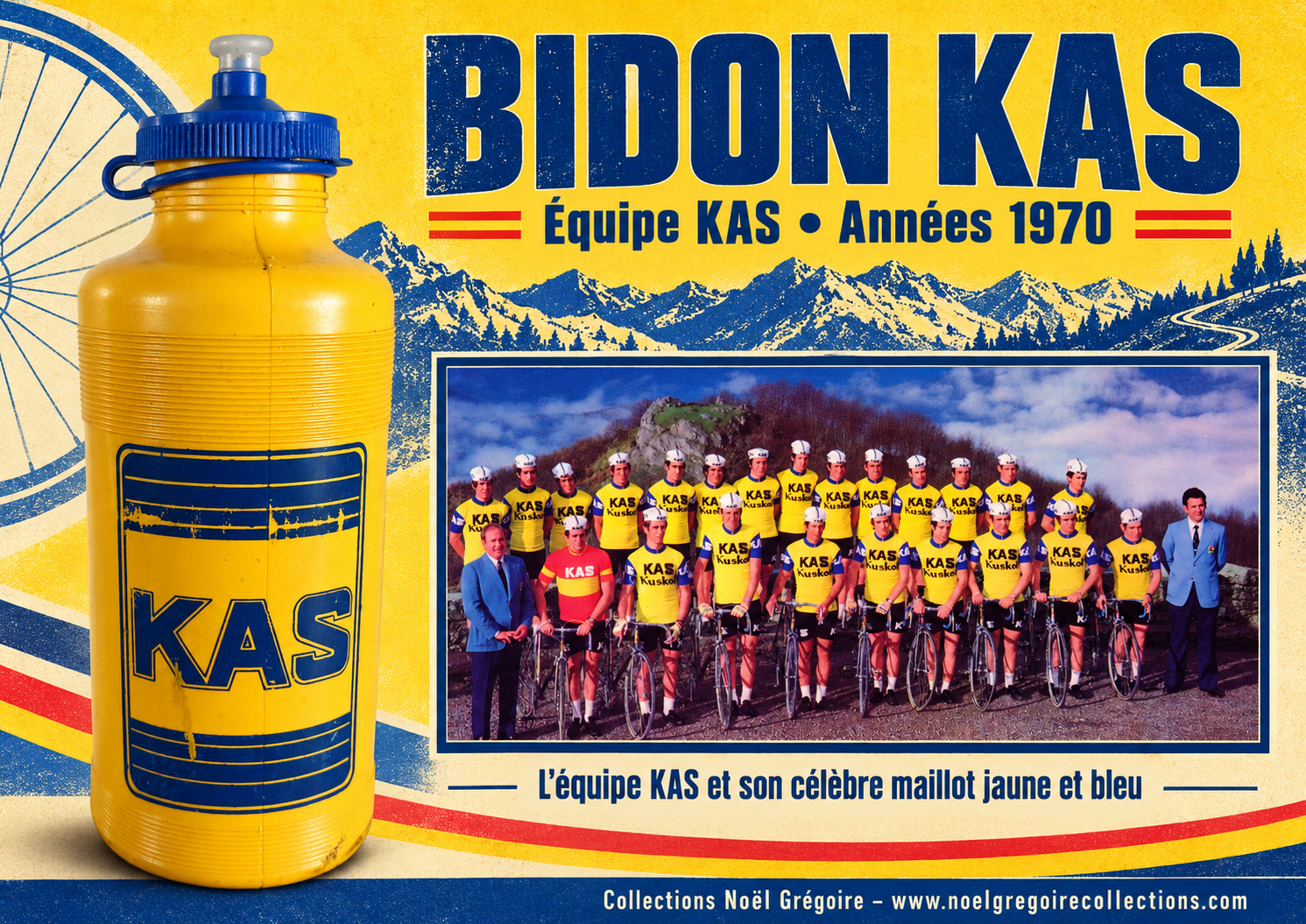
"KAS" team water bottle
Used in the peloton from 1956 to 1979 and from 1985 to 1988
This water bottle was part of the kit of the Spanish professional KAS team, a squad sponsored by the famous Basque soft drinks brand. Yellow and blue, the brand’s iconic colours, also became those of one of the most recognisable teams in the international peloton.
Made of yellow plastic, the bottle has a cylindrical body with slightly flared shoulders, reinforced by several rows of horizontal ribs. It is sealed with a large blue cap fitted with a translucent valve and a clip designed to prevent it from being lost during the race. Its front features a large blue rectangular design surrounding the inscription ‘KAS’.
The scratches, the partial wear to the design and the visible marks on its surface bear witness to its age and its use in the world of professional cycling. These marks have been left intact: they form part of the object’s history and are essential elements of its authenticity.
A prominent presence in the major races of the 1960s and 1970s, the KAS team particularly excelled in the mountains. Its ranks included, notably, José Manuel Fuente, Julio Jiménez, Domingo Perurena and Miguel María Lasa. Its riders won numerous stages and several secondary classifications in the Vuelta a España, the Tour de France and the Giro d’Italia.
The yellow and blue jersey remains inextricably linked to the achievements of José Manuel Fuente, a two-time winner of the Vuelta in 1972 and 1974 and regarded as one of the finest climbers of his generation. With its distinctive design, this water bottle evokes the strong identity and long history of a team that left a profound mark on Spanish cycling.
Housed in the Virtual Cycling Museum – Noël Grégoire Collections, this water bottle is a valuable example of the refreshment equipment used in the professional peloton during the 1970s.
ITEM N° 731
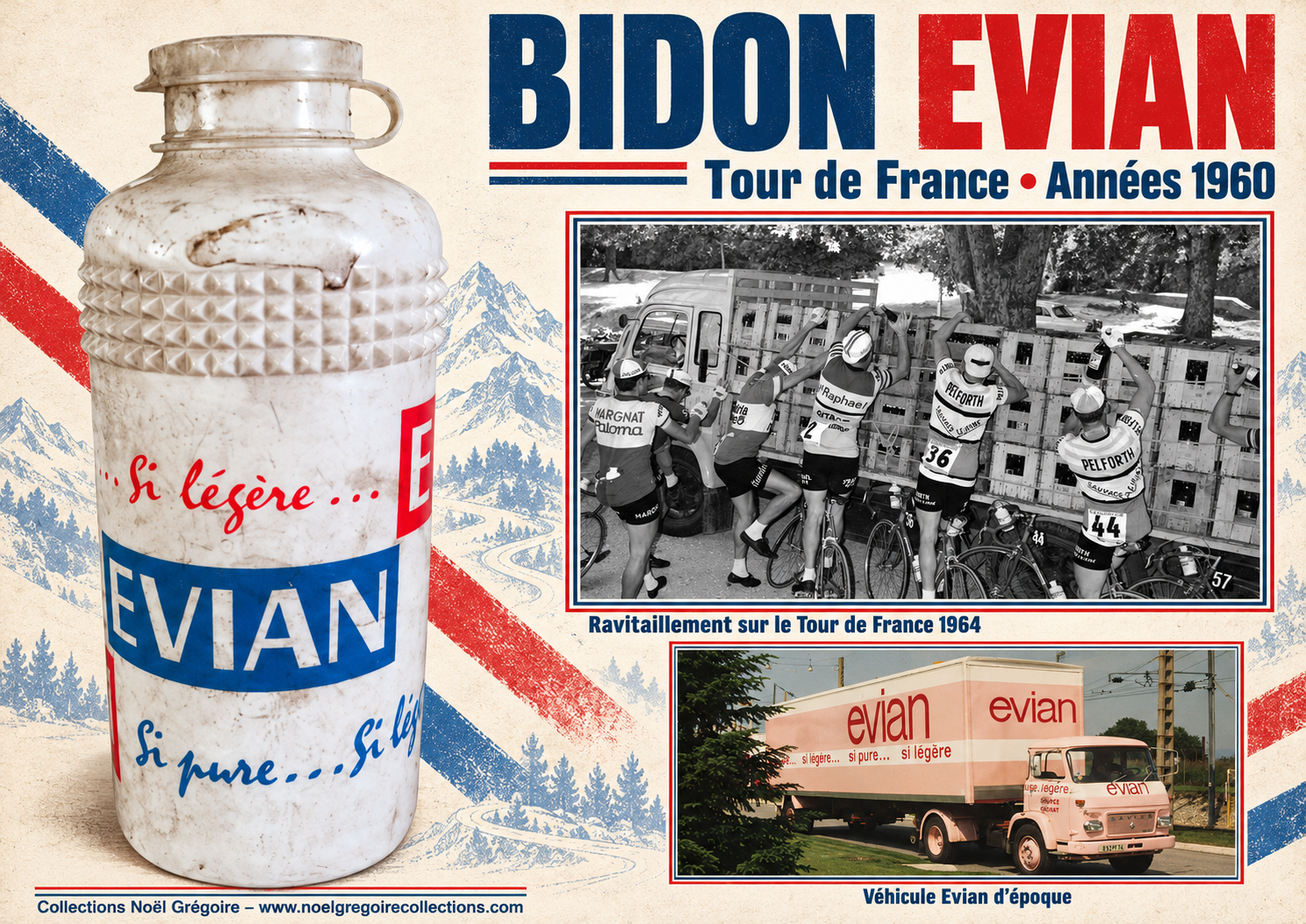
"Evian" water bottle used in the Tour de France
Used in the peloton around the 1960s
This plastic water bottle was designed to provide refreshments for cyclists during the 1960s. It bears the red, white and blue colours of the French brand Evian, which was a very prominent presence on the roads of the Tour de France at the time.
The bottle has a white cylindrical body topped with a rounded shoulder. Its upper section is encircled by a wide band featuring pyramid-shaped raised patterns, designed to make it easier to grip despite sweat, rain or the movements of the bike. Its original cap remains attached to the neck by a side clip, preventing it from being lost during the race.
The advertising design features the name ‘EVIAN’ in large letters, accompanied by the former slogan ‘So light… So pure… So light…’. This distinctive design links this item to the water bottles distributed on the Tour de France between the early and mid-1960s.
At that time, the water bottles were handed to riders in their musettes at feed stations, transported in the cars of the sports directors, or brought back to the peloton by support staff responsible for supplying their team leaders. As they were easily lost, swapped or thrown away during the race, few authentic examples have survived to the present day.
The numerous stains, scratches, dents and signs of wear visible on this one bear witness to prolonged use. These have been deliberately preserved, as they form an essential part of the object’s history and authenticity.
Housed in the Virtual Cycling Museum – Noël Grégoire Collections, this water bottle serves as a reminder of the evolution of refreshment provision in professional cycling and the long-standing presence of mineral water brands at the heart of the Tour de France. Evian models featuring this same shape and slogan are documented at the Tour de France between 1962 and 1966.
ITEM N° 732
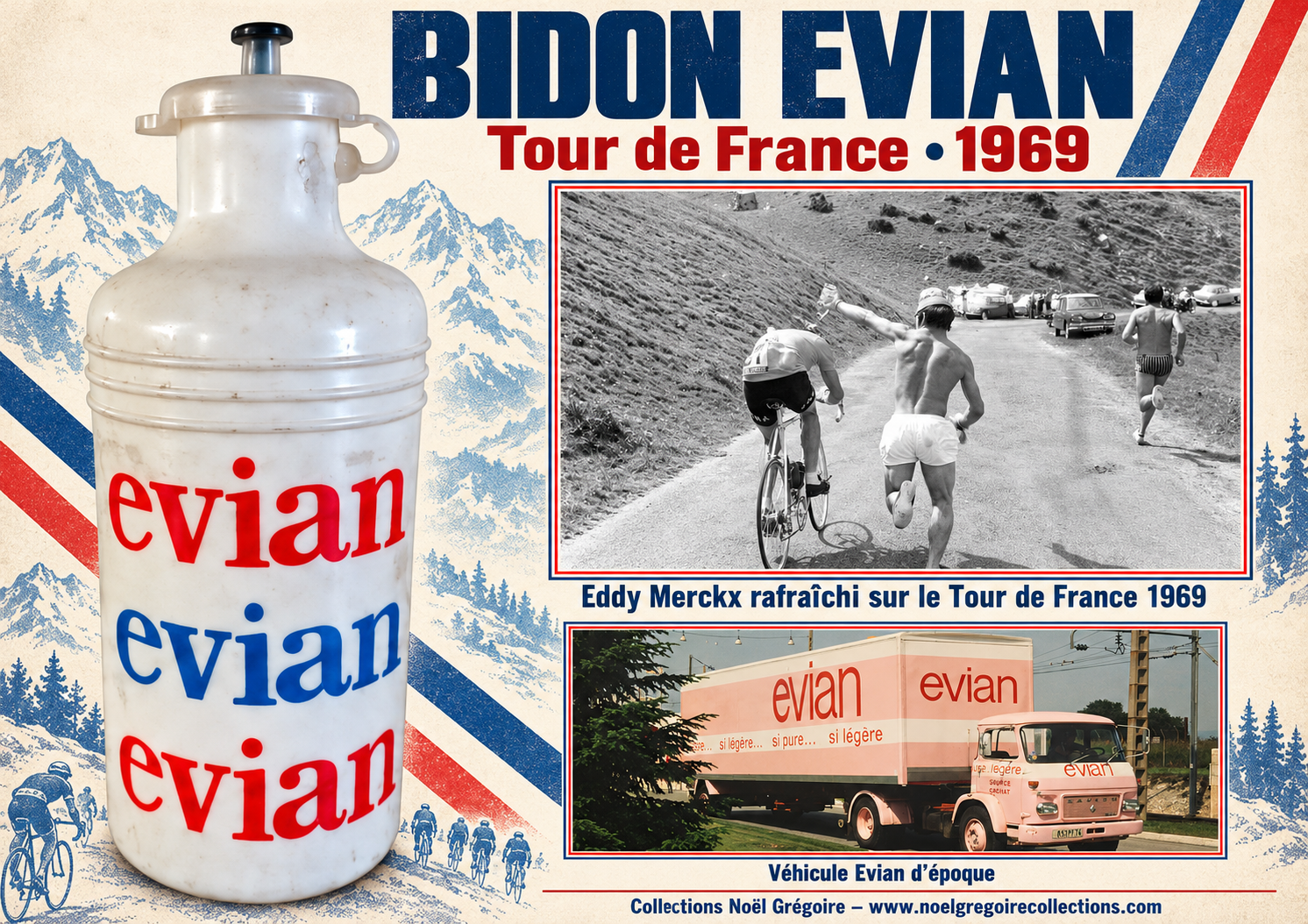
Water bottle used in the 1969 Tour de France
Official “Evian” water bottle
This plastic water bottle was distributed to riders during the 1969 Tour de France. It bears witness to the involvement of mineral water brands in the organisation of the refreshment stations and to their long-standing association with the Tour de France.
The bottle has a white cylindrical body topped by a rounded shoulder. Three horizontal ribs reinforce the upper section and make it easier to grip. Its translucent cap is fitted with a valve allowing the rider to drink directly whilst keeping the bottle in its cage. A side clip secures the cap to the neck to prevent it from being lost during the race.
The main face is adorned with three ‘evian’ inscriptions, arranged vertically in alternating red, blue and red. This simple design, particularly visible within the peloton, echoed the French national colours and ensured strong brand recognition.
The dirt, scratches, slight deformations and colour variations visible on its surface bear witness to the item’s age and its use in the world of professional cycling. These marks have been preserved in their entirety, as they contribute to its authenticity and history.
The 1969 Tour de France was marked by the overwhelming dominance of Eddy Merckx, who won the general classification, the points classification and the King of the Mountains classification. The photograph used to illustrate the page shows the Belgian champion being refreshed by a spectator during that race; it places the water bottle within the distinctive atmosphere of cycling in the late 1960s.
Housed in the Virtual Cycling Museum – Noël Grégoire Collections, this water bottle is a valuable example of the refreshment equipment used on the Tour de France and serves as a reminder of the vital importance of hydration during the long summer stages. The white model with triple red–blue–red markings is well documented as an Evian water bottle from the 1969 Tour de France.
