

The water bottles, caps, musettes and gloves - 7
ITEM N° 727
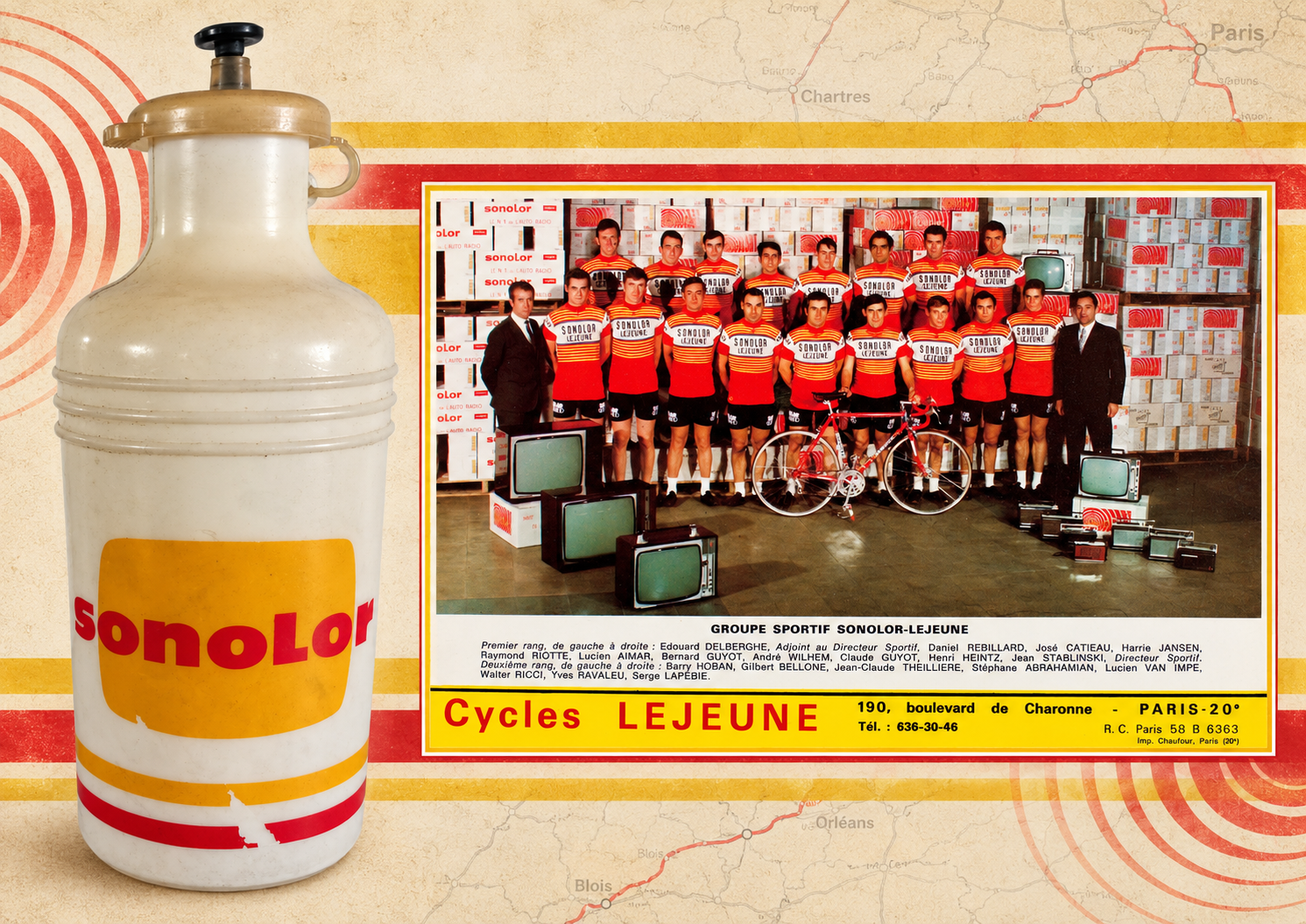
‘Sonolor-Lejeune’ team water bottle
Active in the peloton from 1969 to 1972
This plastic water bottle was part of the kit of the French professional cycling team Sonolor–Lejeune. Formed in 1969 following the Pelforth–Sauvage–Lejeune team, it brought together the French radio and television manufacturer Sonolor with Lejeune Cycles. The Sonolor brand continued to feature in the peloton under other names until 1974.
The bottle has an ivory-coloured, translucent plastic cylindrical body, topped by a wide, rounded shoulder and a long neck. Several horizontal ribs reinforce the upper section. Its cap features a black spout allowing the rider to drink quickly and a flexible strap designed to prevent it from being lost during the race.
The main design consists of a large yellow rectangle bearing the name ‘Sonolor’ in red lettering. Two bands, one yellow and the other red, surround the lower section. These colours are a direct reference to the team’s highly recognisable jerseys.
Led notably by former world champion Jean Stablinski, the team included renowned riders such as Lucien Van Impe, Lucien Aimar, Barry Hoban, Bernard Guyot, Raymond Riotte, José Catieau and Willy Teirlinck. It played an important role in Lucien Van Impe’s early professional years.
The scratches, marks, discolouration of the plastic and small visible losses in the coloured stripes bear witness to prolonged use. These marks have been preserved, as they are an integral part of the object’s history and authenticity.
Featured in the Virtual Cycling Museum – Noël Grégoire Collections, this water bottle is a valuable artefact bearing witness to the Sonolor–Lejeune team and French professional cycling in the early 1970s.
ITEM N° 728
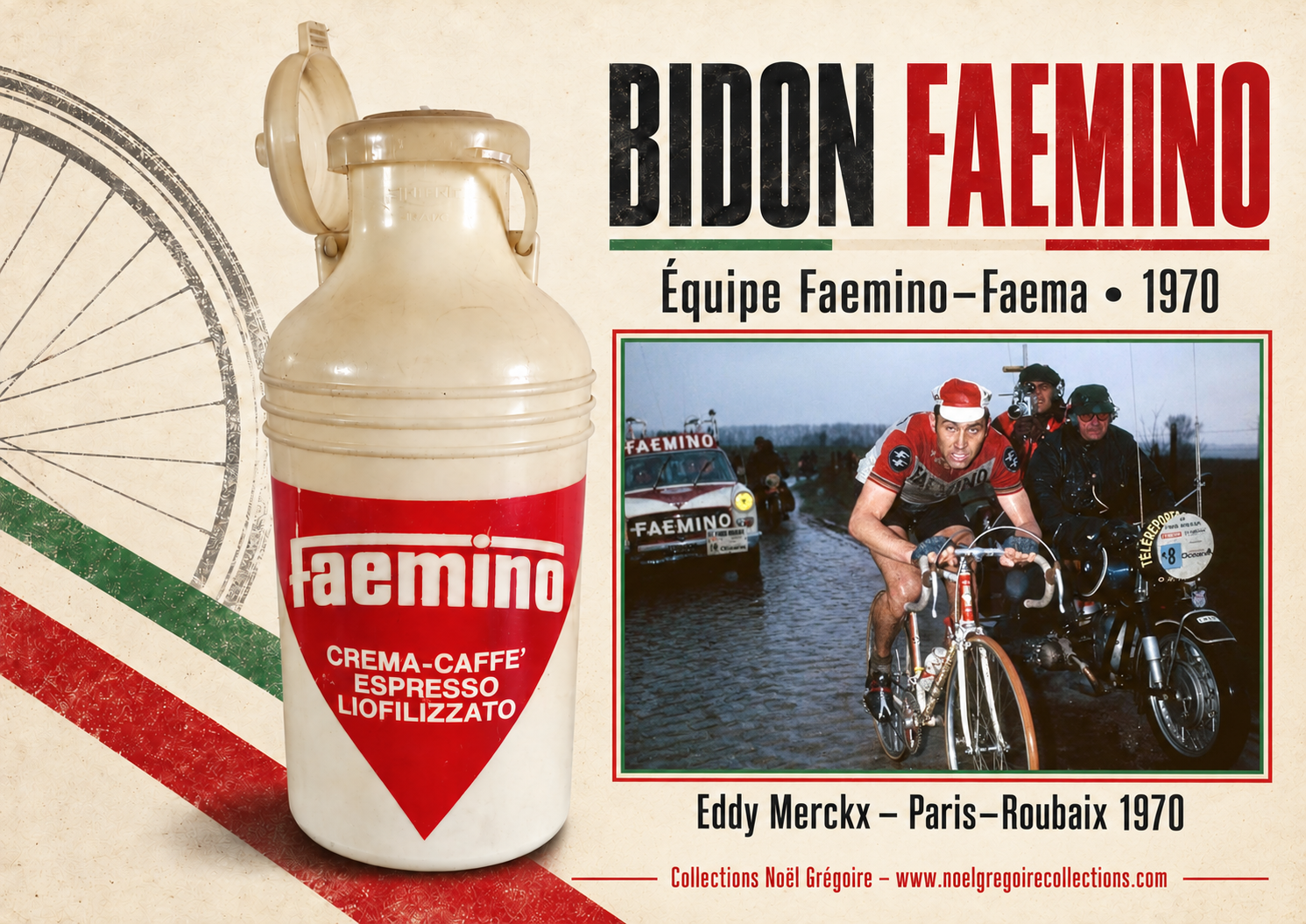
"Faemino–Faema" team water bottle
Used in the peloton in 1970
This water bottle was part of the equipment used by the Faemino–Faema professional team during the 1970 season. Faemino was a brand of freeze-dried coffee launched by the Italian company Faema, a manufacturer of coffee machines and sponsor of the team led by Eddy Merckx.
The bottle has a cylindrical body made of cream-coloured plastic, reinforced by several horizontal ribs. Its wide neck is sealed by a hinged cap, which is still attached to the bottle by its original fastening mechanism. The front features a large red triangular label bearing the words ‘Faemino – Crema-Caffè Espresso Liofilizzato’.
The scratches, signs of wear and colour variations visible on its surface bear witness to its age and its use within the world of professional cycling. These have been deliberately preserved, as they are an integral part of the item’s history and authenticity.
The 1970 season was a particularly prestigious one for Faemino–Faema. Notably, Eddy Merckx won the Giro d’Italia, the Tour de France, Paris–Roubaix and Ghent–Wevelgem. At the end of that season, the team was disbanded and several of its riders joined the Molteni team.
Housed in the Virtual Cycling Museum – Noël Grégoire Collections, this water bottle serves as a tangible reminder of the final season of one of the most famous teams in cycling history and of a landmark year in Eddy Merckx’s career.
ITEM N° 729
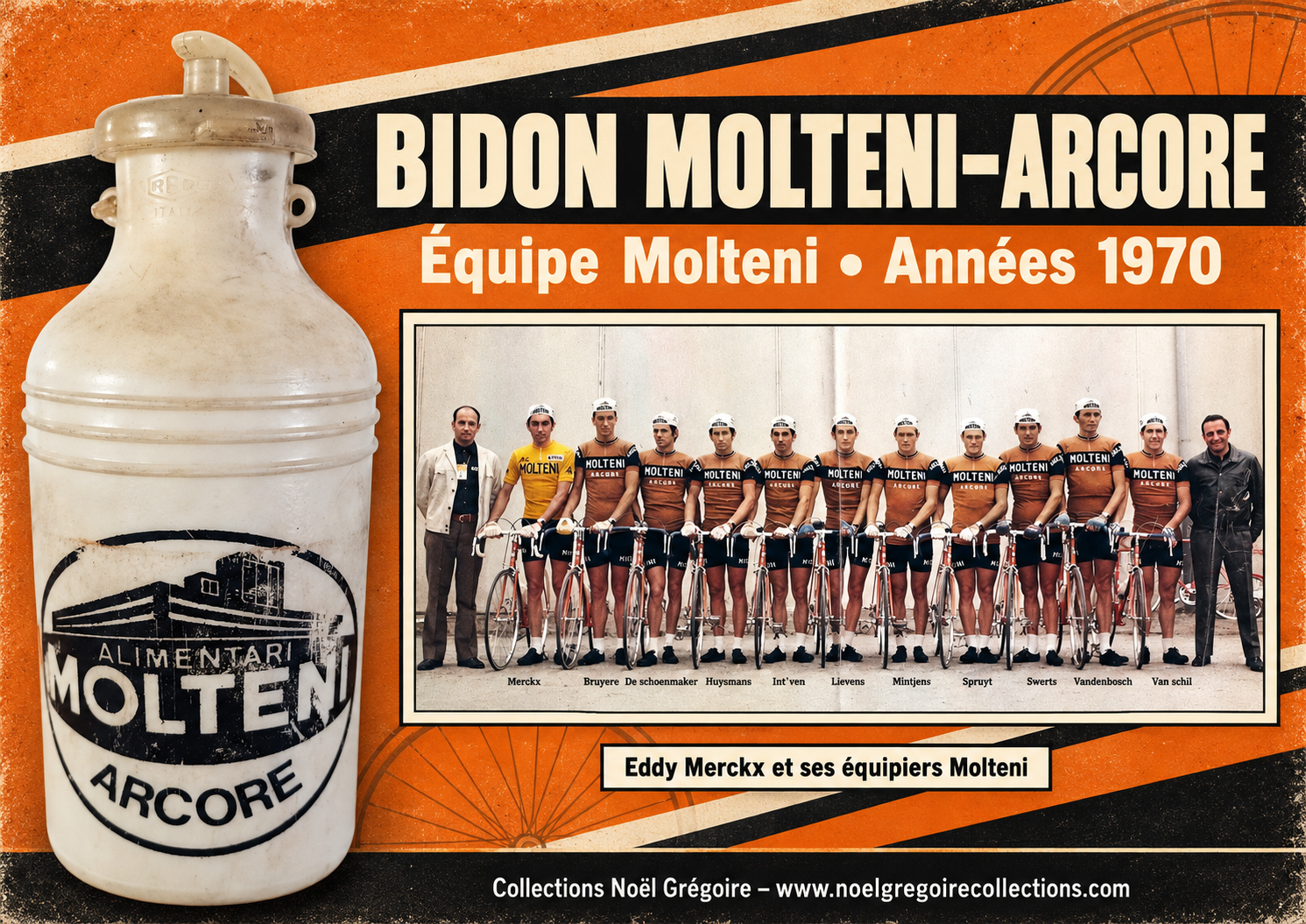
"Molteni-Arcore" team water bottle
Active in the peloton from 1958 to 1976
This water bottle was part of the kit of the Molteni professional team, a squad founded in 1958 and sponsored by the Italian food company of the same name, based in Arcore, Lombardy. Originally Italian, the team came under a Belgian licence from 1971, following the arrival of Eddy Merckx.
Made of cream-coloured plastic, the bottle has a cylindrical body topped by a wide shoulder and several horizontal ribs. Its hinged cap features a spout and remains attached to the neck via its original fastening mechanism.
The front bears the company’s former black-and-white emblem, depicting the company’s buildings above the inscription ‘Alimentari Molteni – Arcore’. The heavily worn print, along with the scratches and marks visible on the plastic, bear witness to prolonged use within the world of professional cycling. This patina has been preserved in its entirety, as it contributes to the item’s authenticity.
The Molteni team enjoyed its golden age with Eddy Merckx, who wore its colours from 1971 to 1976. During this period, the Belgian champion won, notably, four Tours de France, three Giro d’Italia and numerous major classics. The famous havana, black and white jersey thus became one of the most recognisable kits in the history of cycling.
Housed in the Virtual Cycling Museum – Noël Grégoire Collections, this water bottle is a precious physical artefact from one of the most prestigious teams of the 1970s. Its wear and tear serves as a reminder that it was, above all, a functional object, intended for supplying riders with refreshments during training sessions and races.
