

The print media - 3
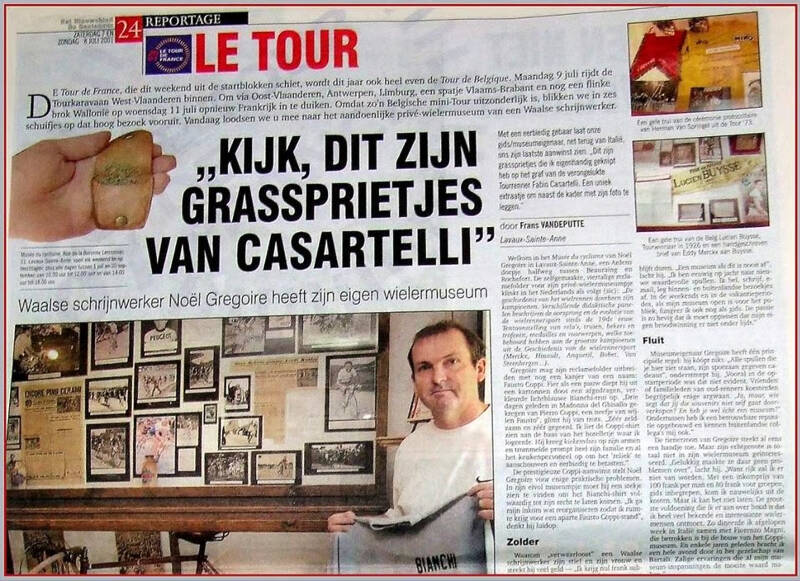
Published in the Flemish daily newspaper *Het Nieuwsblad* to mark the 2000 Tour de France’s passage through Belgium, this feature takes readers on a journey of discovery through the Cycling Museum in Lavaux-Sainte-Anne. Under the original headline ‘Look, these are blades of grass from Casartelli’, journalist Frans Vandeputte presents the unique world of Noël Grégoire, a Walloon carpenter who became a collector and guardian of cycling history.
The article describes a private museum brimming with bicycles, jerseys, trophies, photographs and artefacts linked to the greatest champions. It mentions, in particular, Eddy Merckx, Bernard Hinault, Antonin Magne, Louison Bobet, Fausto Coppi and Gino Bartali. Among the items pictured are a yellow jersey worn by Lucien Buysse during the 1926 Tour de France, as well as a jersey from the 1973 Tour.
The title of the feature refers to a particularly moving memento: a few blades of grass collected from the site of Fabio Casartelli’s fatal accident during the 1995 Tour de France. Preserved at the museum, they bear witness to Noël Grégoire’s determination to preserve not only prestigious artefacts, but also the most humble and human traces of cycling’s history.
Through this profile, the journalist highlights the collector’s passionate work, his in-depth knowledge of cycling and the sometimes surprising diversity of his archives. The Cycling Museum thus emerges as a living place of memory, where great victories, tragic fates and personal memories come together to recount the full richness of the Tour’s legend.
‘Fifteen years of efforts to secure Coppi’s jersey’
In this richly illustrated feature, Pascale Lora Schyns invites readers to discover the Lavaux-Sainte-Anne Cycling Museum and the passion that drives its founder, Noël Grégoire. The article showcases the many historical artefacts painstakingly collected: champions’ jerseys, bicycles, photographs, trophies, newspapers and memorabilia linked to the great figures of cycling.
The author highlights, in particular, the Pélissier brothers, Fausto Coppi, Fabio Casartelli, Rudy Dhaenens and Michel Verhoeven. She also recounts the research, the encounters and the sometimes lengthy efforts that have helped to enrich the collections and preserve these precious artefacts of cycling history. The photographs accompanying the article offer a fine glimpse of the museum and the diversity of the objects on display there at the time.
This feature holds a special place in the museum’s history, as it was written and illustrated by my friend Pascale Lora Schyns. Originally from Liège, she studied English and Dutch languages and literature at the University of Liège, before completing her theatre training at the Cours Florent in Paris and the Actors Studio in Rome.
Pascale is also very familiar with the world of professional cycling. As a commissioner for the International Cycling Union, she has also worked as a press officer for professional cycling teams and several riders. Thanks to her fluency in languages, she has also worked as an interpreter for Amaury Sport Organisation, the organiser of the Tour de France, amongst other events. This experience at the heart of the cycling world has enabled her to bring a particularly informed perspective to the museum and its collections.
A writer, actress and keen traveller, Pascale Lora Schyns divides her time between literature, theatre and dance. Her knowledge of cycling, combined with her keen and sensitive eye, has enabled her to accurately capture the atmosphere of the museum as well as the passion that has guided the development of its collections.

