

The print media - 2
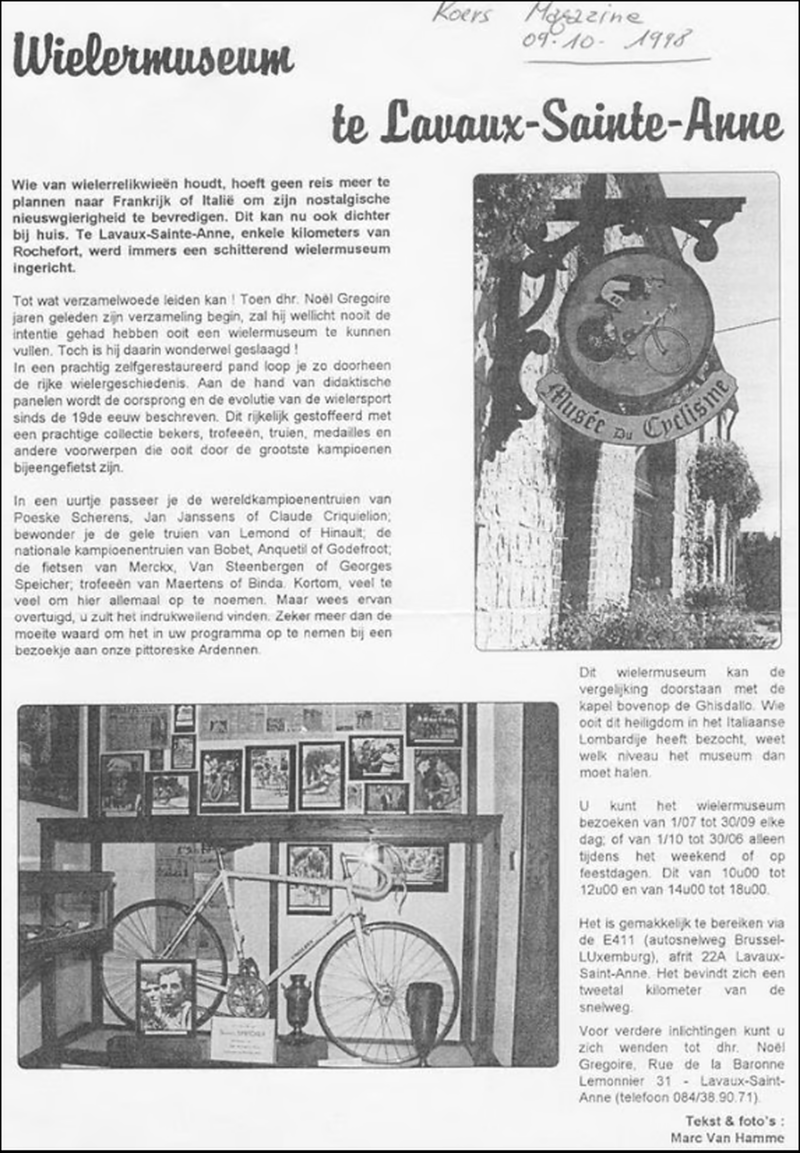
Published in Dutch in *Koers Magazine* on 9 October 1998, under the title ‘Wielermuseum te Lavaux-Sainte-Anne’, this article invites cycling enthusiasts to discover the museum founded by Noël Grégoire, a few kilometres from Rochefort. The journalist presents this venue as a remarkable destination for anyone wishing to relive the atmosphere and memories of cycling’s golden age.
The article highlights the richness and diversity of the collections assembled over the years. Informative display panels trace the origins and evolution of cycling since the 19th century, whilst the display cases showcase cups, trophies, jerseys, medals, bicycles and numerous items that once belonged to the greatest champions.
Among the items mentioned are the world champion’s jerseys of Poeske Scherens, Jan Janssen and Claude Criquielion, the yellow jerseys of Greg LeMond and Bernard Hinault, as well as national champion’s jerseys worn by Louison Bobet, Jacques Anquetil and Walter Godefroot. Visitors can also admire bicycles associated with Eddy Merckx, Rik Van Steenbergen and Georges Speicher, as well as trophies linked to Freddy Maertens and Alfredo Binda.
Impressed by the quality of the collection as a whole, the journalist even compares the museum in Lavaux-Sainte-Anne to the prestigious cycling shrine of the Madonna del Ghisallo in Italy. The article thus highlights the painstaking work of Noël Grégoire and presents his museum as an unmissable stop for enthusiasts of cycling heritage.
Published in *La Gazette des Sports – Régions*, a supplement to the newspaper *La Meuse*, on 1 July 2000, this article, entitled ‘A fine tribute’, presents the Lavaux-Sainte-Anne Cycling Museum as a place where Noël Grégoire brings the legend and memory of the great champions back to life.
The journalist recounts the painstaking work carried out by Noël Grégoire to set up the museum himself and assemble an exceptional collection of bicycles, frames, jerseys, trophies, medals and memorabilia. Among the items mentioned are, in particular, objects linked to Antonin Magne, Georges Speicher, Lucien Buysse, Romain Maes, Henri Pélissier and Eddy Merckx. The yellow sash worn by Lucien Buysse during his victory in the 1926 Tour de France is also showcased.
The article emphasises the passion, perseverance and many years of research required to track down these artefacts from the past. It also highlights the museum’s mission: to offer visitors a journey through the history of cycling, from its earliest great figures to contemporary champions.
A second section is devoted to Noël Grégoire’s meeting with Gino Bartali, twice winner of the Tour de France in 1938 and 1948. In it, he recalls with emotion a meal shared with the Italian champion and the humility of this man who has become a true cycling legend. This encounter is one of the most memorable moments of his research and his life as a collector.

