

Unusual objets - 2
ITEM N° 065
CASARTELLI Fabio (I)
(16.08.1970 – 18.07.1995)
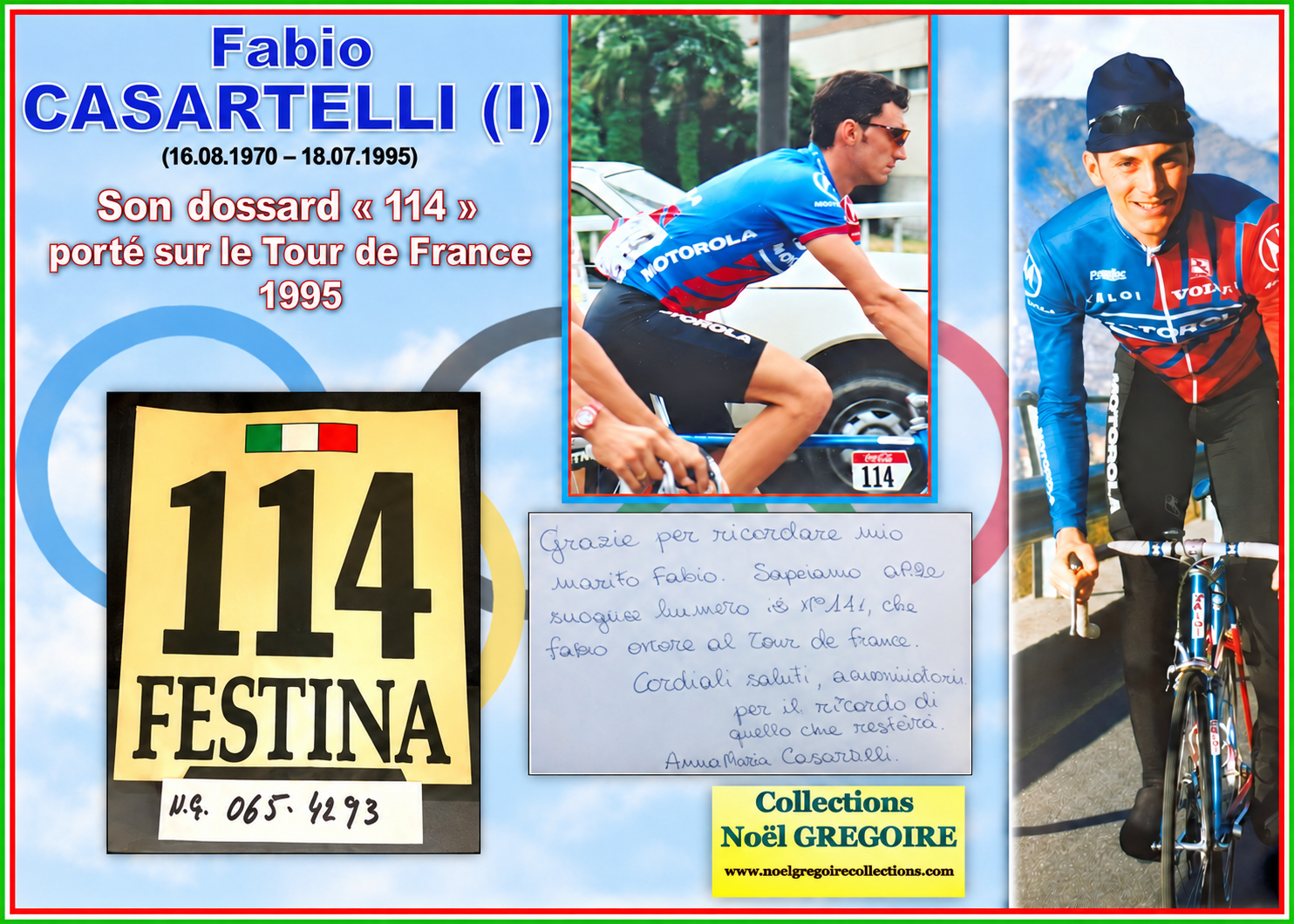
His race number 114, worn during the 1995 Tour de France
Born in Como, Fabio Casartelli was one of the great hopes of Italian cycling in the 1990s. He achieved his greatest success at the 1992 Barcelona Olympic Games, where he won the gold medal in the road race. He turned professional in 1993 and joined the American Motorola team for the 1995 season. Fabio Casartelli’s Olympic profile
The race number 114 shown here was worn by Fabio Casartelli during the 1995 Tour de France. It consists of a light-coloured fabric patch bearing the number 114 in black lettering, the name of the Motorola-Festina team and the colours of the Italian flag. The race photograph shows this same number attached to the rider’s jersey.
On 18 July 1995, during the fifteenth stage, the Italian champion tragically lost his life following a crash on the descent from the Col de Portet-d’Aspet. His death, at the age of just 24, caused immense grief within the peloton and throughout the world of cycling.
A handwritten letter signed by Anna Maria Casartelli accompanies this item. In it, she thanks Noël Grégoire for keeping Fabio’s memory alive and confirms the deeply personal nature of this collection donated to the museum.
Displayed in the Virtual Cycling Museum – Noël Grégoire Collections, this historic race number poignantly honours the memory of Fabio Casartelli, an Olympic champion whose life was tragically cut short on the roads of the Tour de France.
ITEM N° 070
CLOSE Alex (B)
(26.11.1921 – 21.10.2008)
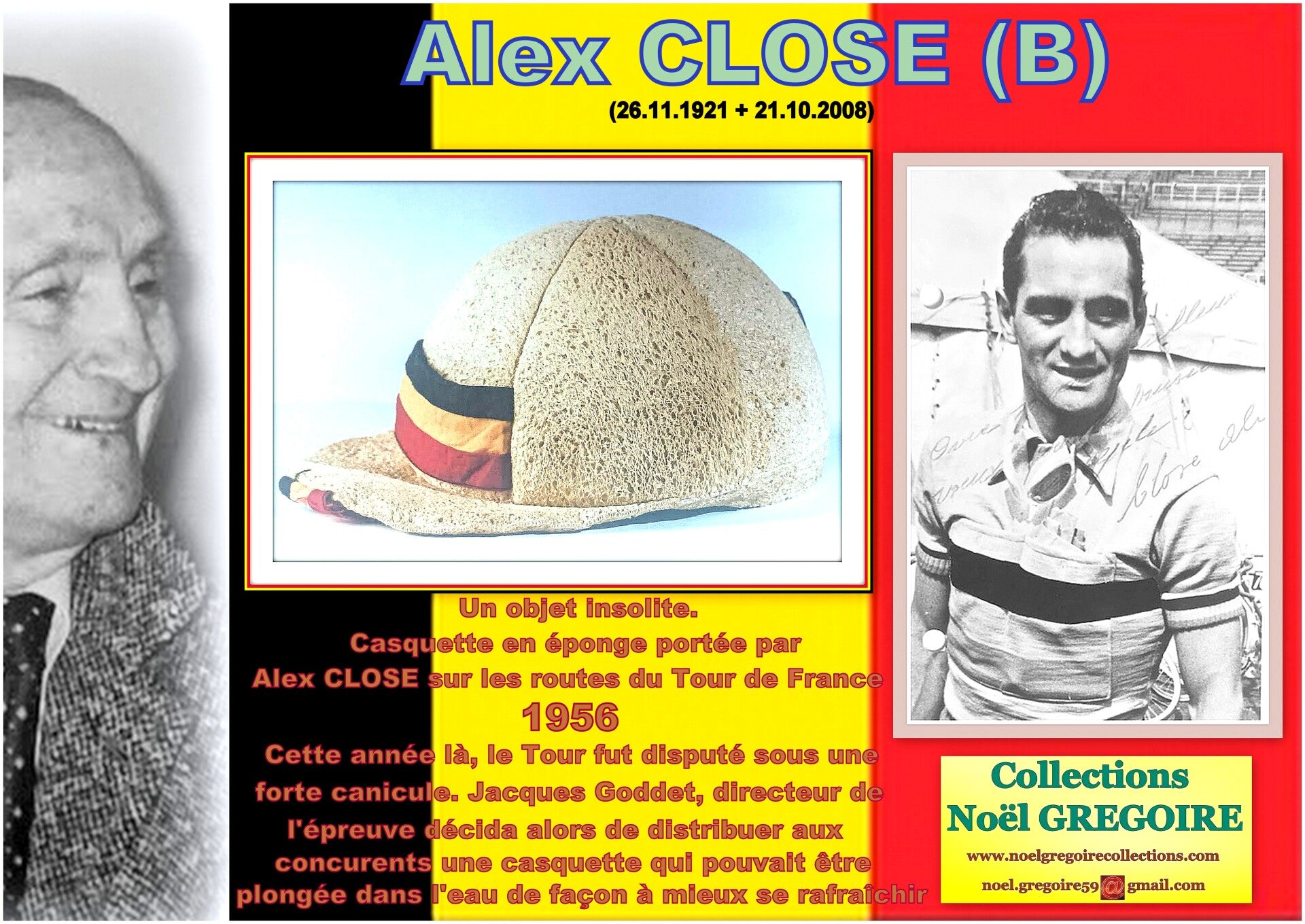
The terry-cloth cap he wore during the 1956 Tour de France 1956
A professional cyclist from 1949 to 1959, Alex Close was one of the finest Belgian road cyclists of his generation. He took part in six Tours de France, finishing seventh in 1952 and fourth in 1953. Winner of the Tour of Belgium in 1955, he also won the Critérium du Dauphiné Libéré in 1956 and came third in Liège–Bastogne–Liège that same year. Alex Close’s honours list
The cap shown here is believed to have been worn by Alex Close during the 1956 Tour de France, which he finished in seventeenth place. Made from a light-coloured, spongy material, it is adorned on the side with a ribbon in the colours of Belgium.
This unusual item was designed to cope with the particularly gruelling weather conditions faced by the riders. The cap could be dipped in water before being put back on, allowing the cyclist to cool down briefly whilst riding. Its shape and material are testament to the simple yet ingenious solutions employed at a time when technical cooling equipment did not yet exist.
Beyond its unique appearance, this item evokes the harshness of the Tour in the 1950s and the means available to riders to cope with the heat, the length of the stages and fatigue.
On display in the Virtual Cycling Museum – Noël Grégoire Collections, this rare terry cap preserves the memory of Alex Close and bears witness to the ingenuity once employed to protect champions from the gruelling conditions of the Tour de France.
ITEM N° 087
DEKKER Erik (NL)
(né le 21.08.1970)
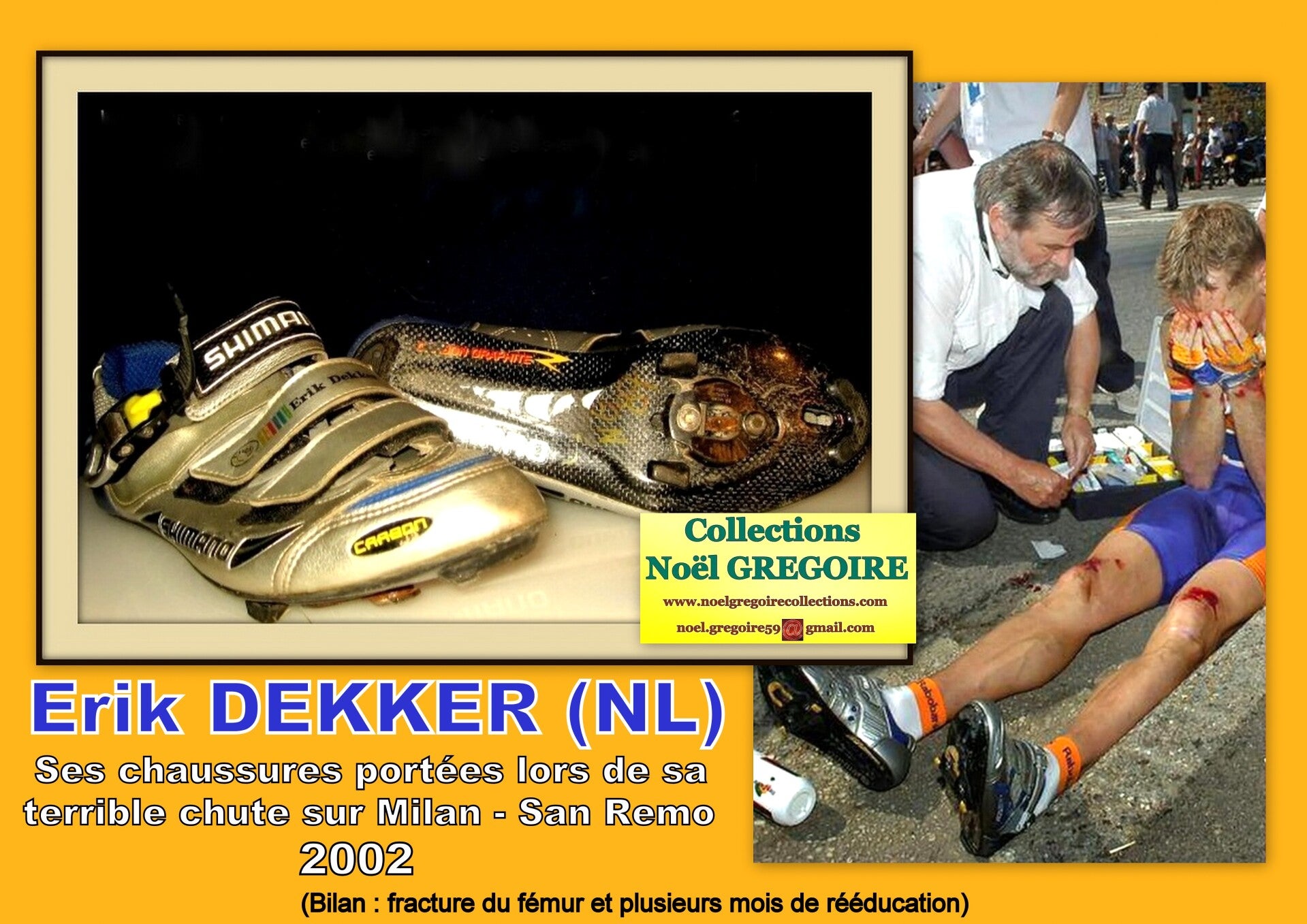
The shoes he was wearing when he crashed in the 2002 Milan–San Remo
A professional cyclist from 1992 to 2006, Erik Dekker was one of the finest representatives of Dutch cycling of his generation. A specialist in breakaways and the classics, he won four stages of the Tour de France, the Clásica de San Sebastián in 2000, the Amstel Gold Race and the World Cup in 2001, and then Tirreno–Adriatico in 2002.
On 23 March 2002, whilst competing in Milan–San Remo for Rabobank, Erik Dekker suffered a violent crash. Seriously injured in the hip, he was forced to undergo a long period of convalescence and rehabilitation, which disrupted much of his season. Cyclingnews
The Shimano shoes shown here were worn at the time of this accident. Silver in colour, they feature three straps and rigid carbon-fibre soles. Erik Dekker’s name and the Dutch flag appear on one of the straps. The numerous scuff marks, the wear on the sole and the visible damage around the cleats bear witness to the severity of the crash.
Preserved in their original condition, these shoes do not serve as a reminder of a victory, but rather of the risks riders face in the major classics, contested at very high speeds on roads that are sometimes treacherous.
On display in the Virtual Cycling Museum – Noël Grégoire Collections, these historic shoes are a striking testament to Erik Dekker’s career and evoke the courage required to return to competition after a serious accident.
