

Race vehicle identification plates - 9
ITEM N° 685
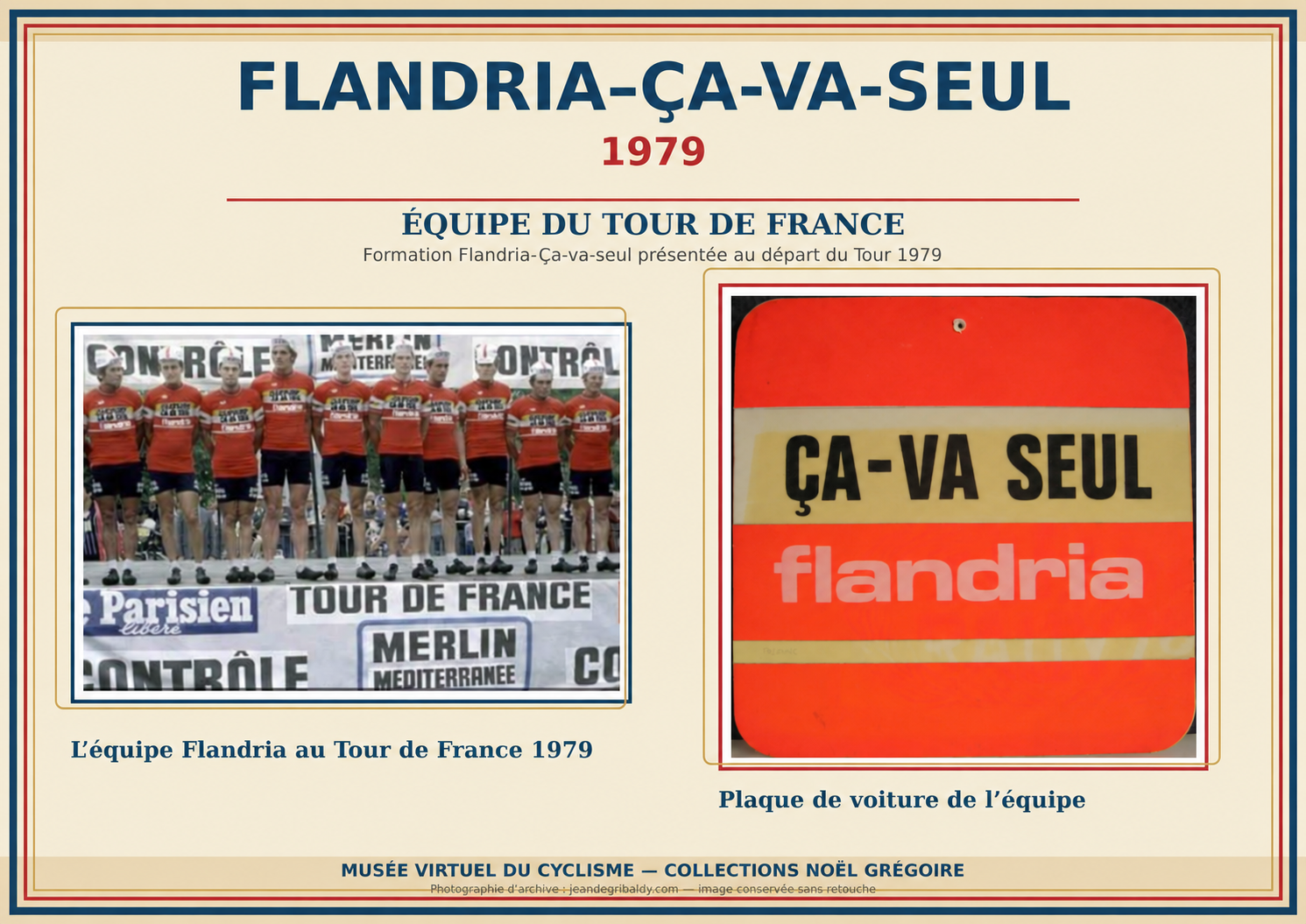
Support vehicle number plate of the Flandria–Ça-va-seul team – 1979
This support vehicle number plate belongs to Flandria–Ça-va-seul, a Belgian professional team that competed in the major cycling races of the 1979 season. Founded in the late 1950s around the bicycle and motorbike manufacturer Flandria, this team played a major role in the history of Belgian cycling for over twenty years. The 1979 season was the last for this iconic team.
The item features the team’s distinctive colours: a bright red background crossed by a wide light-coloured stripe bearing the inscription ‘ÇA-VA SEUL’, whilst the name ‘flandria’ appears in large letters at the bottom. Attached to the front or rear of a team vehicle, this plaque enabled organisers, officials and the public to quickly identify a car belonging to the race convoy.
In 1979, the team adopted the full name Flandria–Ça-va-seul–Sunair. Its squad included, notably, Joaquim Agostinho, Marc Demeyer, René Bittinger, Patrick Bonnet, Hendrik Devos, Jos Deschoenmaecker, René Martens, Jacques Michaud, Patrice Thévenard and Pol Verschuere, all of whom competed under its colours in the Tour de France.
During the 1979 Tour de France, the Portuguese rider Joaquim Agostinho was the team’s main leader. He won the prestigious Alpe d’Huez stage and finished third in the general classification. His Belgian team-mate Marc Demeyer, for his part, won the fourteenth stage. These results were among the last major successes achieved by Flandria before the team disbanded at the end of the season.
Housed in the Virtual Cycling Museum – Noël Grégoire Collections, this plaque bears witness to the vital role of support cars in the organisation of competitions and preserves the memory of the final season of one of Belgian cycling’s most famous teams.

ITEM N° 686
Number plate from a support vehicle at the 1980 Grote Scheldeprijs
This number plate relates to the Grote Scheldeprijs, also known in French as the Grand Prix de l’Escaut. Established in 1907 in the province of Antwerp, this Belgian classic is considered one of the oldest cycling races still held today. Its predominantly flat route and its finish, traditionally located in Schoten, have made it a race particularly suited to sprinters.
The item bears the Dutch inscriptions ‘Grote Scheldeprijs’ and ‘Een organisatie van Schoten W.S.C.’, highlighting the role of the local cycling club in organising the event. The names ‘Sport 80 – Super Magazine’ and the Flemish daily newspaper ‘Het Laatste Nieuws’ also bear witness to the sports press’s involvement in promoting the race. The handwritten number ‘3’ was presumably used to identify one of the vehicles authorised to travel in the race convoy.
The 1980 edition took place on 29 July, covering a distance of approximately 250 kilometres, starting and finishing in Schoten. The Belgian Ludo Peeters, a member of the IJsboerke–Warncke Eis team, won in 5 hours 56 minutes. He finished three seconds ahead of his compatriot René Martens, whilst Dutchman Jan Raas took third place.
Born in 1953 in Hoogstraten, Ludo Peeters was a professional cyclist from 1974 to 1990. A well-rounded rider and a strong all-rounder, his notable victories included two wins in Paris–Brussels and three stages of the Tour de France. During the 1980 season, he also finished eighth in the Tour de France and won the combined classification.
Housed in the Virtual Cycling Museum – Noël Grégoire Collections, this plaque serves as a tangible record of the organisation of the Grote Scheldeprijs and commemorates Ludo Peeters’ victory in 1980 in one of the historic classics of Belgian cycling.

ITEM N° 687
Plaque from the promotional caravan for Ghent–Wevelgem 1982
This plaque relates to the 44th edition of Ghent–Wevelgem, a major Belgian classic held on 7 April 1982. Established in 1934, this race traditionally runs from the Ghent region to Wevelgem, traversing the windswept roads of the Flemish plains and several challenging climbs in the Flanders hills.
The plaque bears the Dutch inscriptions ‘44th Gent–Wevelgem’ and ‘Publiciteitskaravaan’, the latter referring to the advertising convoy that preceded the peloton. Mounted on a promotional vehicle, the plaque enabled the organisers and security services to identify the cars officially authorised to accompany the race.
The references to ‘Sport 80’ and ‘Het Laatste Nieuws’ highlight the importance of the media in the organisation and promotion of major Belgian cycling competitions. The plaque also features the name of V.C. Vliegend Wiel, the historic organising club behind Gent–Wevelgem.
The 1982 edition covered a distance of approximately 255 kilometres, between Ghent and Wevelgem. The Belgian Frank Hoste, a member of the TI-Raleigh–Campagnolo team, won in 6 hours 15 minutes. He finished twelve seconds ahead of a group led by Eddy Vanhaerens, ahead of Alfons De Wolf.
Born in Ghent in 1955, Frank Hoste was a professional cyclist from 1977 to 1991. An excellent sprinter, he also became Belgian road champion in 1982. He won several stages of the Tour de France and claimed the points classification in the Tour de France in 1984. His victory at Ghent–Wevelgem remains one of the major highlights of his career.
Housed in the Virtual Cycling Museum – Noël Grégoire Collections, this plaque bears witness to the role once played by the advertising caravan and media partners in the organisation of the Flemish classics. It also commemorates Frank Hoste’s victory at Ghent–Wevelgem in 1982.
