

Plaque's cars - 8
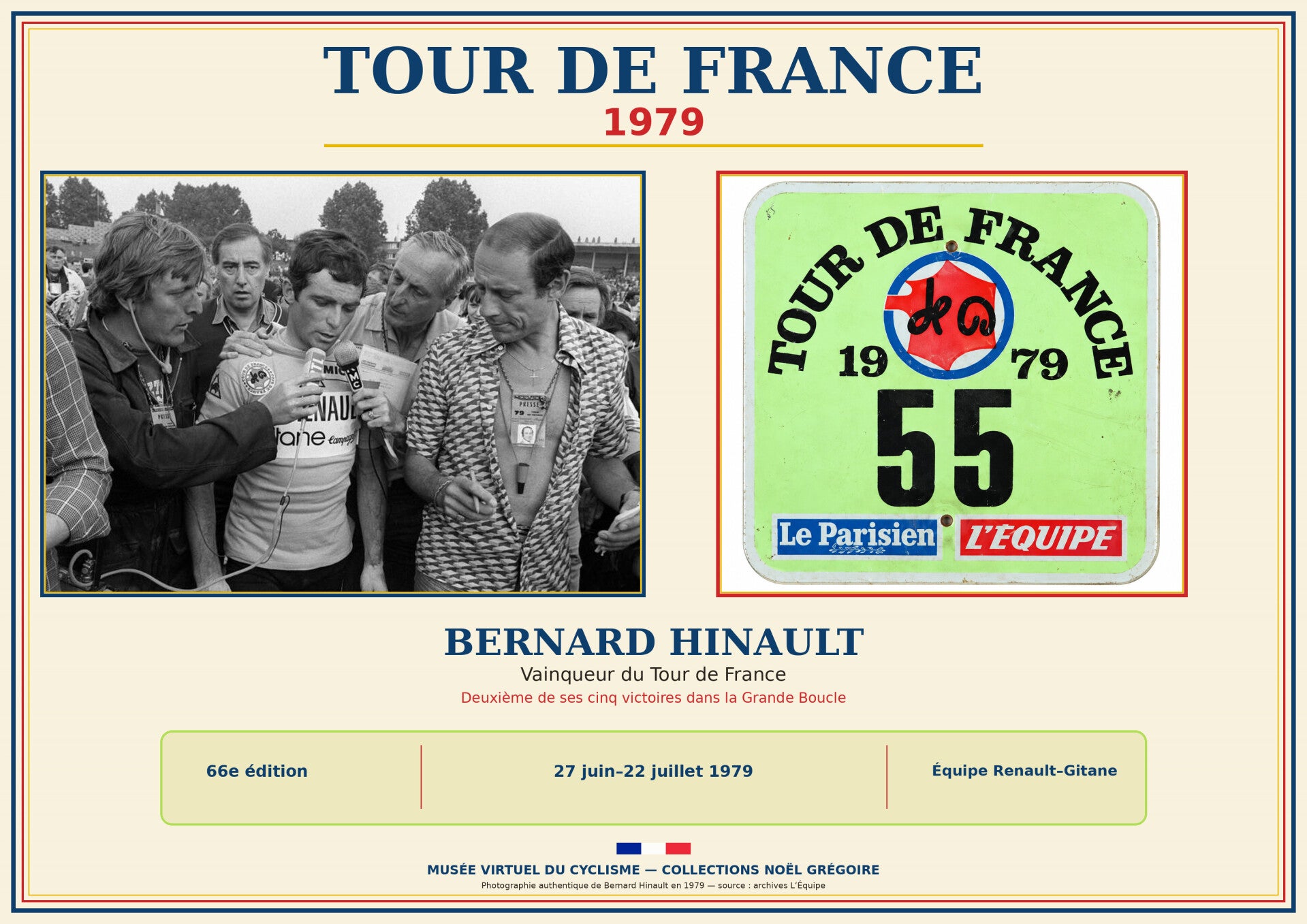
ITEM N° 681
Car number plate from the 1979 Tour de France
This identification plate relates to the 1979 Tour de France, the sixty-sixth edition of the Grande Boucle. Held from 27 June to 22 July, the race comprised a prologue and 24 stages, covering a distance of approximately 3,765 kilometres.
Made in a particularly eye-catching light green colour, the plate bears the words ‘Tour de France’ and ‘1979’, as well as the number 55. The logos of *Le Parisien libéré* and *L’Équipe*, newspapers then associated with the organisation of the race, appear at the bottom. Fitted to an accredited vehicle, it enabled it to be identified within the race convoy and the large mobile support organisation accompanying the peloton.
Its condition, marked by some signs of wear, minor damage and the holes required for its attachment, bears witness to its actual use on the race routes. These marks now form an essential part of its authenticity and documentary value.
The 1979 edition was won by the Frenchman Bernard Hinault, riding for the Renault–Gitane team. Having already won in 1978, the Breton rider thus secured his second consecutive victory in the Tour de France. He also won the points classification and seven stages, confirming his dominance in that edition.
On display in the Virtual Cycling Museum – Noël Grégoire Collections, this plaque commemorates the 1979 Tour de France and the second of Bernard Hinault’s five overall victories in the Grande Boucle. It also bears witness to the indispensable role played by official vehicles, the press and the support convoy in the material history of the Tour.
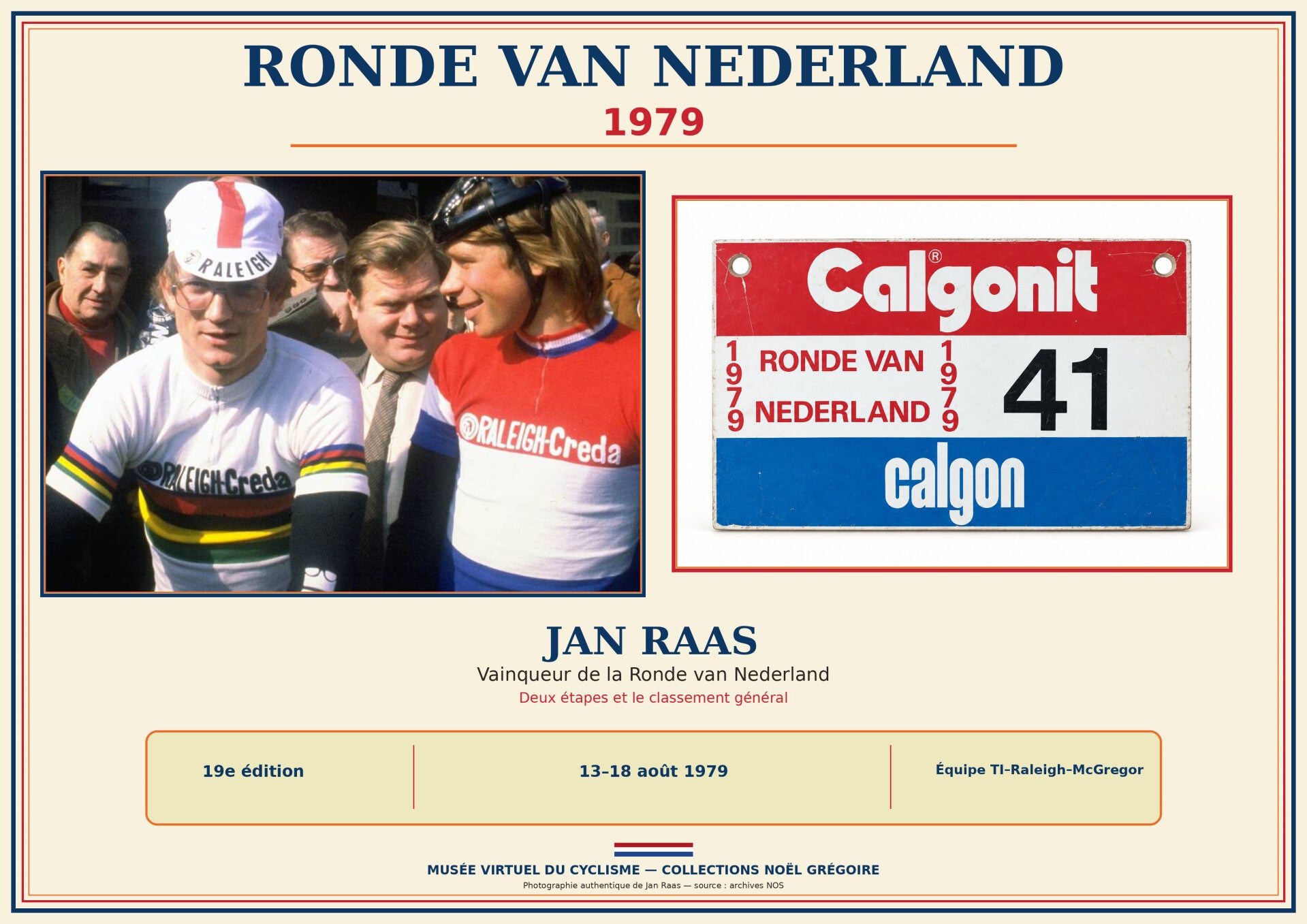
ITEM N° 682
Number plate from a support vehicle at the 1979 Tour de France
This number plate relates to the 1979 Ronde van Nederland, also known as the Tour of the Netherlands. This nineteenth edition took place from 13 to 18 August 1979, over a route of approximately 947 kilometres comprising a prologue and five stages, the last of which was divided into two sections.
The plate features a particularly legible design, dominated by the colours red, white and blue. It bears the inscriptions ‘Ronde van Nederland’, ‘1979’, the number 41, as well as the Calgonit and Calgon logos. The two upper perforations were used to attach it to an accredited vehicle accompanying the race.
The scratches, signs of wear and minor damage visible on its surface bear witness to its use. Far from diminishing its appeal, this patina enhances its documentary value by recalling the actual conditions under which official and advertising vehicles travelled within the race convoy.
The 1979 edition was won by the Dutchman Jan Raas, a member of the TI–Raleigh–McGregor team. He finished ahead of his compatriot Gerrie Knetemann and the Belgian Daniel Willems. Raas also won the prologue and the second stage before retaining the lead in the general classification right up to the final finish.
This victory was part of an exceptional 1979 season for Jan Raas, who also won the Tour of Flanders, the Amstel Gold Race and the Road World Championships held in Valkenburg.
On display in the Virtual Cycling Museum – Noël Grégoire Collections, this plaque commemorates Jan Raas’s victory in the 1979 Ronde van Nederland. It also serves as a tangible reminder of the role played by support vehicles, commercial partners and the race caravan in the organisation of major cycling races.
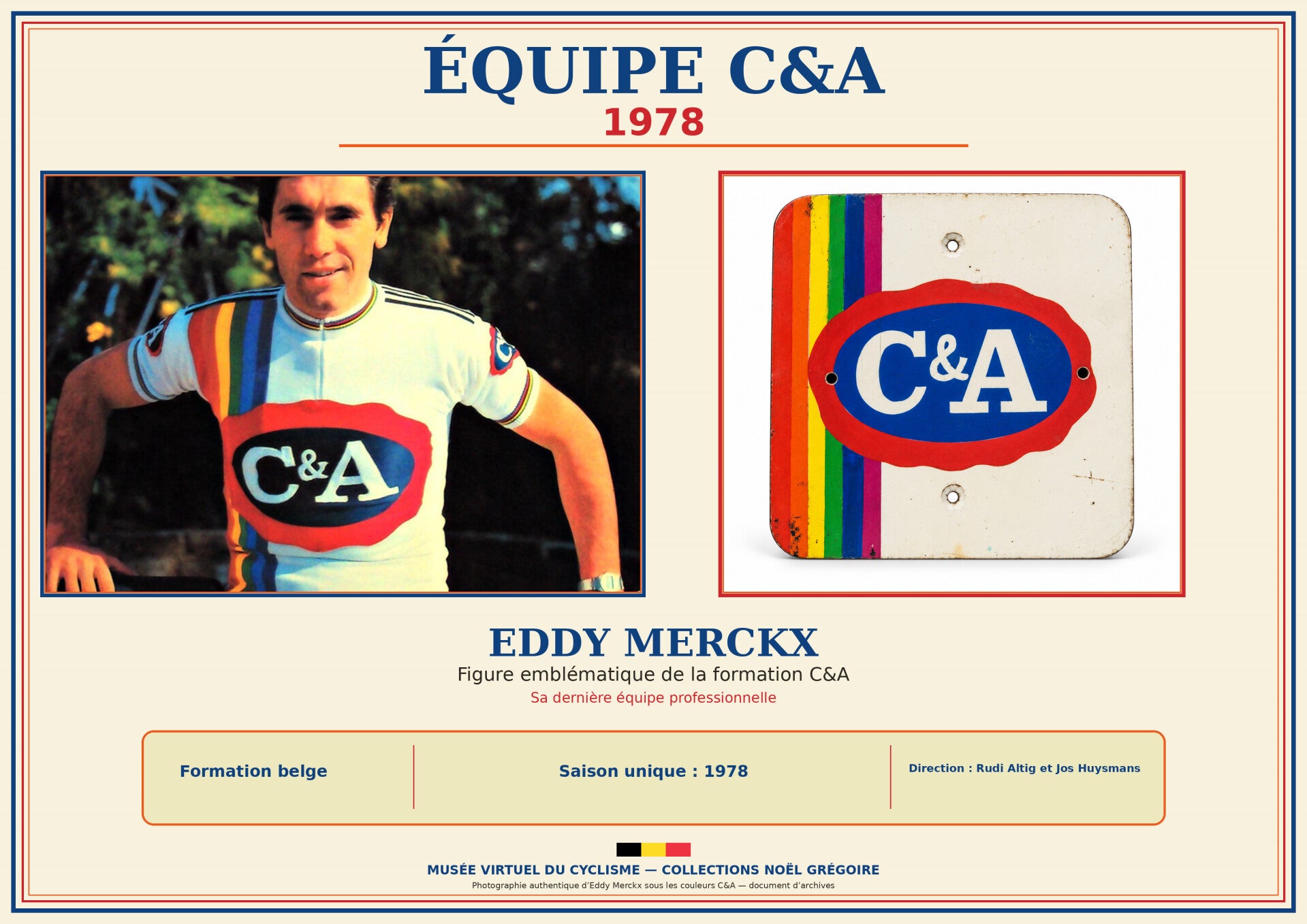
ITEM N°683
C&A team number plate – 1978
This identification plate relates to the Belgian professional cycling team C&A, a team formed at the start of the 1978 season around Eddy Merckx. Contrary to the caption previously added beneath the item, this team did not exist in 1979: it competed for just one season, in 1978.
Almost square in shape with rounded corners, the plate has a white background crossed, on its left-hand side, by several brightly coloured vertical stripes. Its centre features the large C&A emblem, consisting of white letters on a blue oval surrounded by red. Four perforations allowed it to be attached to a team vehicle.
The scratches, signs of wear, dirt and marks on the edges bear witness to its use. This patina is now an important element of its authenticity and serves as a reminder of the conditions under which the team cars accompanied the riders, mechanics and team managers on a daily basis.
The C&A team was, in part, the successor to the Fiat France team and was managed by former riders Rudi Altig and Jozef Huysmans. Its squad included, notably, Eddy Merckx, Lucien Van Impe, Joseph Bruyère, Walter and Willy Planckaert, Guido Van Calster and Eddy Schepers.
C&A was Eddy Merckx’s final professional team. Already hampered by several physical problems, the Belgian champion officially brought his career to an end on 18 May 1978. The team nevertheless continued the season and took part, notably, in the Tour de France before disbanding at the end of the year.
On display in the Virtual Cycling Museum – Noël Grégoire Collections, this plaque serves as a tangible reminder of the short-lived C&A team and Eddy Merckx’s final professional season. It also highlights the indispensable role of support vehicles in the day-to-day running of cycling teams.
