

The plate's cars - 3
ITEM N° 666
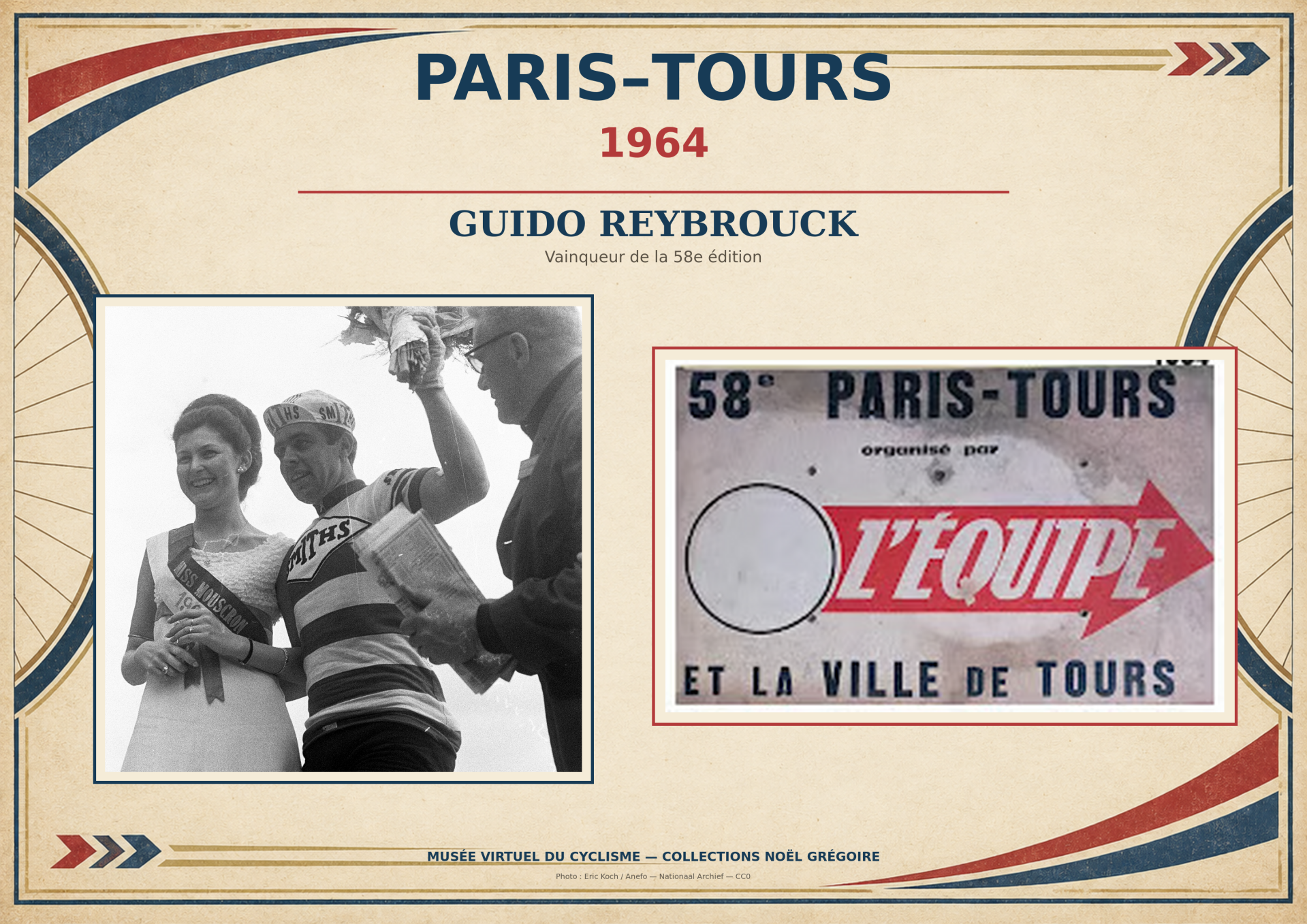
Number plate from a support vehicle at the 1964 Paris–Tours
This number plate relates to Paris–Tours, one of the oldest classics in French professional cycling. Established in 1896, this race traditionally runs from the Paris region to the city of Tours. Its generally fast route and long, wind-exposed roads have made it a race particularly favoured by sprinters and classics specialists.
The plate bears the inscriptions ‘58th Paris–Tours’, ‘organised by L’Équipe’ and ‘the City of Tours’. The circular space visible on the left-hand side was likely intended to hold a number or some form of identification. This plate thus served to identify one of the official or support vehicles forming part of the race convoy.
The presence of the name L’Équipe highlights the vital role played by the sports press in organising and promoting major post-war cycling competitions. The reference to the City of Tours also emphasises the local council’s involvement in hosting the finish and in raising the profile of the event.
The plaque relates to the 58th edition of Paris–Tours, held on 11 October 1964 over a distance of 248 kilometres. The race, marked by rain and hail, attracted over a hundred participants. Only sixty riders were ultimately classified at the finish.
Victory went to the young Belgian Guido Reybrouck, a member of the Flandria–Romeo team. He won the sprint in 6 hours, 48 minutes and 3 seconds, ahead of his compatriots Rik Van Looy and Gustaaf De Smet. Van Looy, who suffered a mechanical problem some twenty kilometres from the finish, managed to rejoin the leading group but was unable to prevent Reybrouck from taking the win.
Aged just 22, Guido Reybrouck secured one of the first major victories of his career. An excellent sprinter, he triumphed again in Paris–Tours in 1966 and 1968, thus becoming a three-time winner of the race. He also won the Belgian National Championship, the Amstel Gold Race and thirteen stages in the three Grand Tours.
On display in the Virtual Cycling Museum – Noël Grégoire Collections, this plaque commemorates Guido Reybrouck’s victory in the 1964 Paris–Tours. Its condition, perforations and inscriptions bear witness to its use and to the logistical organisation surrounding the major cycling classics of that era.
ITEM N° 667
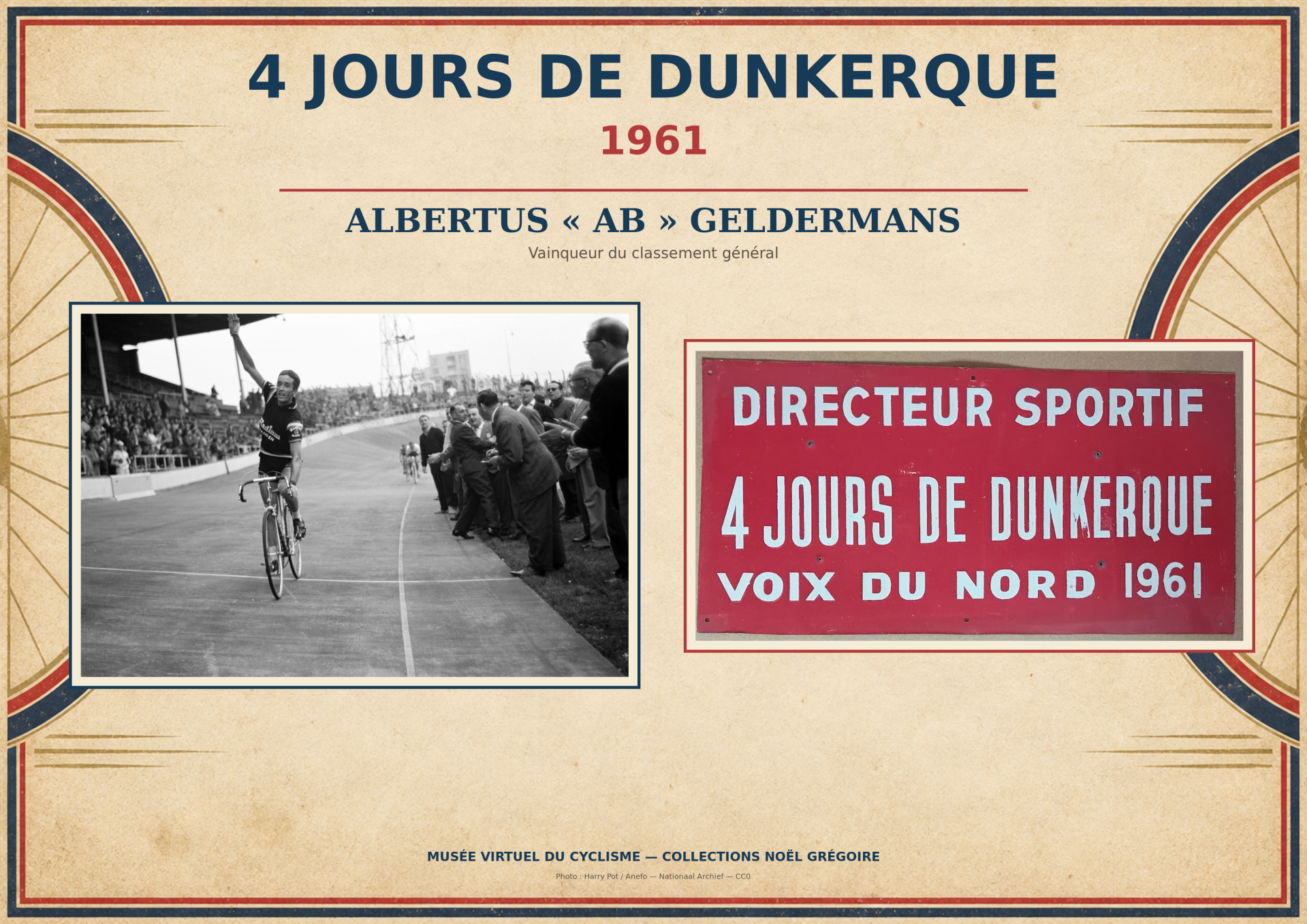
Sports director’s plaque from the 1961 4 Days of Dunkirk
This plaque relates to the Four Days of Dunkirk, a stage cycling race founded in 1955 and held in northern France. Held around Dunkirk and on the roads of the Hauts-de-France region, the event quickly became a key fixture on the professional calendar thanks to its wind-swept routes, demanding roads and stages that often favoured classics specialists.
The item bears the inscriptions ‘Sports Director’, ‘4 Days of Dunkirk’, ‘Voix du Nord’ and ‘1961’. This is an official plaque intended to identify the car of the sports director of a team entered in the race. Attached to the front or rear of the vehicle, it enabled organisers, race officials and riders to quickly recognise his role within the race convoy.
The plate dates from the seventh edition of the Four Days of Dunkirk, held from 11 to 14 May 1961. The route totalled approximately 785 kilometres, spread over four stages, with the first day comprising two half-stages, including a team time trial. All stages started and finished in Dunkirk. 1961 Four Days of Dunkirk
The general classification was won by the Dutchman Albertus ‘Ab’ Geldermans, a member of the Saint-Raphaël–Geminiani team. He finished ahead of the Frenchmen Raymond Poulidor and Pierre Beuffeuil. Geldermans took the lead after the third stage and held on to his advantage until the final finish, despite Jean Stablinski’s victory on the last day.
A well-rounded rider, particularly strong in stage races and time trials, Ab Geldermans had won Liège–Bastogne–Liège and the Tour of Germany in 1960. In 1962, he became Dutch road and time trial champion, finished fifth in the Tour de France and wore the yellow jersey for two days. After his racing career, he became a team manager and played a key role in Jan Janssen’s victory in the 1968 Tour de France. Albertus Geldermans’ honours list
Displayed in the Virtual Cycling Museum – Noël Grégoire Collections, this plaque is a valuable record of the organisation of the Four Days of Dunkirk in 1961. It highlights Ab Geldermans’ victory, the vital role of sports directors and the importance of support vehicles in the running of major cycling races.
ITEM N° 668
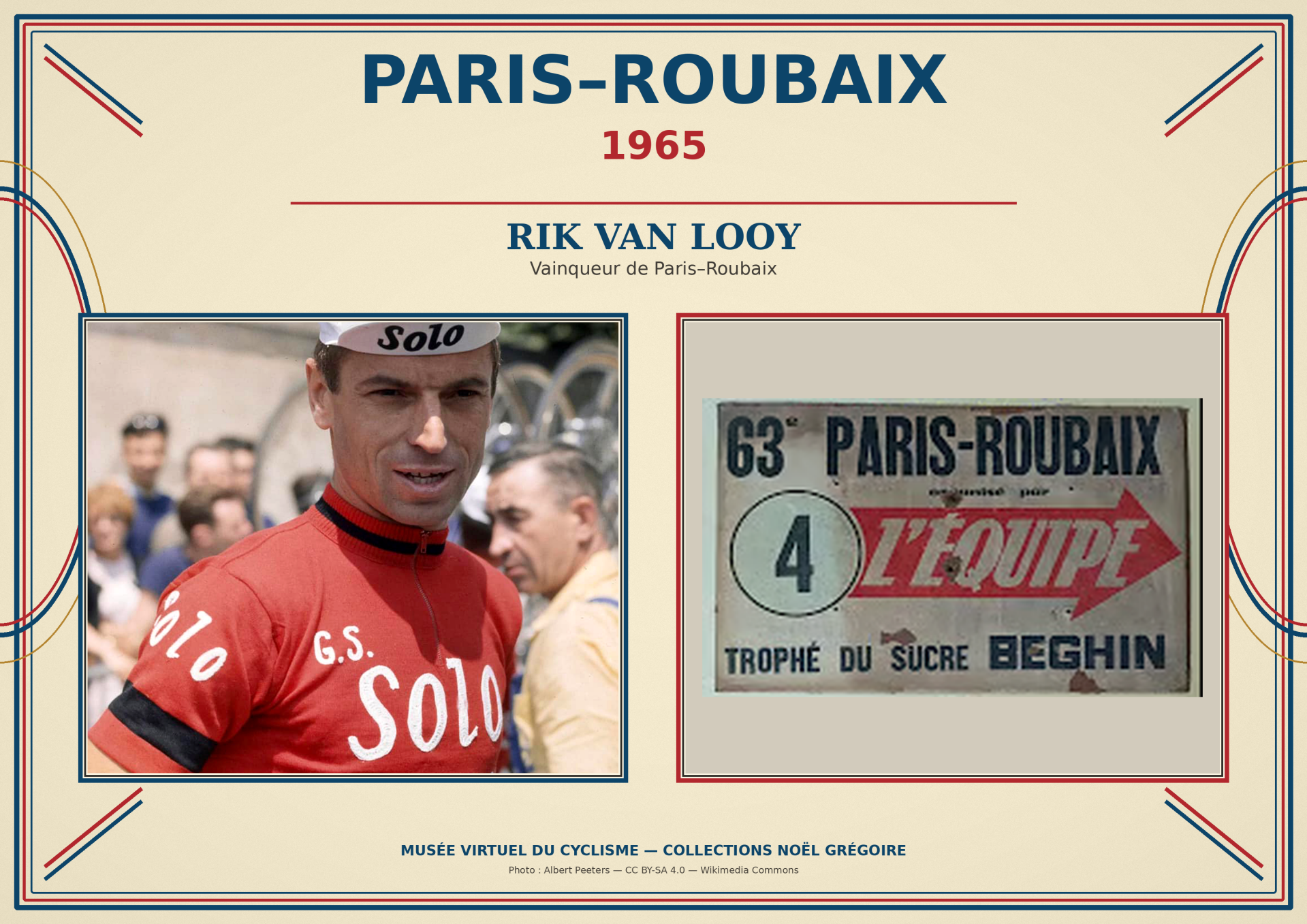
Number plate from a support vehicle at the 1965 Paris–Roubaix
This number plate relates to Paris–Roubaix, one of the oldest and most prestigious classics in professional cycling. Established in 1896, this race in northern France has become famous for its particularly gruelling cobbled sections, which have earned it the nickname ‘Hell of the North’.
The object bears the inscriptions ‘63rd Paris–Roubaix’, ‘L’Équipe’ and ‘Trophée du Sucre Béghin’, as well as the number 4. Its size and perforations suggest that it was most likely an identification plate intended for an official car or a support vehicle. It also bears witness to the role played by the sports press and commercial partners in the organisation of major post-war cycling competitions.
The 63rd edition of Paris–Roubaix took place on 11 April 1965, covering a distance of 267.5 kilometres, including approximately 22 kilometres of cobbled sections. The Belgian Rik Van Looy, a member of the Solo–Superia team, won solo after 6 hours, 23 minutes and 32 seconds of racing. He finished 1 minute and 5 seconds ahead of his team-mate Edward Sels, whilst Willy Vannitsen completed the podium.
This victory marked Rik Van Looy’s third win at Paris–Roubaix, following his victories in 1961 and 1962. Nicknamed ‘the Emperor of Herentals’, he was one of the greatest classics specialists of his era. A double road world champion in 1960 and 1961, he also became the first rider in history to win all five Monuments of cycling.
On display in the Virtual Cycling Museum – Noël Grégoire Collections, this plaque is a valuable physical artefact from Paris–Roubaix in the mid-1960s. It commemorates the organisation of the motorcade accompanying the race and preserves the memory of Rik Van Looy’s third and final victory in the Hell of the North.
