

Plaque's cars - 7
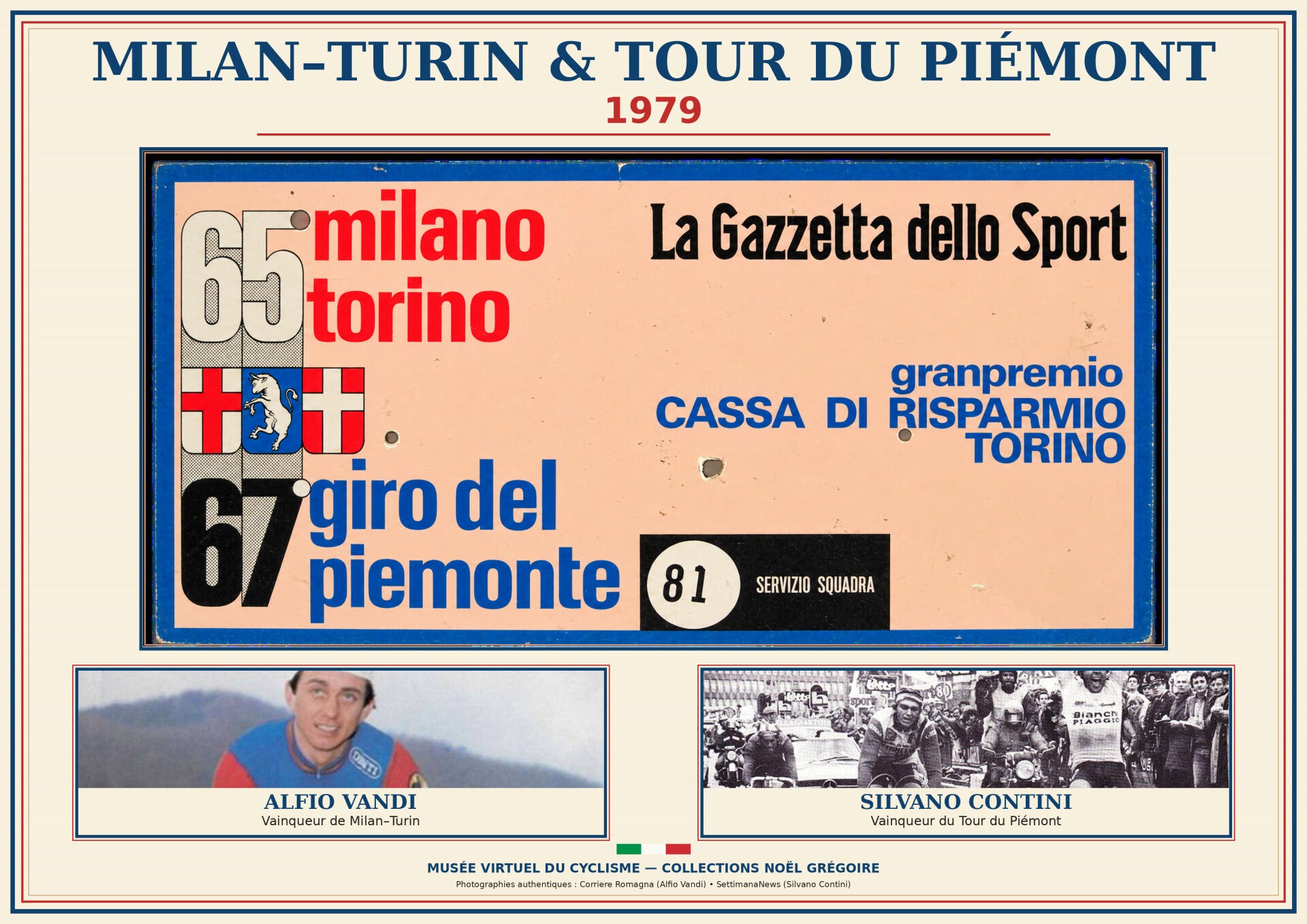
ITEM N° 678
Car number plate from the 1979 Milan–Turin and Tour of Piedmont
This support vehicle number plate is associated with two Italian classics held consecutively in 1979: the 65th edition of Milan–Turin and the 67th edition of the Tour of Piedmont. These two historic races bear witness to the importance of the Piedmont region in the heritage of Italian cycling.
The item bears the inscriptions ‘65 Milano–Torino’, ‘67 Giro del Piemonte’ and ‘La Gazzetta dello Sport’, a sports daily closely associated with the organisation and promotion of major Italian races. The coats of arms of Milan and Turin, along with an advertisement for the Gran Premio Cassa di Risparmio Torino, complete its design.
The black cartouche at the bottom bears the number 81 and the inscription ‘Servizio Squadra’, which can be translated as ‘team service’. This indication shows that the plate was intended to identify a car belonging to one of the teams entered in the race and authorised to travel within the race convoy.
Held on 1 September 1979, the 65th edition of the Milan–Turin race was won by the Italian Alfio Vandi, a member of the Magniflex–Famcucine team. He finished ahead of the Belgian Claude Criquielion and the Italian Wladimiro Panizza.
The following day, 2 September 1979, the Italian Silvano Contini, riding for Bianchi–Faema, won the 67th edition of the Tour of Piedmont. He covered the 227 kilometres in 5 hours 35 minutes, finishing ahead of Wladimiro Panizza and Gianbattista Baronchelli. Only 31 of the 104 riders who started finished the race.
On display in the Virtual Cycling Museum – Noël Grégoire Collections, this plaque provides a valuable insight into how support cars operated in the late 1970s. It also commemorates two Italian victories achieved over the same cycling weekend by Alfio Vandi and Silvano Contini.
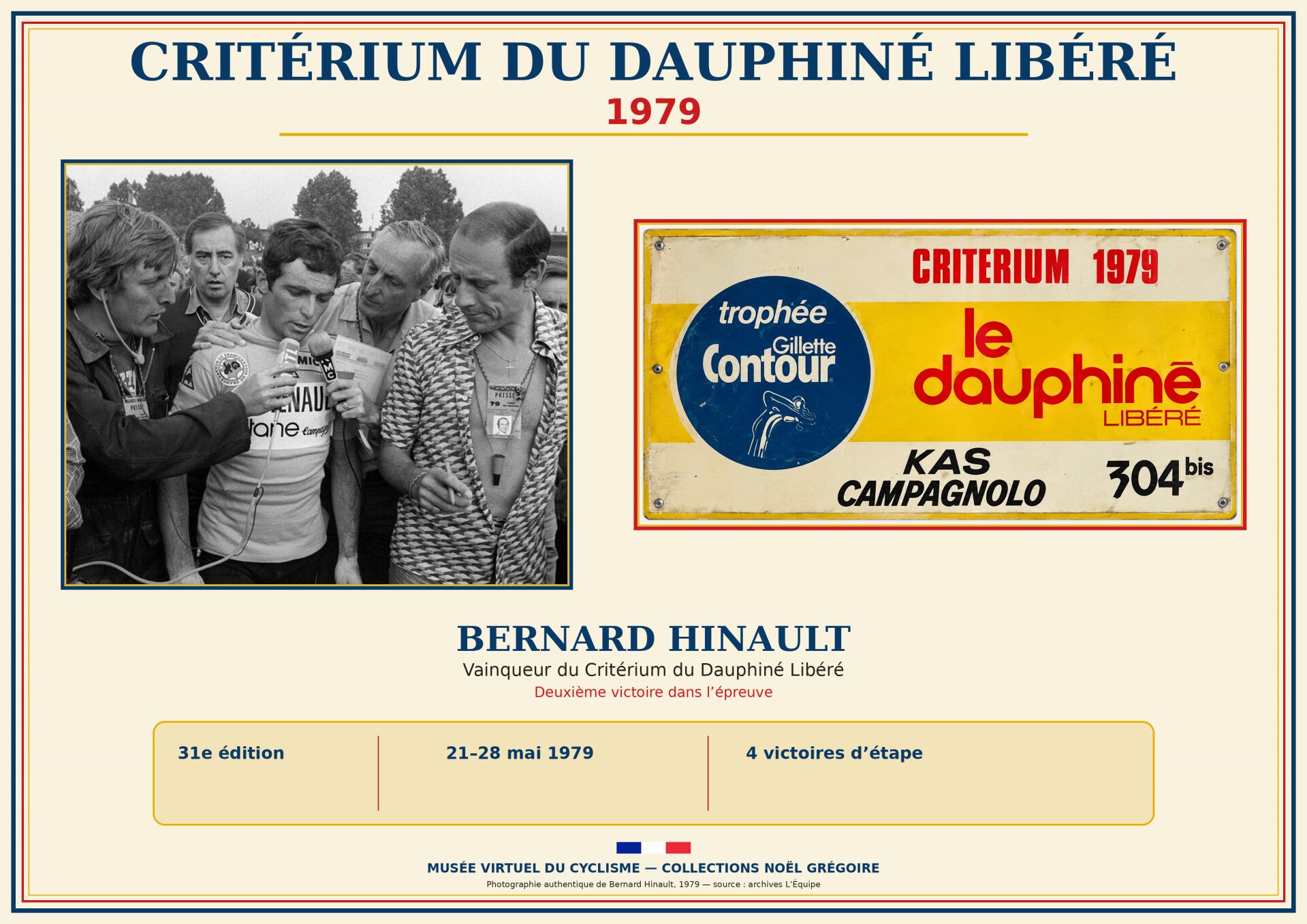
ITEM N° 679
Team car number plate from the 1979 Critérium du Dauphiné Libéré
This support car number plate relates to the 31st edition of the Critérium du Dauphiné Libéré, held from 21 to 28 May 1979. Established in 1947 by the daily newspaper *Le Dauphiné Libéré*, this stage race was already a major event on the French cycling calendar and an important preparatory race for the Tour de France.
The item bears the inscriptions ‘Critérium 1979’, ‘Le Dauphiné Libéré’ and ‘Trophée Gillette Contour’. The presence of the inscriptions ‘KAS–Campagnolo’ and the number 304 bis identifies it as a number plate assigned to a vehicle belonging to the Spanish KAS team, likely part of the team’s technical support or coaching staff.
This number plate was therefore not that of the winning team, as Bernard Hinault was then riding for the Renault–Gitane team. More broadly, it bears witness to the presence of the various teams within the race convoy and the numbering system used to control which vehicles were authorised to follow the race.
The 1979 edition was dominated by Bernard Hinault. The French champion won four stages and took the overall classification ahead of the Dutchman Henk Lubberding and the Spaniard Francisco Galdós, a member of the KAS team. Hinault also won the points classification and the mountains classification.
This was Bernard Hinault’s second victory in the Critérium du Dauphiné Libéré, following his success in 1977. A few weeks later, he also won the Tour de France, achieving the prestigious Dauphiné–Tour double for the first time, a feat he would repeat in 1981.
On display in the Virtual Cycling Museum – Noël Grégoire Collections, this plaque commemorates the 1979 Critérium du Dauphiné Libéré and the logistical organisation of the support cars. It also highlights Bernard Hinault’s dominance and the third-place finish achieved by Francisco Galdós for the KAS–Campagnolo team.
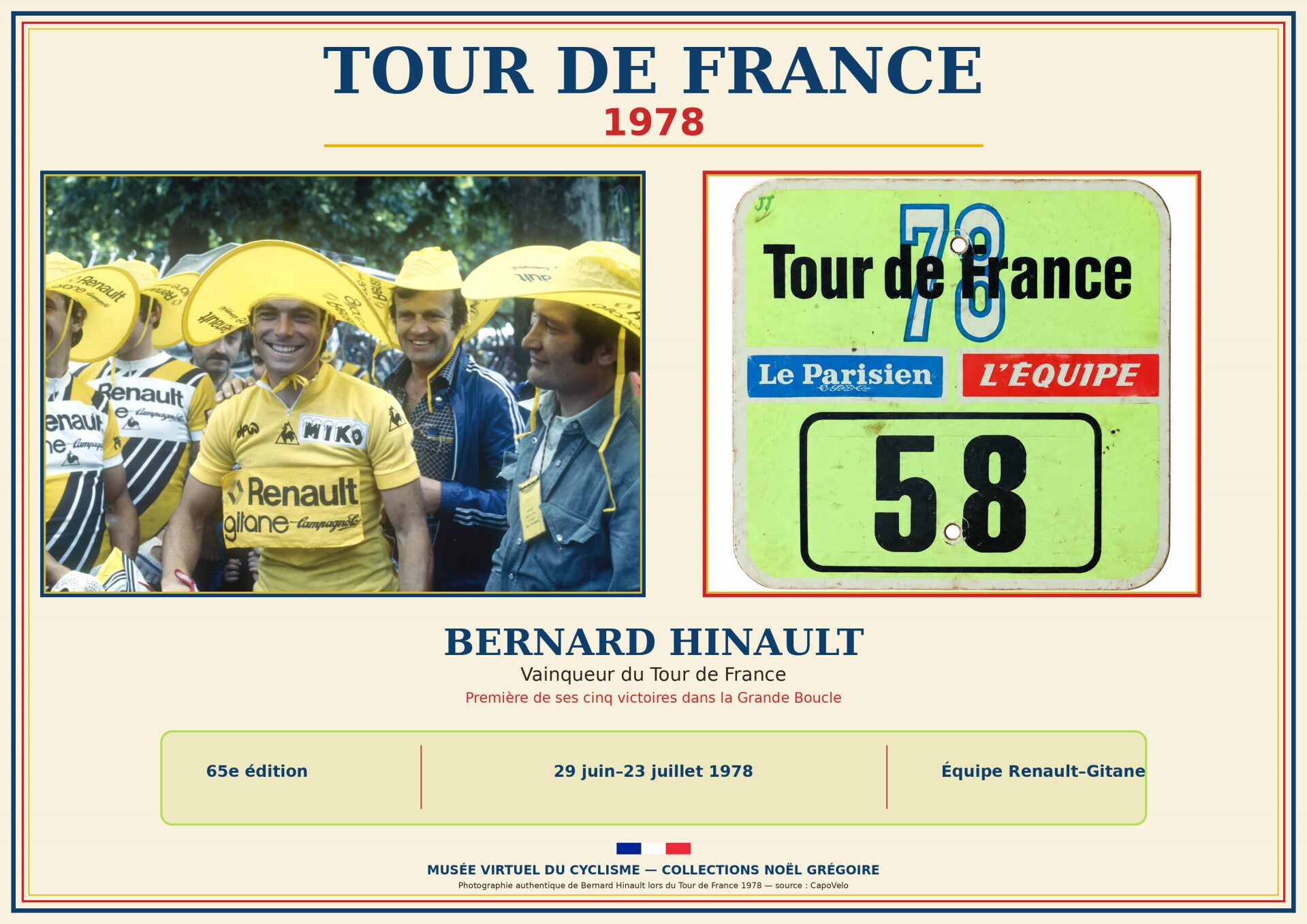
ITEM N° 680
1978 Tour de France support vehicle number plate
This support vehicle number plate relates to the 65th edition of the Tour de France, which took place from 29 June to 23 July 1978. This edition covered France in 22 stages and marked the emergence of a new champion: Bernard Hinault from Brittany, who was taking part in the Tour de France for the first time.
The item bears the inscriptions ‘Tour de France 78’, ‘Le Parisien’ and ‘L’Équipe’, two newspapers historically associated with the organisation and media coverage of the race. Its light green colour and large number 58 allowed the vehicle to which it was assigned to be quickly identified within the race convoy.
Fixed to the front or rear of the cars, these plates regulated the movement of vehicles accompanying the race: team cars, technical vehicles, press, organisers and guests. Today, they constitute valuable physical evidence of how the Tour de France operated before the advent of modern accreditation systems.
Riding for the Renault–Gitane team, Bernard Hinault won the general classification in 108 hours 18 minutes 02 seconds. He finished 3 minutes 56 seconds ahead of the Dutchman Joop Zoetemelk and 6 minutes 54 seconds ahead of the Portuguese Joaquim Agostinho.
At just 23 years of age, Bernard Hinault thus won the Tour de France on his very first attempt. This success marked the first of his five victories in the Tour de France, to which would be added those of 1979, 1981, 1982 and 1985. That same year, he also won the Vuelta a España, cementing his spectacular emergence as one of the greatest cyclists of his era.
On display in the Virtual Cycling Museum – Noël Grégoire Collections, this plaque commemorates the 1978 Tour de France and Bernard Hinault’s first victory. It also bears witness to the vital role played by support vehicles in the organisation and safety of the world’s most famous cycling race.
