

Plaque's cars - 6
ITEM N° 675
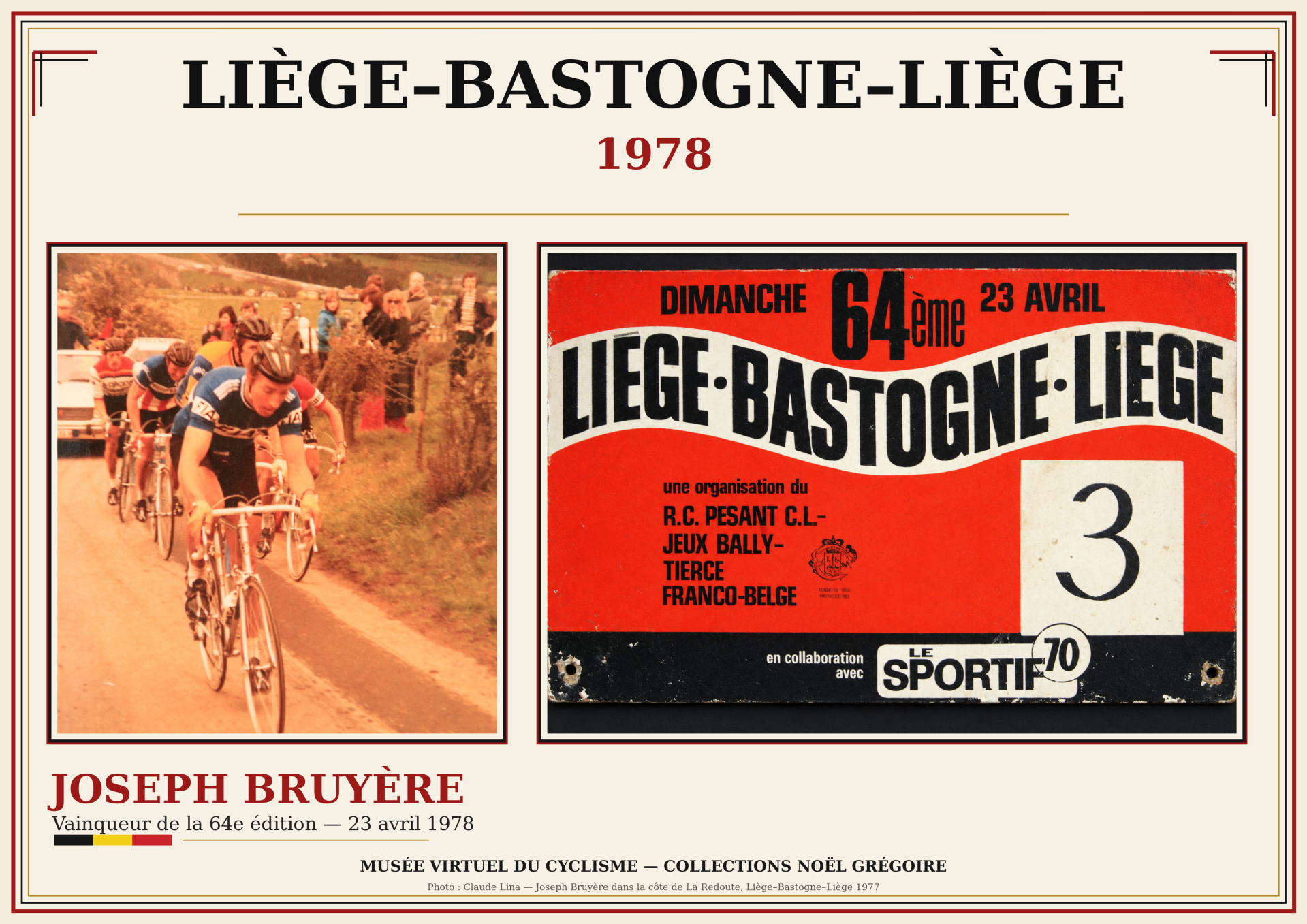
Car number plate from the 1978 Liège–Bastogne–Liège race
This number plate relates to the 64th edition of Liège–Bastogne–Liège, held on Sunday 23 April 1978. Established in 1892 and nicknamed ‘La Doyenne’, this great Belgian classic is the oldest of the so-called ‘Monuments’. Its demanding route through the Ardennes, punctuated by short and particularly steep climbs, makes it one of the most prestigious events in professional cycling.
The item bears the words ‘Liège–Bastogne–Liège’ in large letters, accompanied by the date of the race and the number 3, which was presumably used to identify an authorised vehicle within the race convoy or the organising team. At the bottom are the inscriptions ‘R.C. Pesant C.L. – Jeux Bally – Tiercé Franco-Belge’ and ‘in collaboration with Le Sportif 70’, reflecting the role played by clubs, the press and commercial partners in organising the event.
The 1978 edition was won by the Belgian Joseph Bruyère, then a member of the C&A team. On the climb up the Côte de La Redoute, he managed to pull away from Michel Pollentier, his last direct rival, before continuing alone towards Liège. He crossed the finish line on Boulevard de la Sauvenière 1 minute and 35 seconds ahead of Dietrich Thurau and Francesco Moser. Of the 156 riders who started, only 51 finished the race.
This victory was Joseph Bruyère’s second win in Liège–Bastogne–Liège, following his triumph in 1976. A loyal team-mate to Eddy Merckx for much of his career, Bruyère also had a remarkable personal record: three-time winner of the Circuit Het Volk, wearer of the yellow jersey for eight days and fourth in the 1978 Tour de France.
Featured in the Virtual Cycling Museum – Noël Grégoire Collections, this plaque is a valuable physical artefact bearing witness to the organisation of Liège–Bastogne–Liège in the late 1970s. Its signs of wear, mounting holes and distinctive typography serve as a reminder that it was designed as genuine racing equipment, intended to identify a vehicle forming part of the official procession of ‘La Doyenne’.
ITEM N° 676
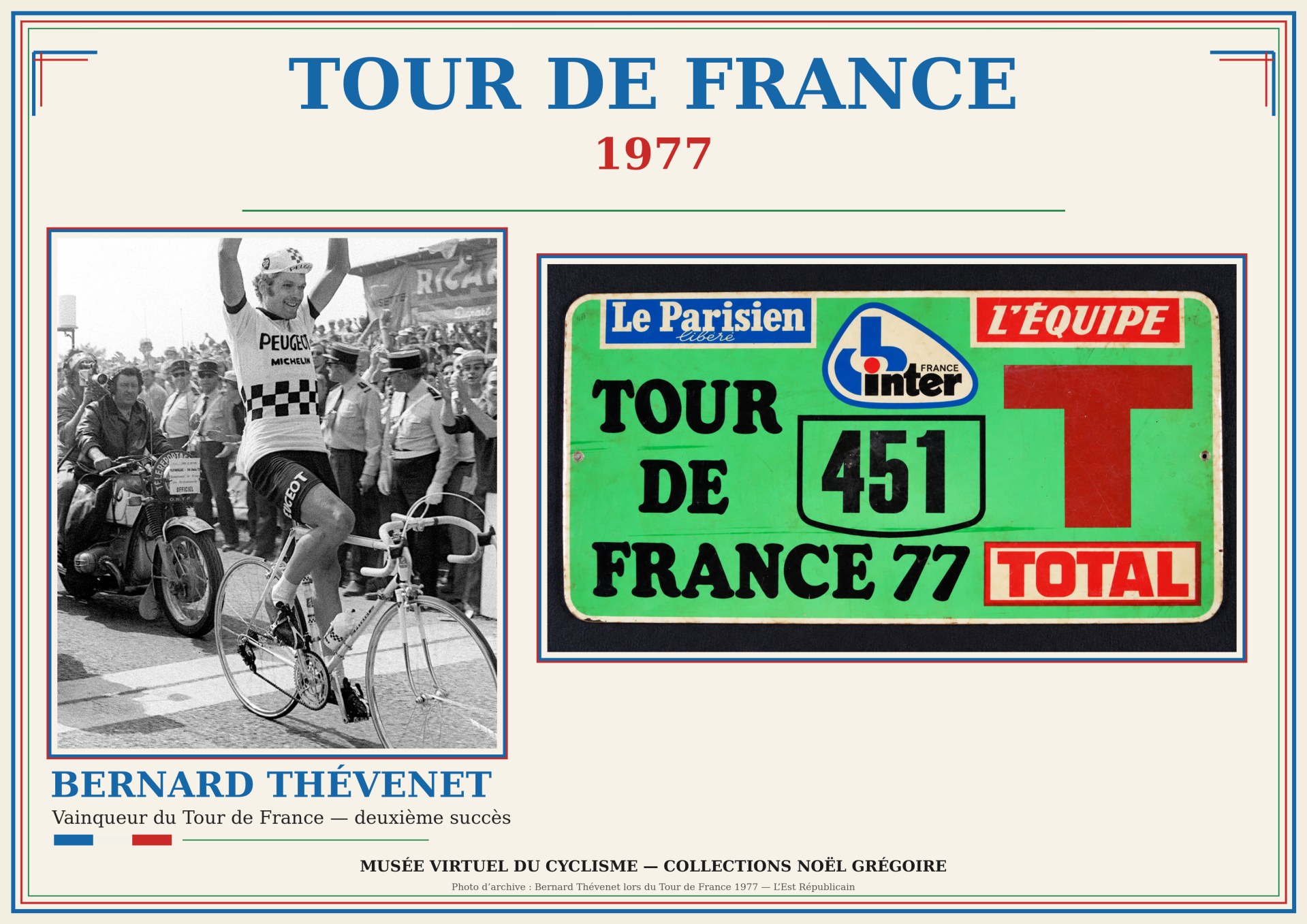
Number plate from a support vehicle for the 1977 Tour de France
This number plate relates to the 64th edition of the Tour de France, which took place from 30 June to 24 July 1977. Intended to be affixed to a vehicle authorised to travel within the race convoy, it enabled the organisers, race officials and security services to immediately identify the vehicle’s role and accreditation.
The badge features a particularly distinctive green background, bearing the words ‘Tour de France 77’ and the number 451. It also bears the logos of L’Équipe, Le Parisien libéré, France Inter and Total, long-standing partners of the event. The large red ‘T’ likely corresponds to a vehicle category or a specific service within the organisation, perhaps related to telecommunications or television. However, this interpretation remains to be confirmed by official accreditation documents from the period.
The 1977 Tour de France was won by the Frenchman Bernard Thévenet, riding for the Peugeot–Esso–Michelin team. Having already won in 1975, he secured his second victory in the Tour de France in Paris, following a particularly closely contested race. He ultimately finished just 48 seconds ahead of the Dutchman Hennie Kuiper – one of the narrowest margins ever recorded between the top two riders in the general classification.
Bernard Thévenet notably consolidated his victory in the Alps, and then during the final time trial. A powerful climber and all-rounder, he remains famous for having brought an end to Eddy Merckx’s dominance in the 1975 Tour de France. His 1977 victory was the last major triumph of his career and cemented his place amongst the leading French champions of the post-war era.
On display in the Virtual Cycling Museum – Noël Grégoire Collections, this badge bears witness to the considerable organisation required to ensure the smooth running of the Tour de France. Its bright colours, numerous logos, accreditation number and signs of wear make it a valuable artefact, at the crossroads of the history of cycling, the press, radio and the motorcade.
ITEM N° 677
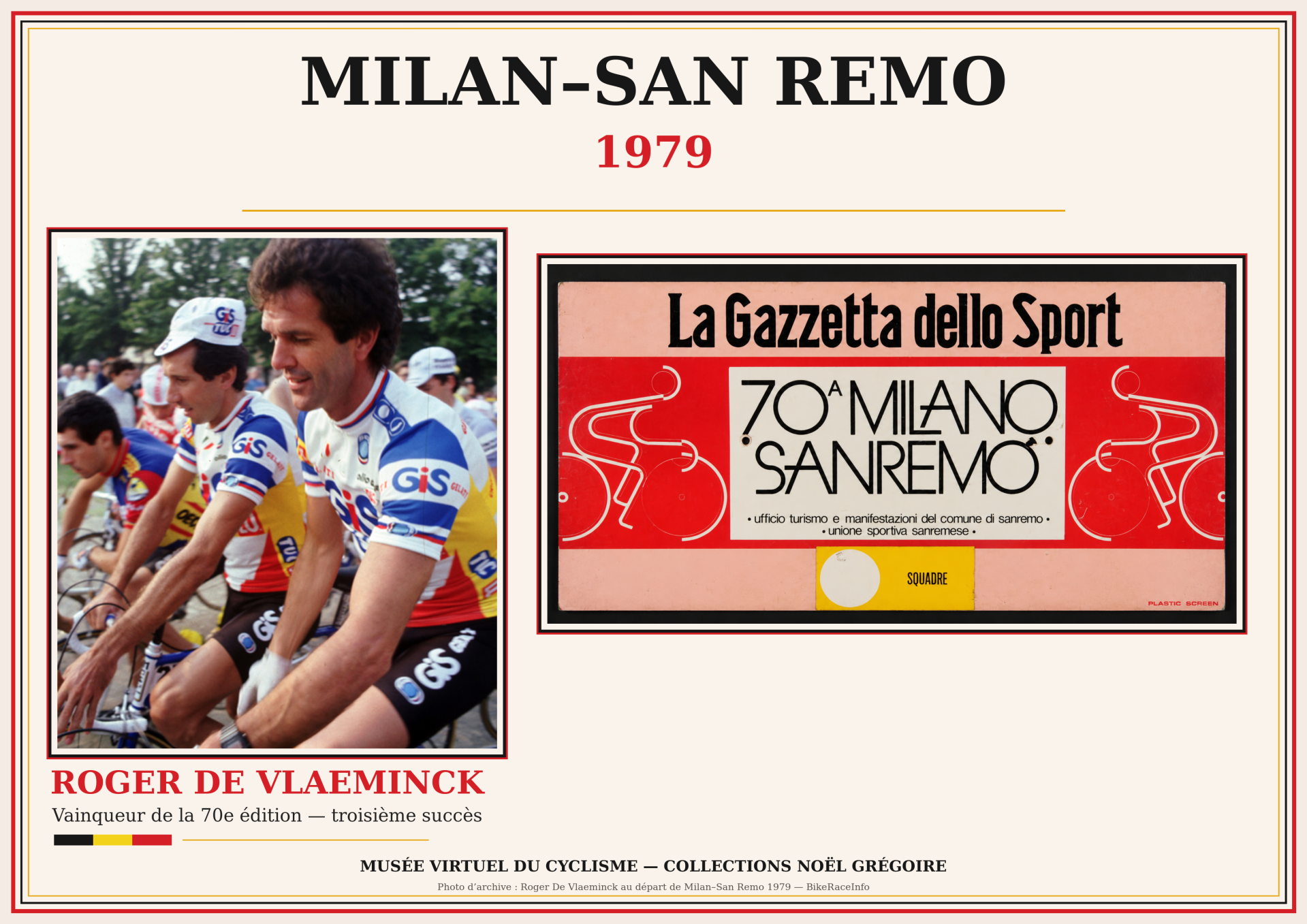
Car number plate from the 1979 Milan–San Remo
This number plate relates to the 70th edition of the Milan–San Remo, held on 17 March 1979. Established in 1907, this great Italian classic traditionally runs from Milan to the Ligurian coast. Nicknamed ‘La Primavera’, it is one of the five Monuments of cycling and is distinguished by its exceptional distance of nearly 300 kilometres.
Featuring the pink, red and black colours of *La Gazzetta dello Sport*, the newspaper organising the event, the plate bears the inscriptions ‘70ª Milano Sanremo’ and ‘Squadre’. The latter likely indicates that it was intended to identify a car belonging to one of the teams competing in the race. The circular space left blank was presumably intended for the addition of a number or a distinctive mark.
The 1979 edition covered 288 kilometres, between Milan and San Remo. After 7 hours, 5 minutes and 44 seconds of racing, the Belgian Roger De Vlaeminck, a member of the GIS Gelati team, won ahead of the Italian Giuseppe Saronni and the Norwegian Knut Knudsen.
This victory marked Roger De Vlaeminck’s third win in Milan–San Remo, following those in 1973 and 1978. A remarkably versatile rider, equally at home on cobbled sections as in fast-paced classics, he remains one of the great one-day race specialists of his era.
On display in the Virtual Cycling Museum – Noël Grégoire Collections, this plaque bears witness to the logistical organisation of the great Italian classics and the vital role played by support cars in managing the teams. It also commemorates Roger De Vlaeminck’s victory in the 1979 Milan–San Remo, one of the eleven wins achieved by the Belgian champion in the Monuments of cycling.
