

Plaque's cars - 5
ITEM N° 672
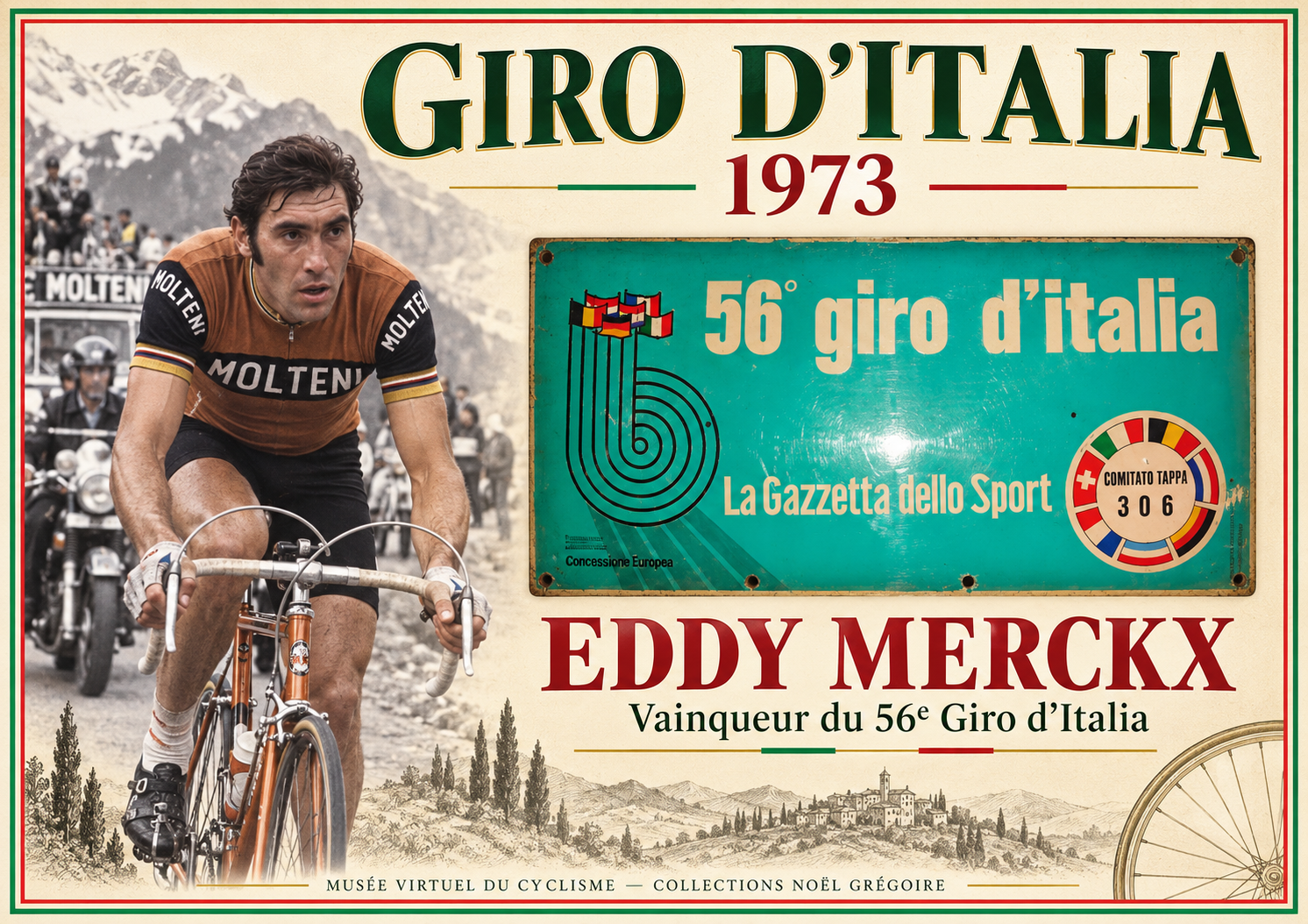
Official plaque from the 56th Giro d’Italia – 1973
This plaque relates to the 56th Giro d’Italia, which took place from 18 May to 9 June 1973. Starting in Verviers, Belgium, the route took the riders to Trieste after more than 3,800 kilometres of racing. This edition was won by the Belgian Eddy Merckx.
The turquoise-coloured plaque bears the inscriptions ‘56° Giro d’Italia’ and ‘La Gazzetta dello Sport’, a newspaper historically associated with the organisation of the event. The central design features the number 56 in a stylised form, accompanied by small flags evoking the international nature of the race.
On the right is a multicoloured disc bearing the inscription ‘Comitato Tappa’ and the number 306. This identification likely refers to a number plate assigned to a vehicle or a member of the stage committee forming part of the Giro’s organisation and official convoy. It served to identify vehicles authorised to travel within the race convoy.
Eddy Merckx dominated this edition whilst riding for the Molteni team. He won the general classification ahead of the Italians Felice Gimondi and Giovanni Battaglin. This victory marked his fourth success in the Giro d’Italia, following those in 1968, 1970 and 1972.
The year ‘1974’, previously added beneath the photograph of the plaque, was therefore incorrect: the 1974 Giro was the 57th edition, also won by Eddy Merckx. The original inscription ‘56° Giro d’Italia’ allows us to attribute this plaque with certainty to the 1973 edition.
Featured in the Virtual Cycling Museum – Noël Grégoire Collections, this plaque is a valuable physical record of the organisation of the Giro d’Italia and commemorates one of Eddy Merckx’s greatest victories at the height of his career.
ITEM N° 673
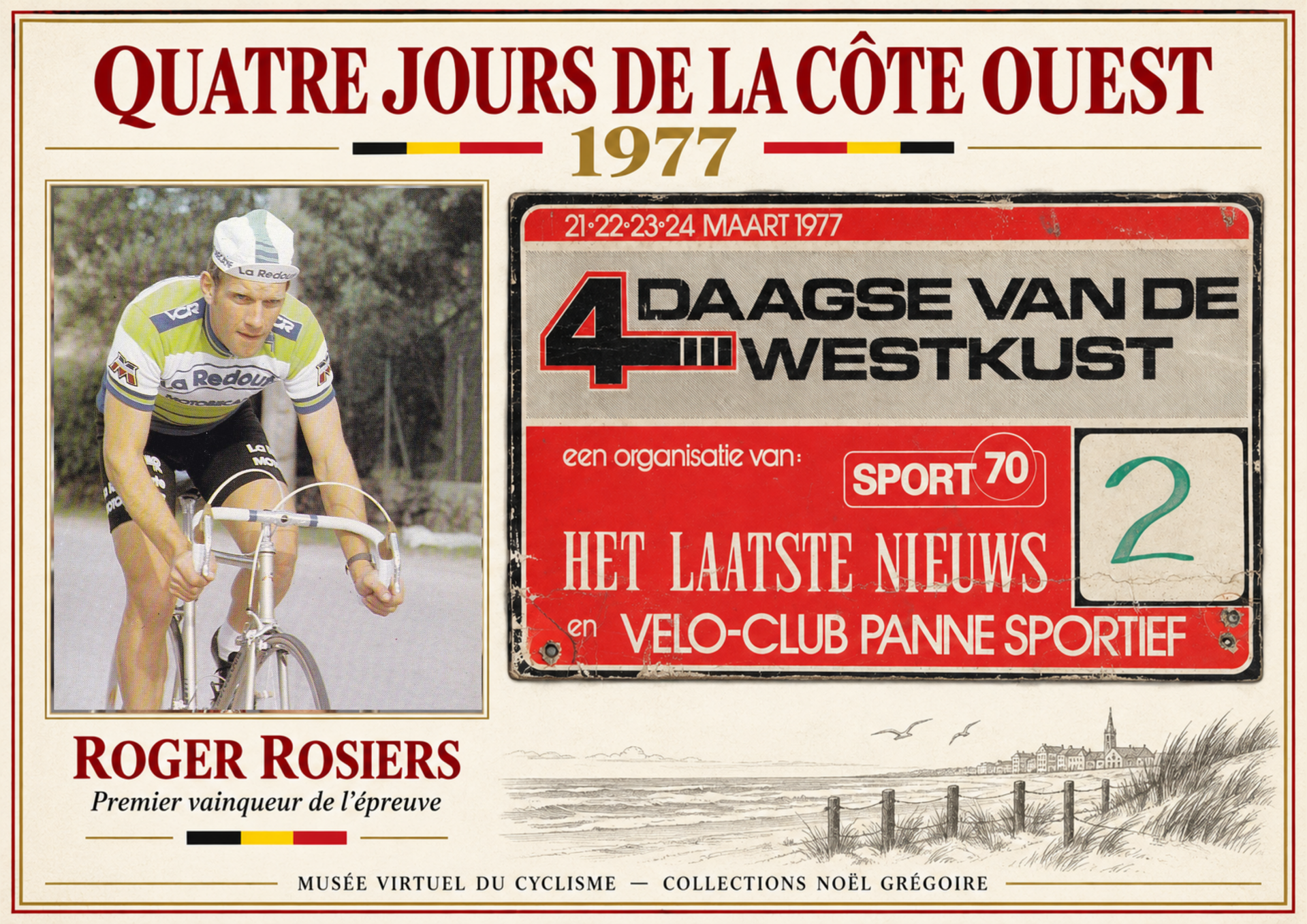
Official commemorative plaque for the 1977 West Coast Four-Day Race
This plaque relates to the first edition of the Vierdaagse van de Westkust, or Four Days of the West Coast, held in Belgium from 21 to 24 March 1977. This stage race, centred around La Panne, is the predecessor of the Three Days of La Panne, a race that has since become the Bruges–La Panne Classic.
The item bears the Dutch inscription ‘4 Daagse van de Westkust’, accompanied by the dates of the event. The references to Sport 70, Het Laatste Nieuws and Vélo-Club Panne Sportief highlight the joint role played by the sports press and local associations in organising this first edition.
The large number 2, inscribed in a designated space, was presumably used to identify a vehicle belonging to the organisers, the race management or the official support convoy. Given its size and visibility, this plate would have been affixed to the front or rear of a car authorised to travel within the race convoy.
The overall classification of this inaugural edition was won by the Belgian Roger Rosiers, ahead of the Frenchman Yvon Bertin and the Belgian Guido Van Sweevelt. Rosiers, who also won Paris–Roubaix in 1971, thus remains the first winner of the race that would become the Three Days of La Panne.
The yellow label bearing the number 25, visible in the top right-hand corner, appears to be an inventory or classification mark added at a later date, rather than part of the plate’s original design.
On display in the Virtual Cycling Museum – Noël Grégoire Collections, this item bears witness to the birth of a major event on the Flemish cycling calendar and preserves the memory of Roger Rosiers’ victory in its very first edition in 1977.
ITEM N° 674
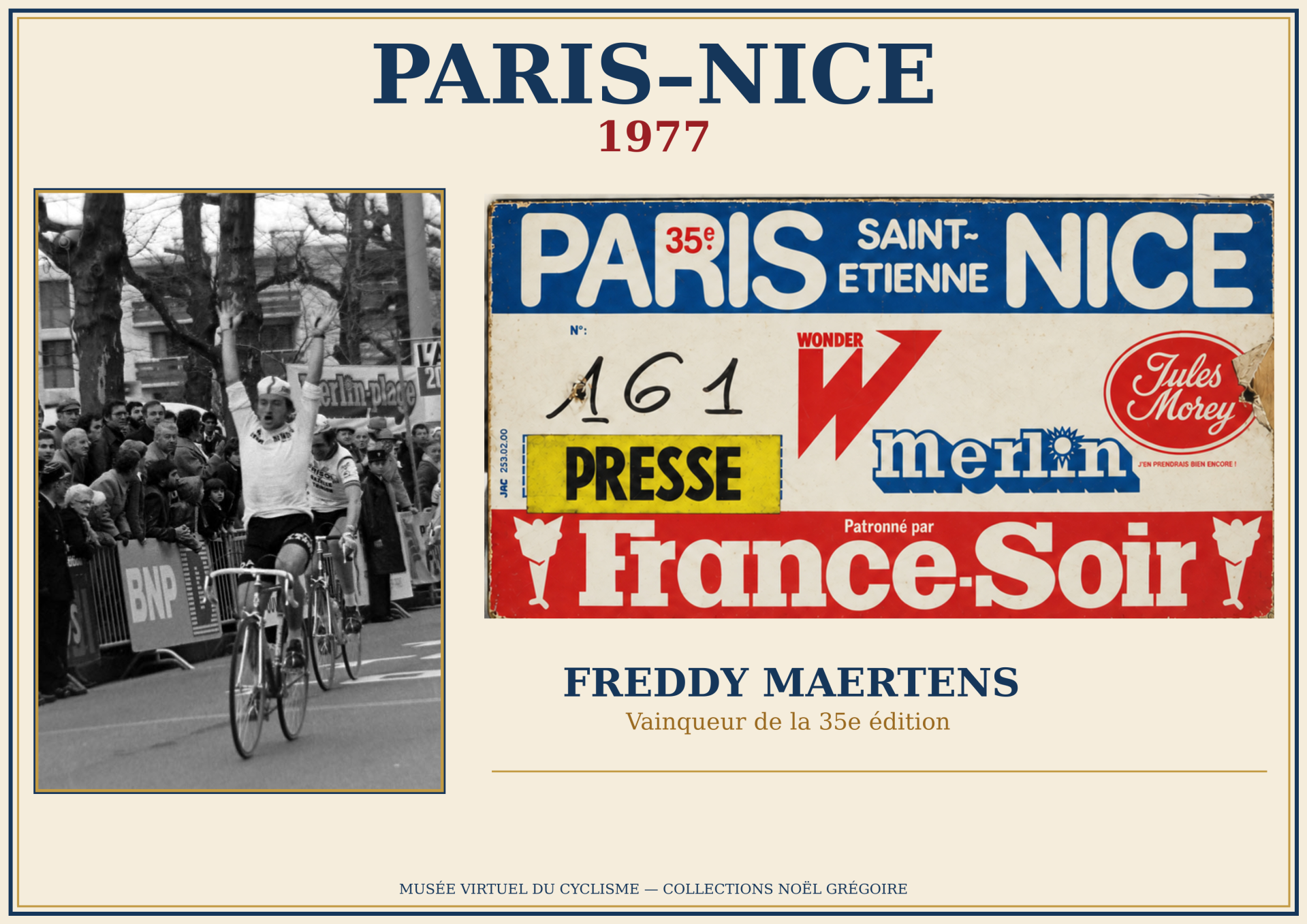
Paris–Nice press vehicle plaque – 1977
This number plate relates to the 35th edition of Paris–Nice, held from 10 to 17 March 1977. Nicknamed the ‘Race to the Sun’, that year’s race took the riders from the Paris region to Nice, passing through Saint-Étienne, amongst other places.
The top of the plate bears the inscriptions ‘Paris – Saint-Étienne – Nice’ and ‘35th’. The yellow ‘PRESSE’ banner, together with the handwritten number 161, suggests that this was likely a plate intended to identify an accredited vehicle carrying journalists or photographers within the official support convoy.
The brands Wonder, Merlin and Jules Morey, as well as the prominent ‘France-Soir’ inscription, bear witness to the role played by commercial partners and the press in the organisation and promotion of major cycling races in the 1970s. The newspaper France-Soir is listed here as a sponsor of the event.
The overall classification of the 1977 Paris–Nice was won by the Belgian Freddy Maertens, a member of the Flandria–Velda team. He finished ahead of the Dutchman Gerrie Knetemann and the Belgian Jean-Luc Vandenbroucke. The official historical results of Paris–Nice confirm Maertens’ victory in that edition.
Freddy Maertens put in a particularly remarkable performance: having won the prologue and several stages, he held the lead in the general classification right through to Nice. An archive photograph shows him crossing the finish line in Saint-Étienne wearing the white leader’s jersey.
On display in the Virtual Cycling Museum – Noël Grégoire Collections, this plaque is a valuable testament to the organisation of Paris–Nice, the work of the journalists covering the race, and Freddy Maertens’ victory during one of the most brilliant seasons of his career.
