

Plate's cars - 4
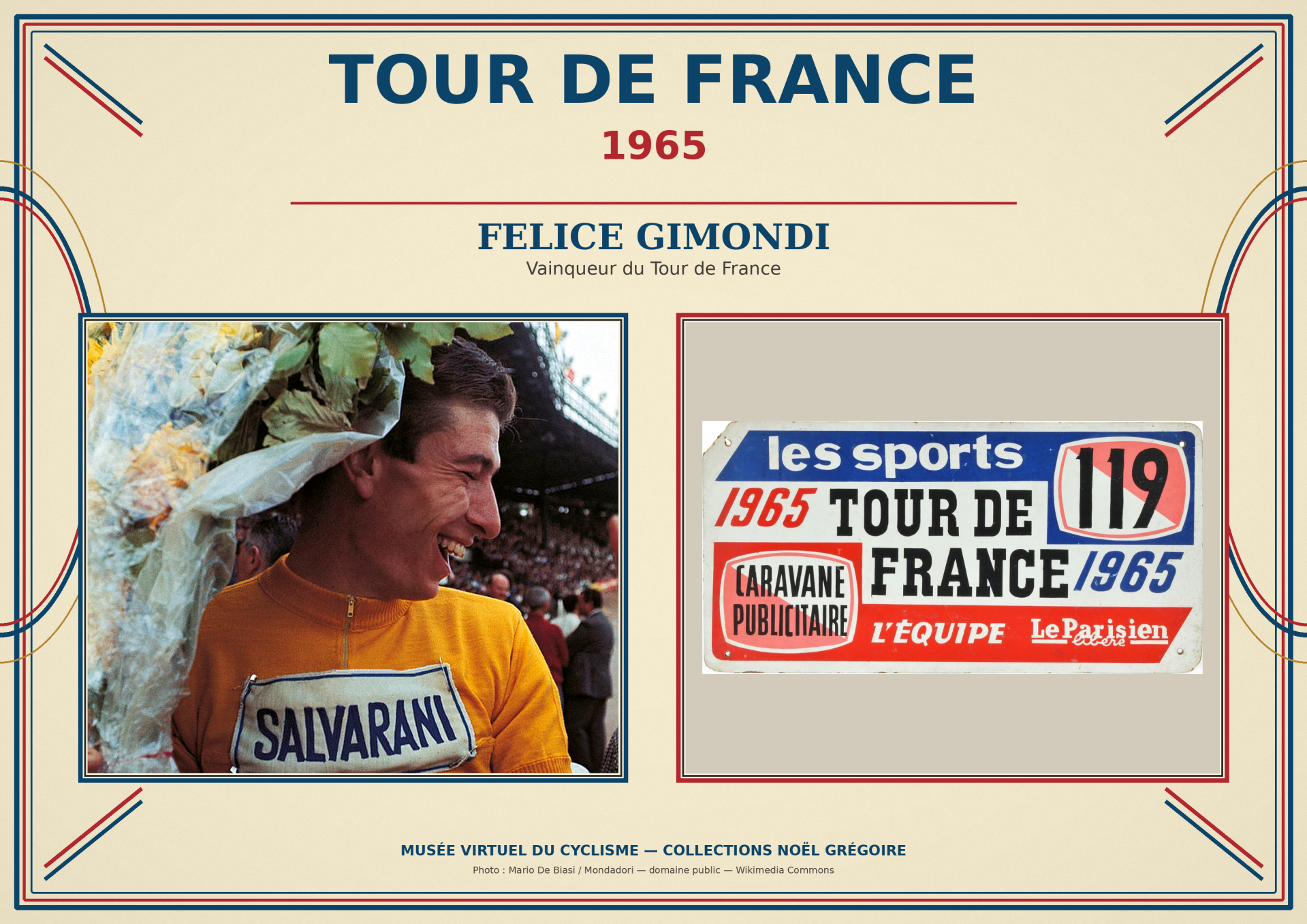
ITEM N° 669
Vehicle number plate from the 1965 Tour de France promotional convoy
This number plate relates to the 52nd edition of the Tour de France, which took place from 22 June to 14 July 1965. Starting in Cologne, Germany, the race reached Paris after 22 stages and a total distance of approximately 4,177 kilometres. It featured 130 competitors, 96 of whom were classified at the finish.
Made of metal, the plate bears the inscriptions ‘Tour de France 1965’, ‘Advertising Caravan’ and the number 119. It also features the names of three newspapers: the Belgian daily *Les Sports*, the sports newspaper *L’Équipe* and *Le Parisien libéré*. Its perforations allowed it to be attached to a vehicle taking part in the advertising convoy that preceded the riders along the route.
The convoy was already an essential part of the spectacle of the Tour. Comprising vehicles decorated in the colours of the newspapers and partner brands, it promoted them to the crowds lining the roadsides. This plate therefore served to identify and authorise one of these vehicles within the official procession.
The 1965 Tour de France was won by the Italian Felice Gimondi, a member of the Salvarani team. Initially selected as a team mate and entered into the race at the last minute, the 22-year-old rider took the yellow jersey from the very first days. He won three stages, including the final time trial between Versailles and Paris, and finished 2 minutes and 40 seconds ahead of Raymond Poulidor. Gianni Motta took third place, 9 minutes and 18 seconds behind.
This victory made Gimondi one of the youngest winners of the Tour and marked the start of an exceptional career. He went on to become the second rider in history, after Jacques Anquetil, to win all three major national tours: the Tour de France, the Giro d’Italia and the Vuelta a España.
On display in the Virtual Cycling Museum – Noël Grégoire Collections, this plaque bears witness to the popular appeal and promotional nature of the Tour de France in the 1960s. It preserves the memory of the race’s travelling circus and Felice Gimondi’s surprise victory on his debut in 1965.
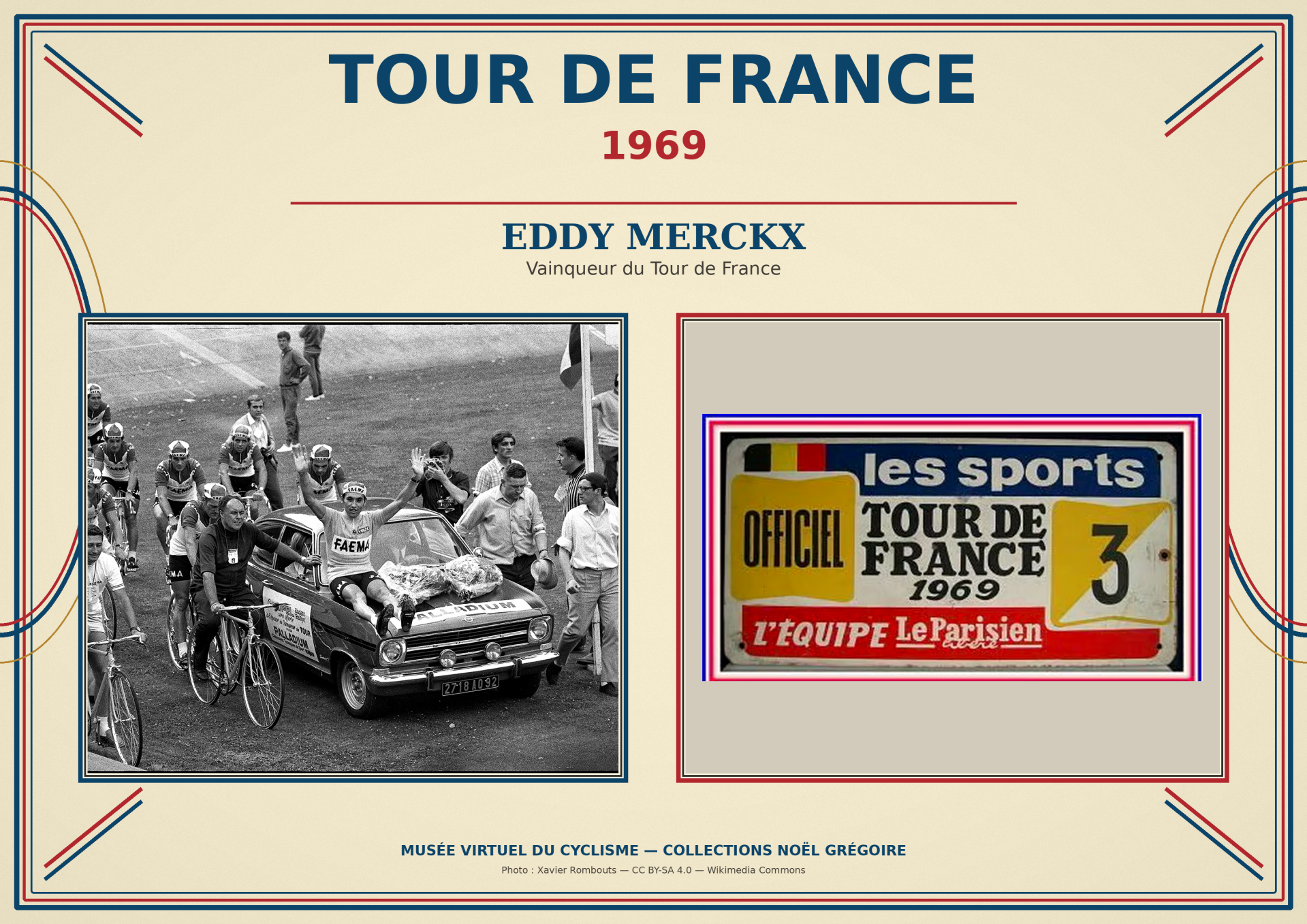
ITEM N° 670
Official vehicle number plate from the 1969 Tour de France
This number plate relates to the 56th edition of the Tour de France, which took place from 28 June to 20 July 1969. Starting in Roubaix, the race finished in Paris after 22 stages and a distance of approximately 4,117 kilometres. This edition remains famous for the exceptional dominance of Eddy Merckx, who was competing in his first Tour at the time.
The plate bears the words ‘Officiel’, ‘Tour de France 1969’ and the number 3, as well as the names of the newspapers *Les Sports*, *L’Équipe* and *Le Parisien libéré*. The Belgian flag likely refers to the origins of the newspaper *Les Sports*. Its format and perforations indicate that it was intended to be attached to an official vehicle accompanying the race.
These plaques were used to identify cars authorised to travel in the Tour convoy. They facilitated the work of the organisers, race officials, journalists and technical staff present on the route every day. The low number 3 suggests a vehicle occupying an important role within the organisation, although it is not possible to determine its exact function.
The 1969 Tour de France was won by the Belgian Eddy Merckx, a member of the Faema team. Winner of six individual stages, he finished 17 minutes and 54 seconds ahead of Roger Pingeon, whilst Raymond Poulidor took third place. Merckx also won the points, mountains, overall and combativity classifications, achieving a level of dominance that remains unrivalled in the history of the race.
Already a winner of the Giro d’Italia, Paris–Roubaix and several major classics, Eddy Merckx, aged 24, confirmed his status as an exceptional champion. His long-range attack during the Pyrenean stage between Luchon and Mourenx, which saw him finish nearly eight minutes ahead of his pursuers, remains one of the most famous feats of his career.
On display in the Virtual Cycling Museum – Noël Grégoire Collections, this plaque is a valuable record of the organisation of the Tour de France in the late 1960s. It highlights both the significant presence of the press in the official convoy and the first of Eddy Merckx’s five victories in the Tour de France.
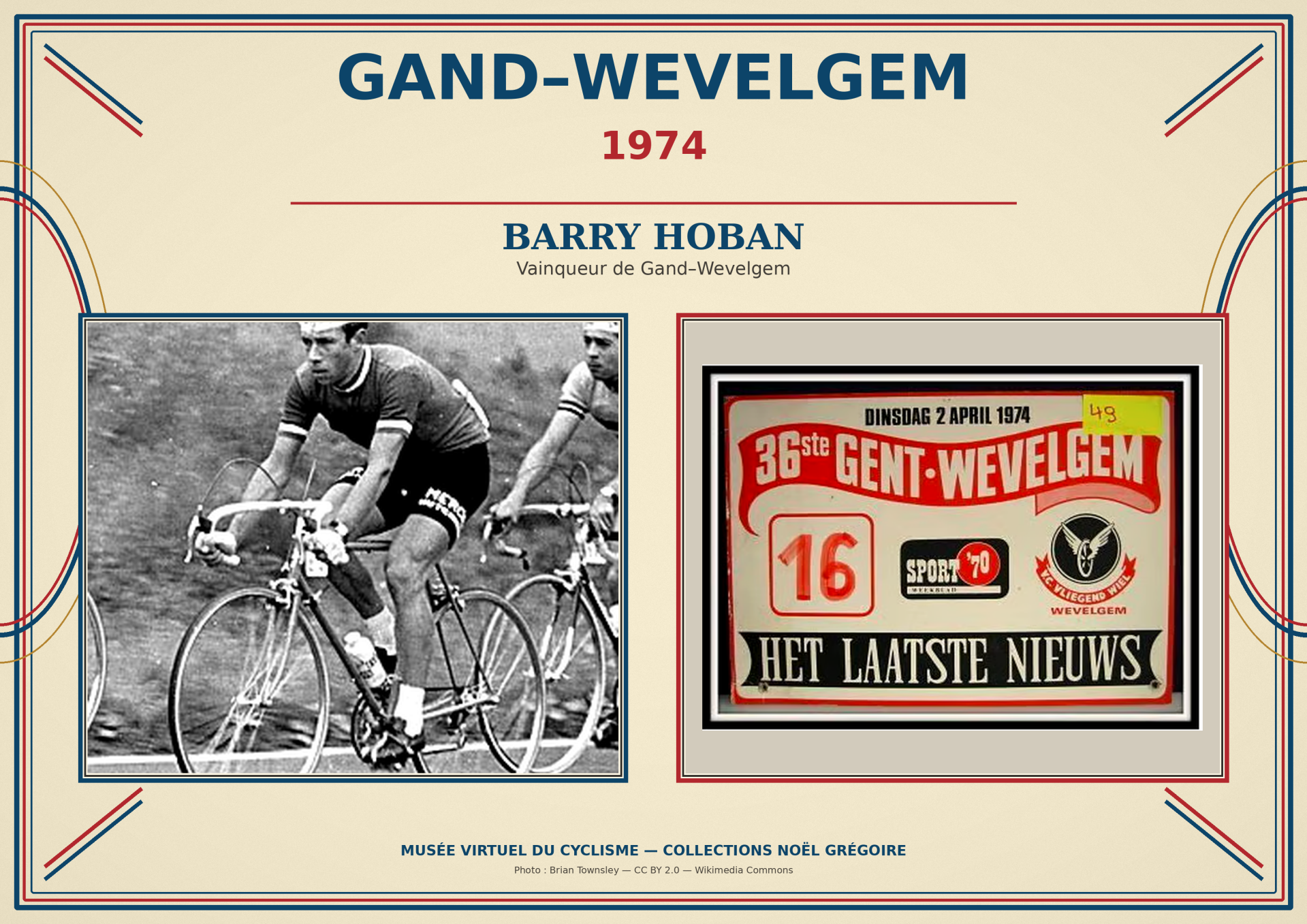
ITEM N° 671
Number plate from the 1974 Ghent–Wevelgem race
This number plate relates to Ghent–Wevelgem, a major Belgian classic first held in 1934. Held in West Flanders, the race is renowned for its wind-swept roads, cobbled sections and the climbs up Mount Kemmel. Its route traditionally favours powerful riders and sprinters capable of withstanding the challenges.
The item bears the Dutch inscriptions ‘Dinsdag 2 april 1974’ — Tuesday 2 April 1974 — and ‘36ste Gent-Wevelgem’, as well as the red number 16. It also features the emblems of Sport 70, the organising club Het Vliegende Wiel Wevelgem and the Flemish daily newspaper Het Laatste Nieuws. Its rigid format and perforations suggest that it was likely intended to identify an official vehicle, a press car or a support vehicle forming part of the race convoy.
The 36th edition of Ghent–Wevelgem was contested over a distance of 244 kilometres. The British rider Barry Hoban, a member of the Gan–Mercier–Hutchinson team, won after a sprint involving thirteen riders. He finished ahead of two of the greatest Belgian champions of the era: Eddy Merckx and Roger De Vlaeminck.
The winner’s time was 5 hours and 30 minutes. Hoban’s victory was a remarkable feat in a classic race largely dominated by Belgian riders. Indeed, he remains the first – and, for several decades, the only – British rider to have his name on the Ghent–Wevelgem roll of honour.
Born in Wakefield in 1940, Barry Hoban was one of the pioneers of British cycling on the continent. A fast sprinter and a particularly consistent rider, he won eight stages of the Tour de France between 1967 and 1975. He also achieved numerous podium finishes in the major classics, including third place in Paris–Roubaix in 1972.
There is some disagreement regarding the exact date of the race: some sources cite 9 April 1974. However, the period plaque clearly states ‘Tuesday 2 April 1974’, a date also recorded in several historical results lists. This inscription therefore constitutes a particularly interesting physical record of the event.
On display in the Virtual Cycling Museum – Noël Grégoire Collections, this plaque commemorates Barry Hoban’s prestigious victory in the 1974 Ghent–Wevelgem. It also bears witness to the vital role played by official vehicles, the Flemish press and the organising clubs in the running of the major Belgian classics.
