

Race car license plate - 1
This section presents a selection of number plates from support vehicles used in major cycle races.
Fitted to official vehicles, they served to identify the organisers, team managers, race officials, journalists and event partners.
Their numbers, colours, emblems and inscriptions bear witness to the organisation of the competitions and the importance of the motorcade.Often marked by wear and tear, knocks and mounting marks, they retain memories of their use on the roads.
Each number plate is placed in its historical context, with the year, the race in question and its winner.
These rare objects are now valuable testimonies to the history and heritage of cycling.
ITEM N° 660
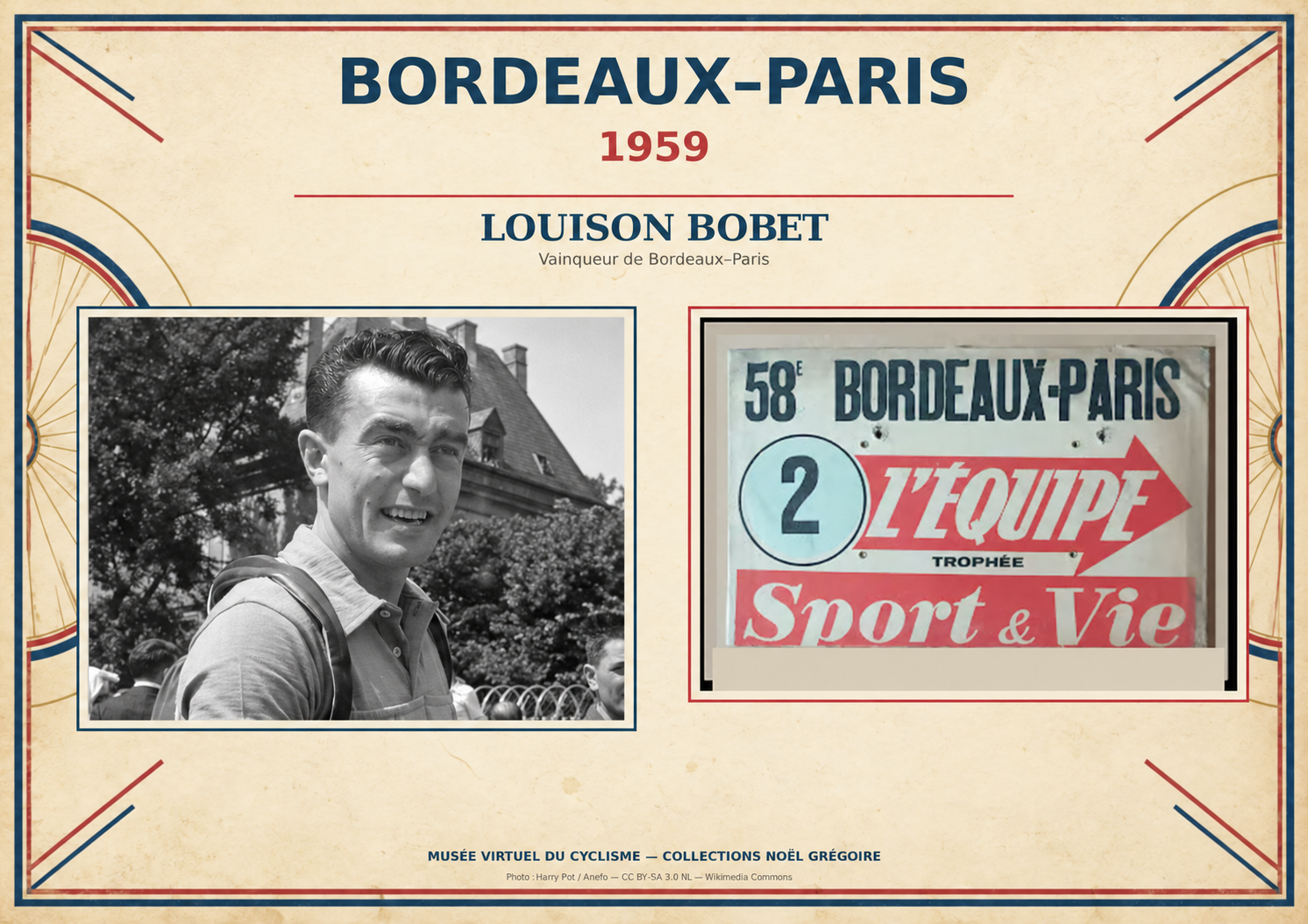
Number plate from the Bordeaux–Paris race, 1959
This number plate relates to the Bordeaux–Paris race, one of the oldest and longest classics in professional cycling. Established in 1891, this race ran from Bordeaux to the Paris region over a distance of approximately 560 kilometres. Its exceptional route made it a true endurance race, much of which was traditionally contested behind motorised pacemakers, and later behind Derny motorbikes.
The item bears the inscriptions ‘58th Bordeaux–Paris’, ‘L’Équipe’ and ‘Trophée Sport & Vie’, as well as the number 2. It was likely a plaque intended to identify an official vehicle or a support car for the race. It also serves as a reminder of the important role played by the daily newspaper *L’Équipe* and its partners in organising and promoting major post-war cycling competitions.
The inscription ‘58th Bordeaux–Paris’ links this plate to the 1959 edition. This corresponds to the race’s historical record: the 58th edition was won by the Frenchman Louison Bobet, riding for the L. Bobet–BP–Hutchinson team. Bordeaux–Paris winners’ list, biography of Louison Bobet
Already a three-time winner of the Tour de France in 1953, 1954 and 1955, world champion in 1954 and winner of several major classics, Louison Bobet took part in the Bordeaux–Paris for the first time in 1959. Despite suffering from digestive problems halfway through the race, he gradually caught up with the riders ahead of him before pulling away from them for good. This victory, secured at the end of a particularly gruelling race, was one of the final major successes of his illustrious career.
On display in the Virtual Cycling Museum – Noël Grégoire Collections, this plaque commemorates Louison Bobet’s victory in the 1959 Bordeaux–Paris race. It bears witness both to the prestige once accorded to this great endurance classic and to the logistical organisation surrounding the major cycling competitions of the era.
ITEM N° 661
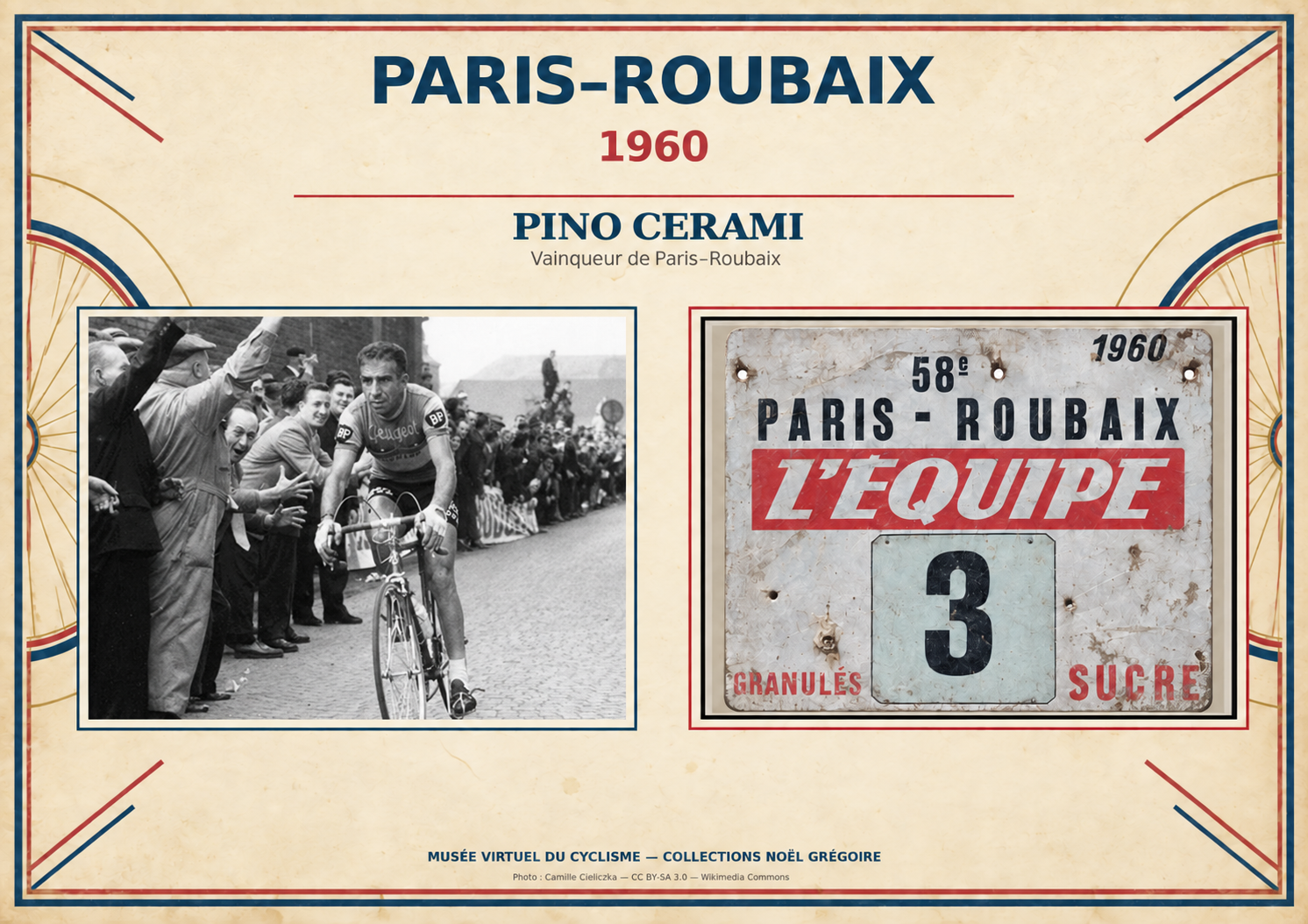
Number plate from a support vehicle at the 1960 Paris–Roubaix
This number plate relates to Paris–Roubaix, one of the oldest and most prestigious classics in professional cycling. Established in 1896, this race runs from the Paris region to Roubaix, traversing the gruelling roads and cobbled sections of northern France. Nicknamed ‘the Hell of the North’, it has become one of cycling’s iconic events thanks to its gruelling route, its cobbled sections and the often challenging weather conditions.
The object bears the inscriptions ‘58th Paris–Roubaix’, ‘L’Équipe’ and the number 3, as well as the advertising slogans ‘Granules’ and ‘Sucre’. It was most likely a plaque intended to identify one of the race’s official or support vehicles. It bears witness to the extensive logistical organisation that accompanied major cycling competitions, as well as to the role played by the sports press and commercial partners in promoting them.
The inscription ‘58th Paris–Roubaix’ links this plate to the race held on 10 April 1960. That year, the riders covered 262.5 kilometres between Compiègne and Roubaix. Victory went to the Belgian of Italian origin, Pino Cerami, a member of the Peugeot–BP–Dunlop team. Results of the 1960 Paris–Roubaix
Cerami broke away in the final kilometres and crossed the finish line alone after just over six hours of racing. He finished fourteen seconds ahead of the Frenchman Tino Sabbadini and fifty-five seconds ahead of the Spaniard Miguel Poblet. Aged nearly 38, he achieved one of the greatest feats of his career and remains one of the oldest winners in the history of Paris–Roubaix.
This victory confirmed Pino Cerami’s remarkable longevity as a professional cyclist. A well-rounded rider with exceptional stamina, he also won the Flèche Wallonne in 1960 and took the bronze medal at the 1963 Road World Championships. His name remains closely associated with the great Franco-Belgian cycling classics.
On display in the Virtual Cycling Museum – Noël Grégoire Collections, this plaque commemorates Pino Cerami’s victory in the 1960 Paris–Roubaix. With its signs of wear, mounting holes and inscriptions, it serves as a tangible record of the race’s organisation and the history of one of cycling’s most legendary events.

ITEM N° 662
Number plate from a support vehicle for the 1963 Paris–Brussels race
This number plate relates to Paris–Brussels, one of the oldest international classics in professional cycling. Established in 1893, this race linked the Paris region to the Belgian capital and was a major event on the Franco-Belgian calendar. Its long and demanding route favoured all-rounders, capable of sustaining the pace over the distance whilst maintaining sufficient speed for the finish.
The plaque bears the initials ‘LVB’ and ‘BWB’, corresponding to the French and Dutch names of the Belgian cycling federation: Ligue vélocipédique belge and Belgische Wielrijdersbond. It also features a stylised drawing of a bicycle frame, the number 28 and the words ‘49th Paris–Brussels’. The perforations at the four corners indicate that it was intended to be attached to an official vehicle or a support car involved in organising the race.
The inscription ‘49th Paris–Brussels’ links this plate to the race held on 28 April 1963. That year, the riders covered 289 kilometres between Paris and Brussels. Victory went to the Frenchman Jean Stablinski, a member of the Saint-Raphaël–Gitane–R. Geminiani team. He finished five seconds ahead of the Briton Tom Simpson and forty-eight seconds ahead of the Dutchman Peter Post. Results of the 1963 Paris–Brussels
The race was characterised by a breakaway forming within the first few kilometres. This group built up a considerable lead and maintained enough of a margin to contest the victory in Brussels. Tom Simpson appeared to be the best sprinter in the group, but a mechanical problem in the final stretch allowed Jean Stablinski to take the win. History of Paris–Brussels
This victory came whilst Stablinski was wearing the prestigious world champion’s jersey, which he had won in 1962. A four-time French champion and winner of the 1958 Vuelta a España, he was also one of Jacques Anquetil’s key team-mates. Renowned for his tactical intelligence and knowledge of the race, he was among the most consistent French riders of his generation.
On display in the Virtual Cycling Museum – Noël Grégoire Collections, this plaque commemorates Jean Stablinski’s victory in the 1963 Paris–Brussels. Its wear and tear, mounting marks and bilingual inscriptions bear witness to its use and to the international organisation behind this great Franco-Belgian classic.
