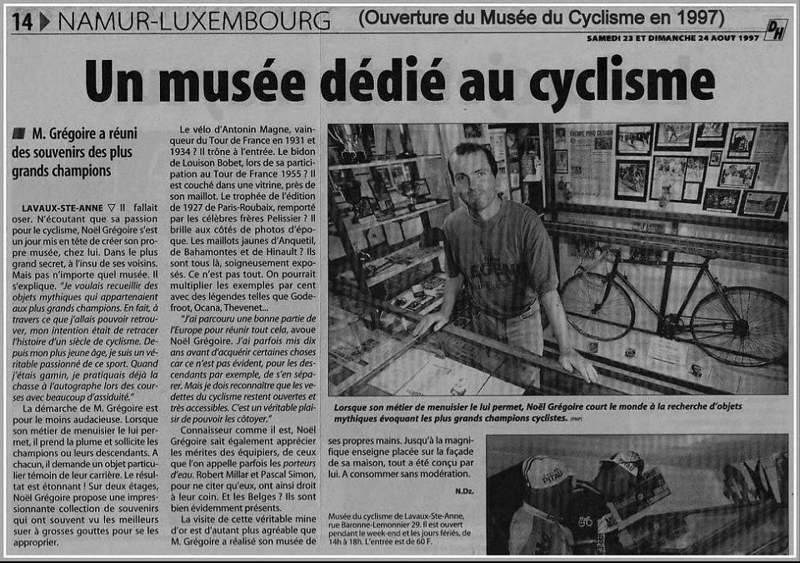
The print media - 1
Published in the newspaper *Le Soir* on 17 September 1997, under the headline ‘A museum dedicated to the kings of cycling, in Lavaux’, this article presents the Lavaux-Sainte-Anne Cycling Museum, which opened in the summer of 1997. The journalist describes a venue entirely fitted out by Noël Grégoire, a carpenter by trade, in order to share his passion for the history of cycling with the public.
This passion, which began in his childhood and was fuelled by his family’s enthusiasm for the exploits of Eddy Merckx, led Noël Grégoire to amass, over the years, a substantial collection of autographs, photographs, jerseys, bicycles, trophies and memorabilia linked to the greatest champions. The article highlights, in particular, items that belonged to the Pélissier brothers, Antonin Magne, Eddy Merckx, Bernard Hinault, Laurent Fignon, Luis Ocaña and Miguel Indurain.
The report also emphasises the painstaking research carried out with the riders, their families and foreign cycling federations in order to obtain these items and signatures. Among the most remarkable items is a Paris–Roubaix trophy won in 1921 by Henri and Francis Pélissier. Through this article, *Le Soir* highlights not only the richness of the collections, but also Noël Grégoire’s infectious passion and his determination to preserve and pass on the legacy of cycling.
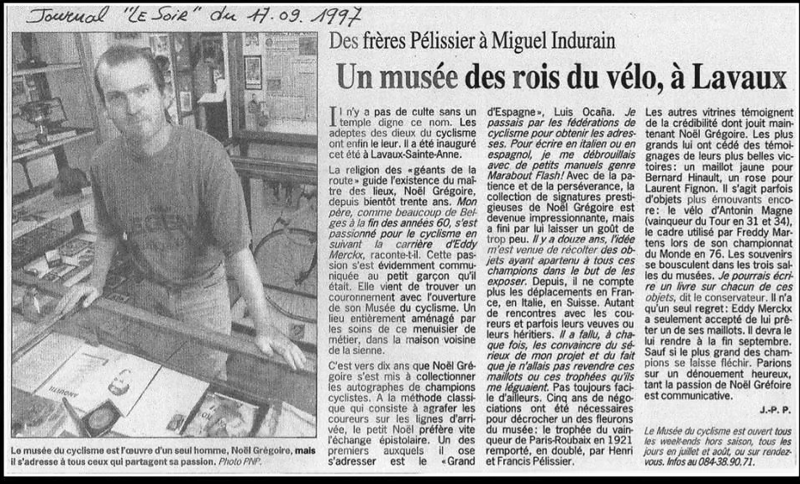
Published in the Namur-Luxembourg edition of *La Dernière Heure* on 23 and 24 August 1997, under the headline ‘A museum dedicated to cycling’, this article marks the opening of the Lavaux-Sainte-Anne Cycling Museum. It highlights the bold initiative of Noël Grégoire, who chose to create a space in his own home entirely devoted to the history of cycling and mementoes of the greatest champions.
The article traces this collector’s passion, which began in his childhood with his quest for autographs at cycling races. Over the years, Noël Grégoire has written to riders and their descendants, travelled across parts of Europe and sometimes waited many years before being able to acquire certain items. His aim was to bring together authentic artefacts capable of recounting a century of cycling and preserving the memory of its great figures.
Among the treasures on display are Antonin Magne’s bicycle – winner of the Tour de France in 1931 and 1934 – a water bottle used by Louison Bobet during the 1955 Tour, a Paris–Roubaix trophy, and yellow jerseys that belonged to Jacques Anquetil, Federico Bahamontes and Bernard Hinault. The journalist also points out that Noël Grégoire, a carpenter by trade, designed and fitted out his museum himself, thus offering the public a unique venue, born of a personal passion and remarkable research.