

The water bottles, caps, musettes and gloves - 11
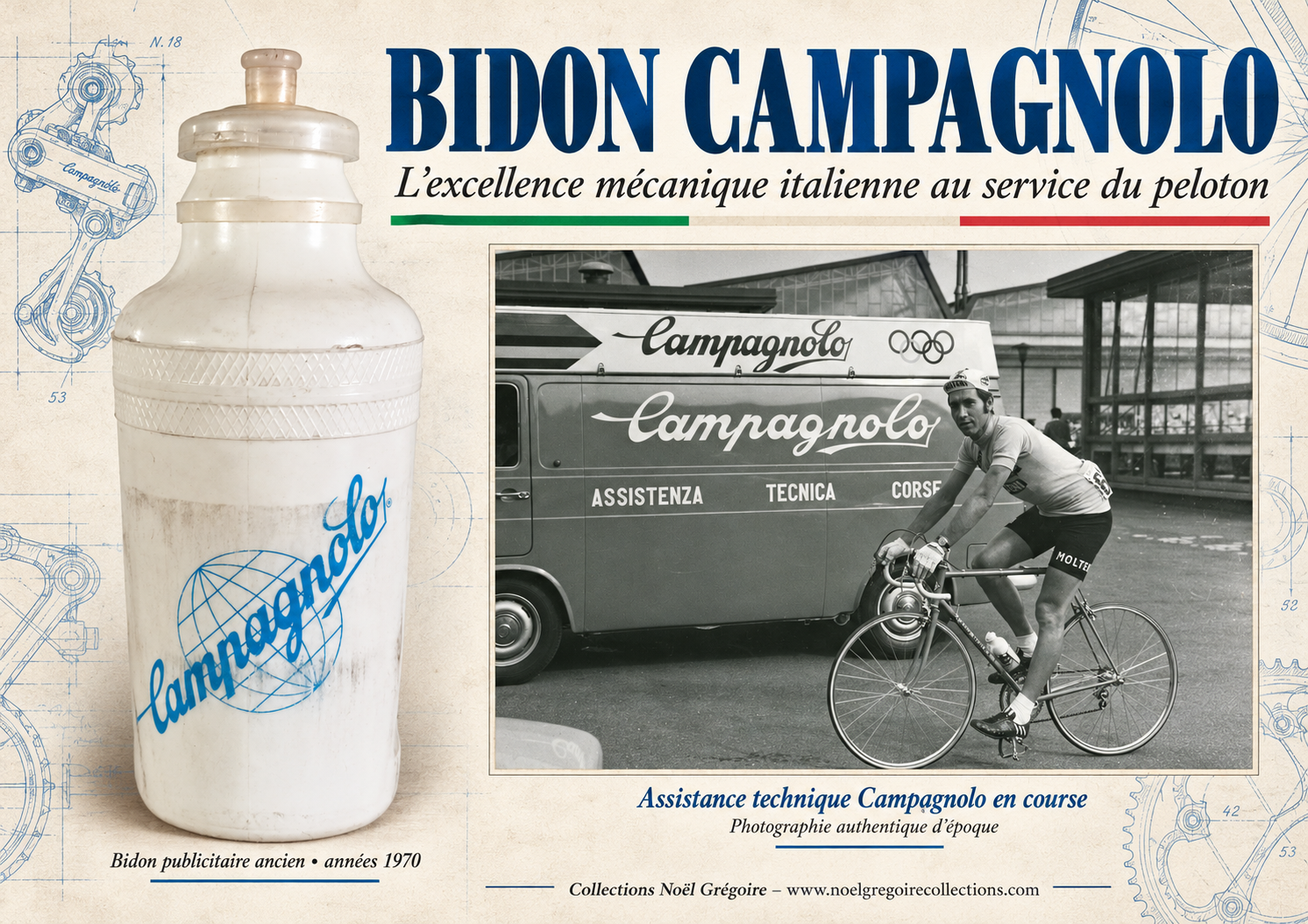
ITEM N° 739
"Campagnolo" water bottle from the 1970s
A presence in cycling since 1933
This vintage white plastic water bottle bears the name ‘Campagnolo’ in front of its historic emblem depicting a globe. This design, which appeared in the brand’s publications during the 1970s, suggests that this period is a likely date of manufacture.
The bottle has a cylindrical body, a rounded shoulder and two bands with criss-crossed raised patterns, making it easy to grip. Its valve cap allowed the cyclist to drink quickly whilst riding. The ageing of the plastic, the scratches and the wear to the markings bear witness to its age and fully contribute to its authenticity.
Founded in Vicenza in 1933 by Tullio Campagnolo, the Italian company established itself as one of the most prestigious manufacturers of components for competition bicycles. Its hubs, derailleurs, cranksets, brakes and wheels have been used by numerous teams and several generations of champions.
Campagnolo also provided technical support at races. Its vehicles, bearing the inscription ‘Assistenza Tecnica Corse’, transported mechanics, wheels and spare parts to assist riders using the brand’s equipment.
In the absence of any documentation establishing its specific provenance, this water bottle cannot be attributed with certainty to a particular rider or team. It should therefore be cautiously described as a Campagnolo promotional water bottle, likely dating from the 1970s.
Featured in the Virtual Cycling Museum – Noël GRÉGOIRE Collections, this object serves as a reminder of the vital role played by Campagnolo in the technical evolution of the racing bicycle and in the history of professional cycling.
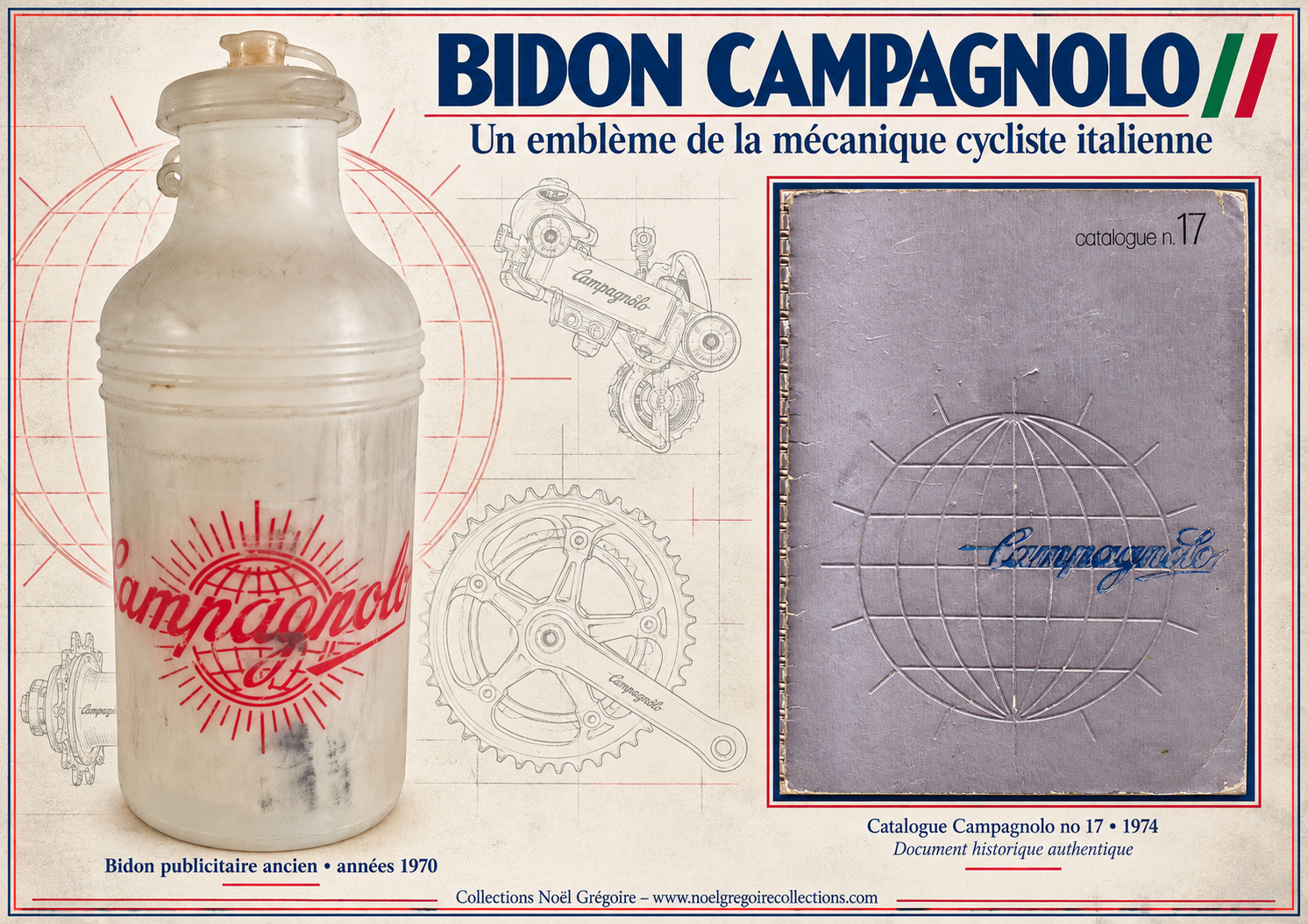
ITEM N° 740
"Campagnolo" water bottle from the 1970s
A presence in cycling since 1933
This vintage translucent plastic water bottle bears the name ‘Campagnolo’ in red against a globe surrounded by spokes. This emblem symbolised the international reach of the famous Italian cycling components manufacturer.
The same graphic design appears on the cover of Campagnolo catalogue no. 17, published in 1974. This correspondence makes it likely that the water bottle dates from the 1970s, although it is not possible to determine the exact year of manufacture.
The object has a cylindrical body, a rounded shoulder and several horizontal ribs reinforcing its structure. Its cap is attached to the neck by a flexible strap to prevent it from being lost during a race. The scratches, scuff marks, ageing of the plastic and wear on the markings bear witness to its age and contribute to its authenticity.
Founded in Vicenza in 1933 by Tullio Campagnolo, the company established itself as one of the most prestigious manufacturers of components for competition bicycles. Its hubs, derailleurs, cranksets, brakes and wheels have been used by numerous professional teams and several generations of champions.
In the absence of any documentation establishing its specific provenance, this water bottle cannot be attributed with certainty to a particular rider or team. It should be presented as a Campagnolo promotional water bottle, likely dating from the 1970s.
Housed in the Virtual Cycling Museum – Noël GRÉGOIRE Collections, it bears witness to Campagnolo’s presence in the peloton and to Italian mechanical excellence associated with competitive cycling.
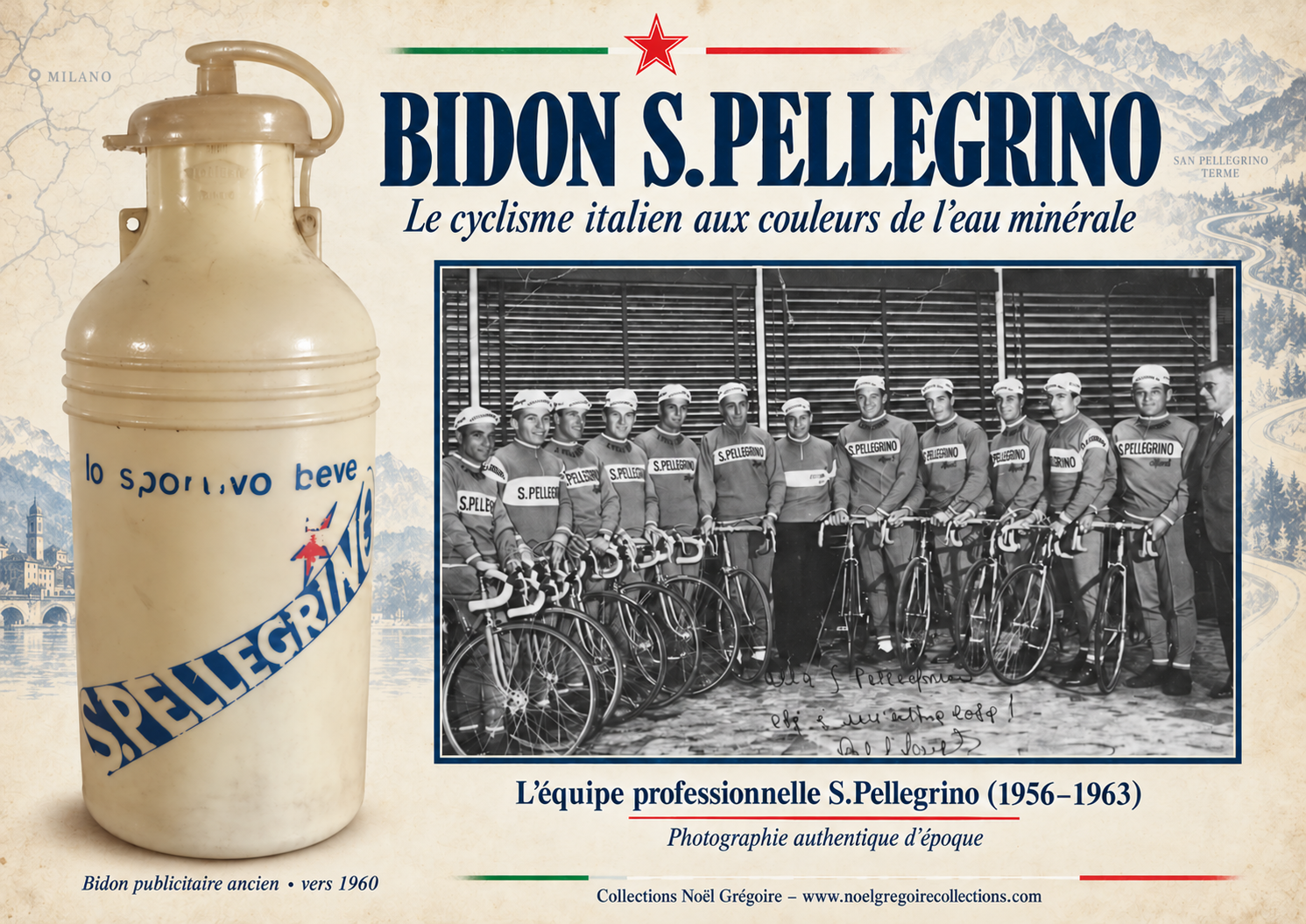
ITEM N° 74
"Etalo-Ventura" water bottle from the late 1960s
Seen in the peloton in 1968 and 1969
This vintage white plastic water bottle bears the names Etalo and Ventura in a particularly striking blue design. It is associated with a Belgian professional cycling team that was active for two seasons: Etalo–Ventura in 1968, then Etalo–Siriki–Ventura in 1969. The team was managed by Jef Braeckevelt.
The bottle has a cylindrical body, a rounded shoulder and several horizontal ribs to make it easier to grip. Its wide cap is secured to the neck by a flexible fastener to prevent it from being lost during the race.
Ventura was a Belgian bicycle brand spun off from the Bonaventure company, based in Veurne. It supplied the professional team in 1968 and 1969 before evolving, a few years later, into the Venturelli brand.
Among the riders who wore the team’s colours were Urbain De Brauwer, Emiel Lambrecht, Luc Delefortrie, René Heuvelmans, Yvan Verbiest and Willy Hoogewijs.
The discolouration of the plastic, the scratches and the signs of wear are important elements in the history of this water bottle. However, in the absence of any documentation establishing its specific provenance, it cannot be attributed with certainty to any particular rider.
Featured in the Virtual Cycling Museum – Noël GRÉGOIRE Collections, this water bottle is a rare physical artefact from a short-lived Belgian team and a testament to the richness of professional cycling in the late 1960s.
