

The water bottles, caps, musettes and gloves - 10
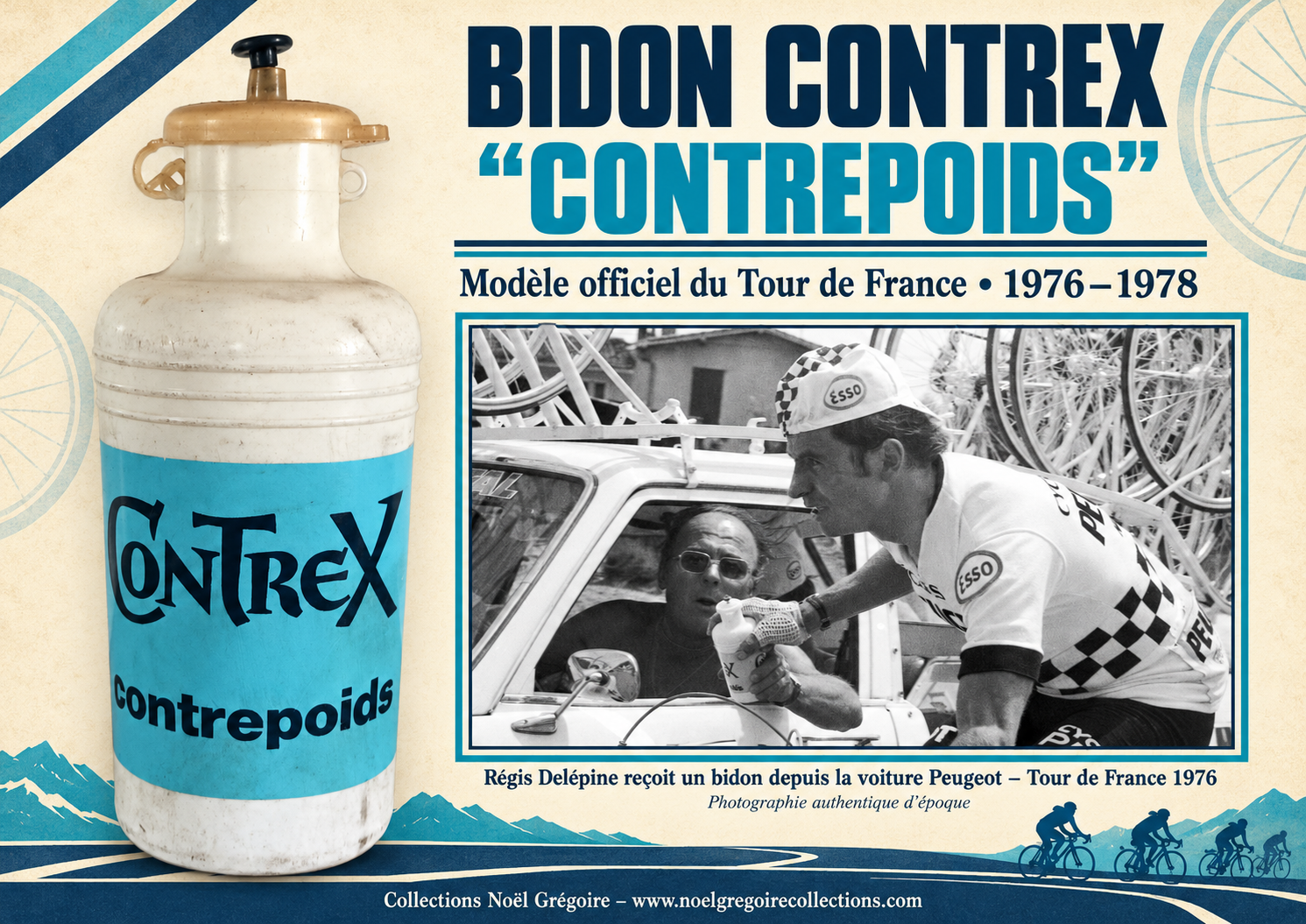
ITEM N° 736
"Contrex" water bottle used in the Tour de France
Used in the Tour de France from 1976 to 1978
This white plastic rider’s water bottle features a wide turquoise-blue band bearing the old Contrex logo and the word ‘Contrepoids’. This name referred to the brand’s advertising positioning, which at the time associated its mineral water with a balanced diet and weight control.
Designed to hold approximately half a litre, the bottle has a cylindrical body, rounded shoulders and several horizontal ribs. Its cap is fitted with a black push-button top and side clips designed to prevent it from being lost during the race. The scratches, dirt and wear and tear on the design bear witness to genuine and prolonged use.
This design corresponds to the model officially distributed at the Tour de France between 1976 and 1978. At that time, Contrex was the supplier of water bottles for the Tour de France, a role the brand held from 1975 to 1984. These bottles were prepared at refreshment stations, placed in riders’ bags or transported in the team managers’ cars.
Team members responsible for supplies would regularly return to their car to collect several water bottles before bringing them back to their teammates. The photograph accompanying the object thus shows Régis Delépine receiving a water bottle from the Peugeot car during the first stage of the 1976 Tour de France. The branding visible on the bottle handed to the rider corresponds to the period during which this Contrex model was in use.
Featured in the Virtual Cycling Museum – Noël Grégoire Collections, this water bottle serves as a tangible reminder of the water supply system on the Tour in the 1970s. It highlights the indispensable role of the water carriers and the close link that existed at the time between mineral water brands and the riders’ daily lives.
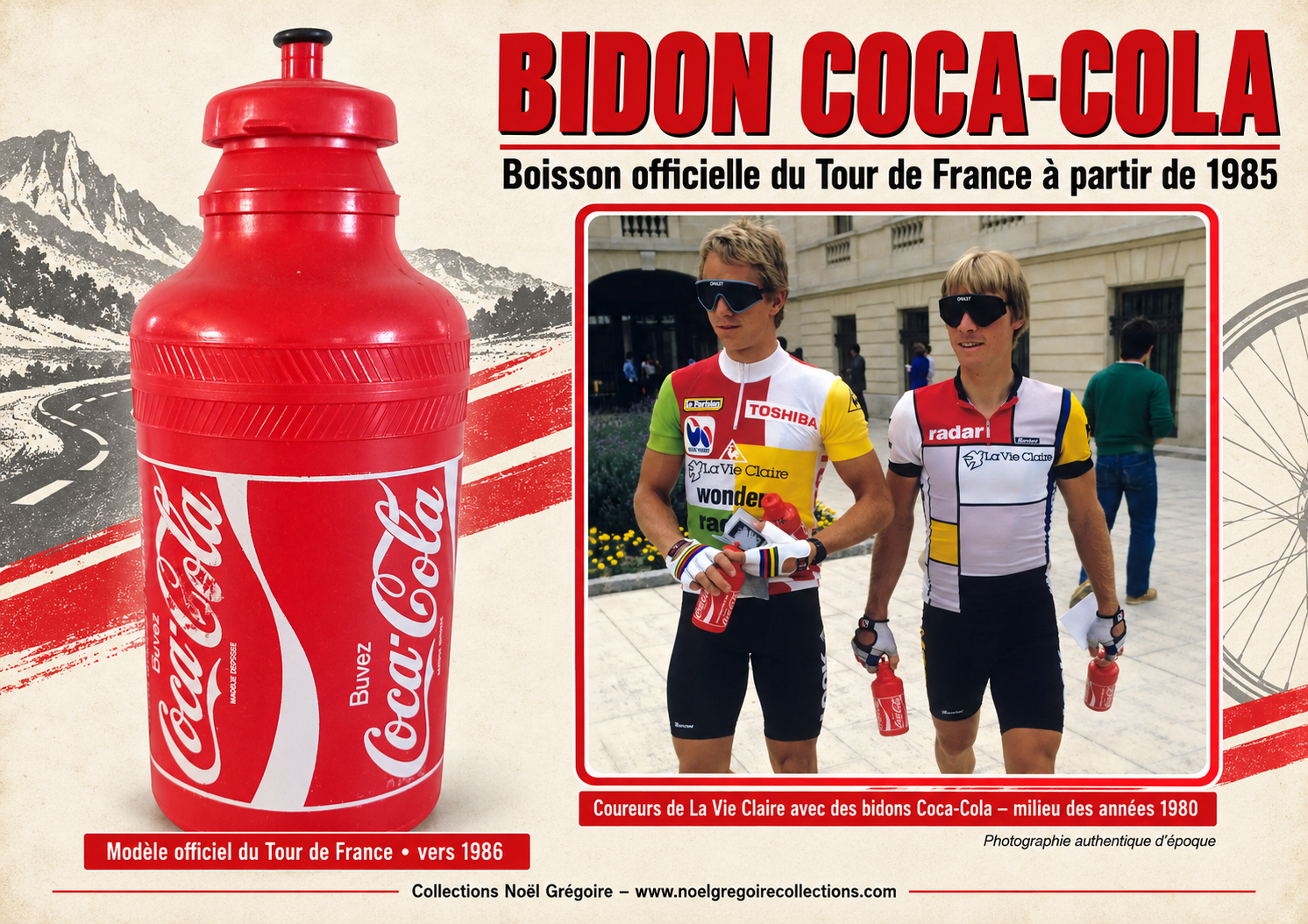
ITEM N° 737
"Coca-Cola" water bottle used in the Tour de France
Featured in the Tour de France from 1951 to 2009
This red plastic rider’s water bottle features the old white Coca-Cola design, accompanied by the bilingual words ‘Buvez’ and ‘Drink’. This design reflects the international dimension the Tour de France took on during the 1980s.
The bottle has a cylindrical body, rounded shoulders and two wide bands to make it easier to grip. Its cap is fitted with a black push-button nozzle that the cyclist could operate with their teeth without interrupting their effort. The scratches and partial wear to the design bear witness to its age and extensive use.
Coca-Cola’s presence on the Tour’s routes, however, predates this model by some time. The brand joined the advertising caravan as early as 1951, with vehicles tasked with distributing drinks and promotional items to the public. Archival documents also confirm the presence of a Coca-Cola supply lorry on the 1955 Tour. YouTube
A new chapter began in 1985, when Coca-Cola became the official drink and one of the major partners of the Tour de France. The red bottles, manufactured under licence by Spécialités T.A., were then distributed to riders in their musettes, at refreshment stations and from the team cars. Their bright colour quickly became a familiar sight in the peloton.
The brand also extended its visibility to the race classifications. In 1991 and 1992, Coca-Cola Light sponsored the King of the Mountains classification and had its name associated with the famous white jersey with red polka dots. fr.wikipedia.org
In 2001, Coca-Cola left the circle of major partners and withdrew from the race caravan in its most prominent form. The brand nevertheless remained a standard partner of the Tour and retained its status as the official drink until 2009. Just Food
On display in the Virtual Cycling Museum – Noël Grégoire Collections, this water bottle thus serves as a reminder of a history that began well before the 1980s. It bears witness to the provision of refreshments for the riders, the commercial evolution of the Tour and Coca-Cola’s enduring presence in the spectacle of the advertising caravan.
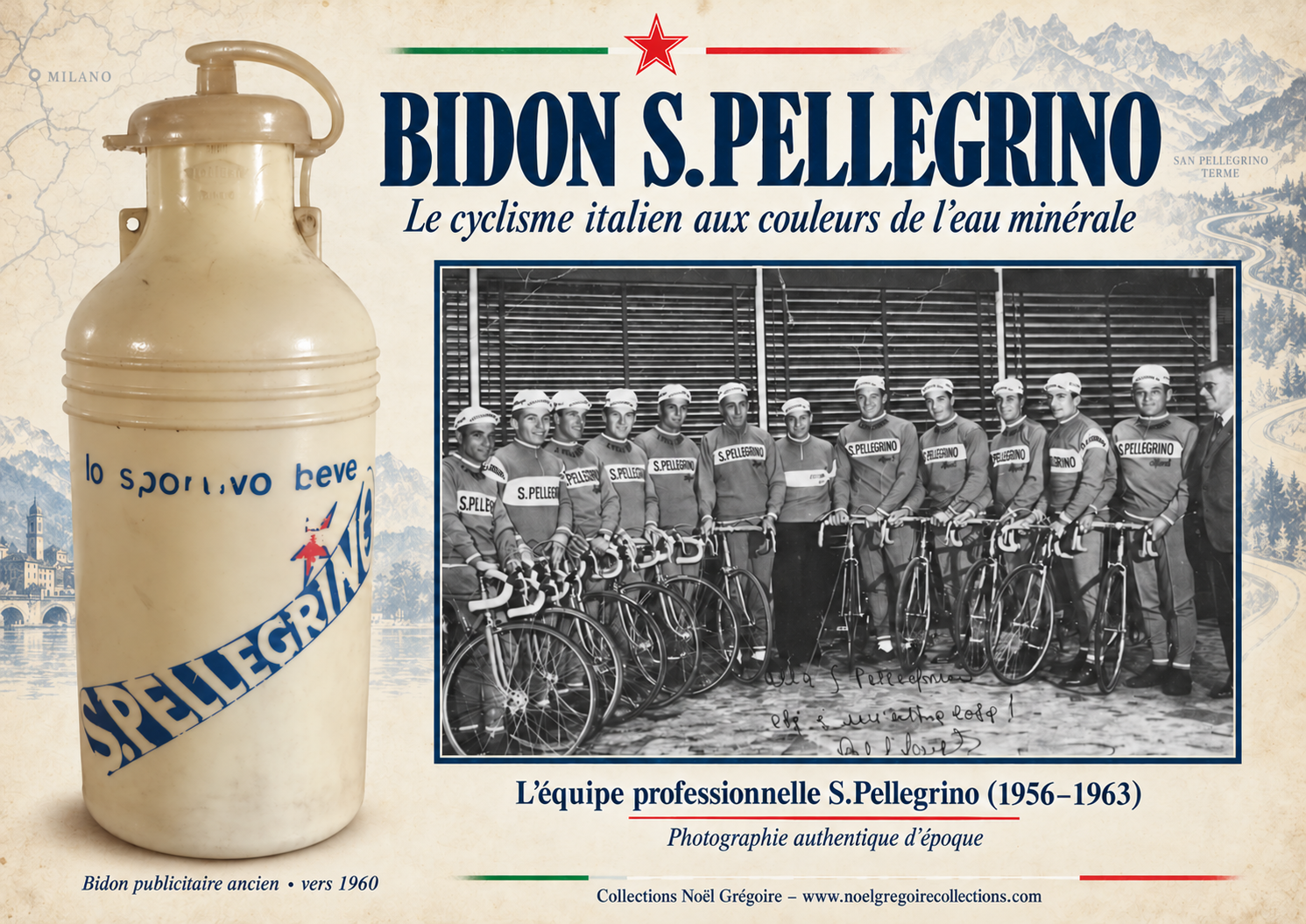
ITEM N° 738
"San Pellegrino" water bottle used around 1960
Featured in the peloton from 1956 to 1963
This vintage plastic water bottle features the historic branding of the Italian mineral water brand S.Pellegrino. Its design consists of a striking blue diagonal stripe, accompanied by the famous red star and part of the Italian slogan ‘Lo sportivo beve…’, which can be translated as ‘The sportsman drinks…’.
The bottle has an ivory-coloured cylindrical body, topped by a rounded shoulder and several horizontal ribs. Its cap, attached to the neck by a wide, flexible strap, allowed the cyclist to drink quickly whilst ensuring it would not be lost during the race. The fact that it is made of plastic reflects the period when this material was gradually replacing the old metal water bottles.
S.Pellegrino played a significant role in Italian cycling at the turn of the 1950s and 1960s. In particular, the brand lent its name to a professional team competing in the major events on the calendar and, on several occasions, in the Giro d’Italia. Riders such as Aldo and Enzo Moser, Marino Fontana, Franco Cribiori, Romeo Venturelli and Vincenzo Meco wore its colours. The team was also closely associated with Gino Bartali, who played a part in managing it.
The wear and tear on the branding, the scratches, the discolouration of the plastic and the marks left by use are essential elements of this water bottle’s history. They should not be regarded as mere signs of deterioration, but as tangible evidence of its age and its presence in the cycling world of the time.
The link with the S.Pellegrino professional team provides a particularly evocative historical context, although it does not allow us to state with certainty that this water bottle was necessarily used by one of its riders.
Featured in the Virtual Cycling Museum – Noël GRÉGOIRE Collections, this water bottle bears witness to the long-standing association between mineral water brands, riders’ hydration and sports sponsorship. Its patina, Italian design and distinctive shape make it a representative artefact of professional cycling in the second half of the 20th century.
