

The bikes - 1
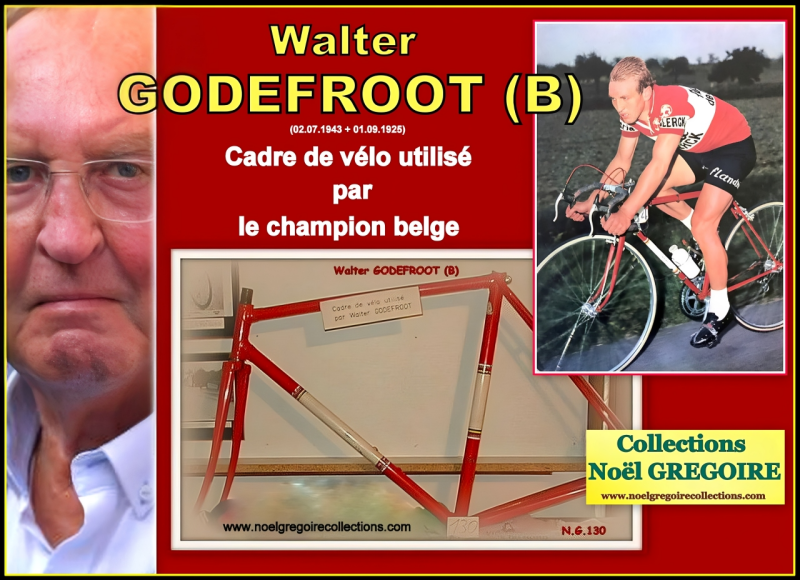
ITEM N° 130
GODEFROOT Walter (B)
(02.07.1943 – 01.09.2025)
Bicycle frame used by the Belgian champion
Born on 2 July 1943 in Ghent, Walter Godefroot was one of the finest Belgian cyclists of his generation. A professional from 1965 to 1979, he made a name for himself as a formidable sprinter and a specialist in the major classics.
Nicknamed ‘the Bulldog of Flanders’, he stood out for his power, his fighting spirit and his remarkable racing instinct. As early as 1964, whilst still an amateur, he won the bronze medal in the road race at the Tokyo Olympic Games.
His impressive list of victories includes, notably, Liège–Bastogne–Liège in 1967, Ghent–Wevelgem and the Tour of Flanders in 1968, Paris–Roubaix in 1969, and a second Tour of Flanders in 1978. He also became Belgian road champion in 1965 and 1972. Walter Godefroot also excelled in the Grand Tours. He won ten stages of the Tour de France and claimed the green jersey for the points classification in 1970. He also won one stage of the Giro d’Italia and two stages of the Vuelta a España.
The frame on display was used by Walter Godefroot during his career. Its red and silver finish, embellished with delicate patterns, evokes the characteristic aesthetic of racing bicycles from that era. Constructed from steel and assembled using tube joints, this frame bears witness to the traditional craftsmanship of bicycle manufacturers. Its sporty geometry and robust design met the demands of a powerful rider, capable of excelling both in sprints and on cobbled roads. The photographs pay tribute to the champion at different stages of his life.
After his racing career, Walter Godefroot became a renowned team manager. In particular, he played a key role within the Telekom team, one of the most influential teams in the professional peloton during the 1990s and 2000s.
Walter Godefroot passed away on 1 September 2025 at the age of 82, leaving behind the memory of a great classics champion and a man who devoted most of his life to cycling.
On display in the Virtual Cycling Museum – Noël GREGOIRE Collections, this frame is a valuable testament to Walter Godefroot’s career and the golden age of Belgian cycling.
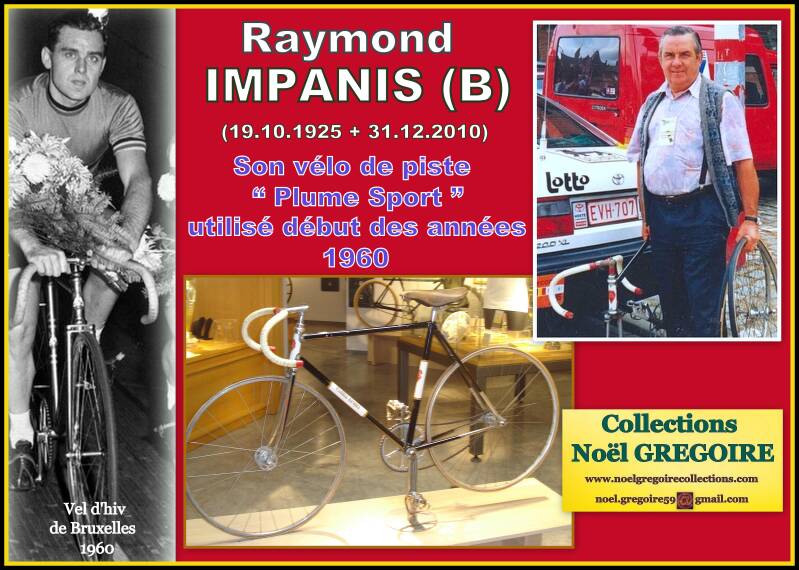
ITEM N° 149
IMPANIS Raymond (B)
(19.10.1925 – 31.12.2010)
His ‘Plume Sport’ track bike, used in the early 1960s
Born on 19 October 1925 in Berg, in Flemish Brabant, Raymond Impanis was one of Belgium’s great post-war champions. A professional cyclist from 1947 to 1963, he enjoyed a remarkable career on both the road and the track.
Nicknamed ‘the Baker of Berg’, Raymond Impanis stood out for his endurance, versatility and attacking style. He won numerous prestigious races, including Ghent–Wevelgem in 1952 and 1953, the Tour of Flanders and Paris–Roubaix in 1954, as well as the Flèche Wallonne in 1957. A regular feature in major stage races, he competed in several Tours de France, winning three stages. He also excelled in Paris–Nice, winning the race four times – in 1954, 1960, 1961 and 1962 – a record that remained unbroken for many years. Alongside his road racing career, Raymond Impanis competed in numerous track events. Like many champions of his era, he performed at velodromes and took part in events that were hugely popular with the Belgian public.
The bicycle on display is an elegant ‘Plume Sport’ track bike, used by Raymond Impanis in the early 1960s. Its black frame, devoid of brakes and derailleurs, reflects the minimalist design typical of bicycles intended for velodrome competitions. The bicycle is fitted with track handlebars wrapped in white handlebar tape, a leather saddle and tubular tyres. Its fixed gear provides direct power transfer, an essential feature of machines designed for speed and track racing.
The photographs depict two periods in the champion’s life. On the left, Raymond Impanis is pictured on his bike at the Vélodrome d’Hiver in Brussels in 1960. On the right, he poses many years later alongside the very same bicycle, which has been carefully preserved as a testament to his career.
Featured in the Virtual Cycling Museum – Noël GREGOIRE Collections, this ‘Plume Sport’ track bike is a remarkable memento of Raymond Impanis and of an era when the great road racers also thrilled audiences at the velodromes.
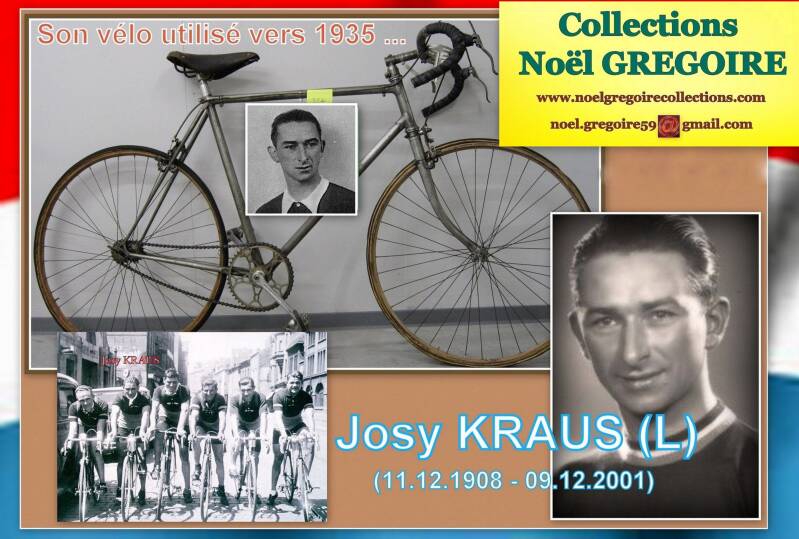
ITEM N° 384
KRAUS Josy (L)
(11.12.1908 – 09.12.2001)
His road bike used around 1935
Born on 11 December 1908 in Grevenmacher, Josy Kraus was a Luxembourgish cyclist who competed during the 1920s, 1930s and 1940s. Turning professional in 1933, he enjoyed success in road cycling, cyclo-cross and track events.
A particularly versatile rider, he became Luxembourg cyclo-cross champion in 1928, 1930 and 1931. He also won the national road championship in the independent category four times, from 1931 to 1934. His major successes included the Tour de Lorraine and Paris–Houlgate in 1931, Strasbourg–Metz, Brussels–Anseremme and Colmar–Strasbourg in 1932, and Nancy–Verdun–Nancy in 1935. He also finished seventh in the professional road world championships held in Leipzig in 1934. Josy Kraus took part in the Tour de France in 1936, but was forced to withdraw before reaching the finish in Paris. He also competed in the first Tour de Luxembourg, held in 1935, riding for the Peugeot–Dunlop team.
The bicycle on display is believed to have been used by Josy Kraus around 1935. Its steel construction, its frame assembled using connectors, and its wheels fitted with wooden rims are indicative of the techniques employed for competition bicycles during the interwar period. The bicycle features deeply curved racing handlebars, a leather saddle and particularly minimalist fittings. Its exposed controls and cables, together with the simplicity of its drivetrain, are reminiscent of an era when riders competed in long races on often challenging roads using robust yet unadorned equipment.
The photographs help to place this bicycle in its historical context. The central portrait and the one on the right show Josy Kraus during his career, whilst the photograph at the bottom of the poster shows him in the midst of a group of Luxembourgish cyclists.
Josy Kraus also distinguished himself in middle-distance races as a pacemaker. In 1938, he took part in the Track World Championships in Amsterdam, where a serious fall brought his race to an end and left him seriously injured. He nevertheless continued his career in the years that followed before retiring from competition after the Second World War.
Featured in the Virtual Cycling Museum – Noël GREGOIRE Collections, this bicycle, used around 1935, is a valuable testament to Josy Kraus’s career and the early golden years of Luxembourg cycling.
