

The trophies - 25
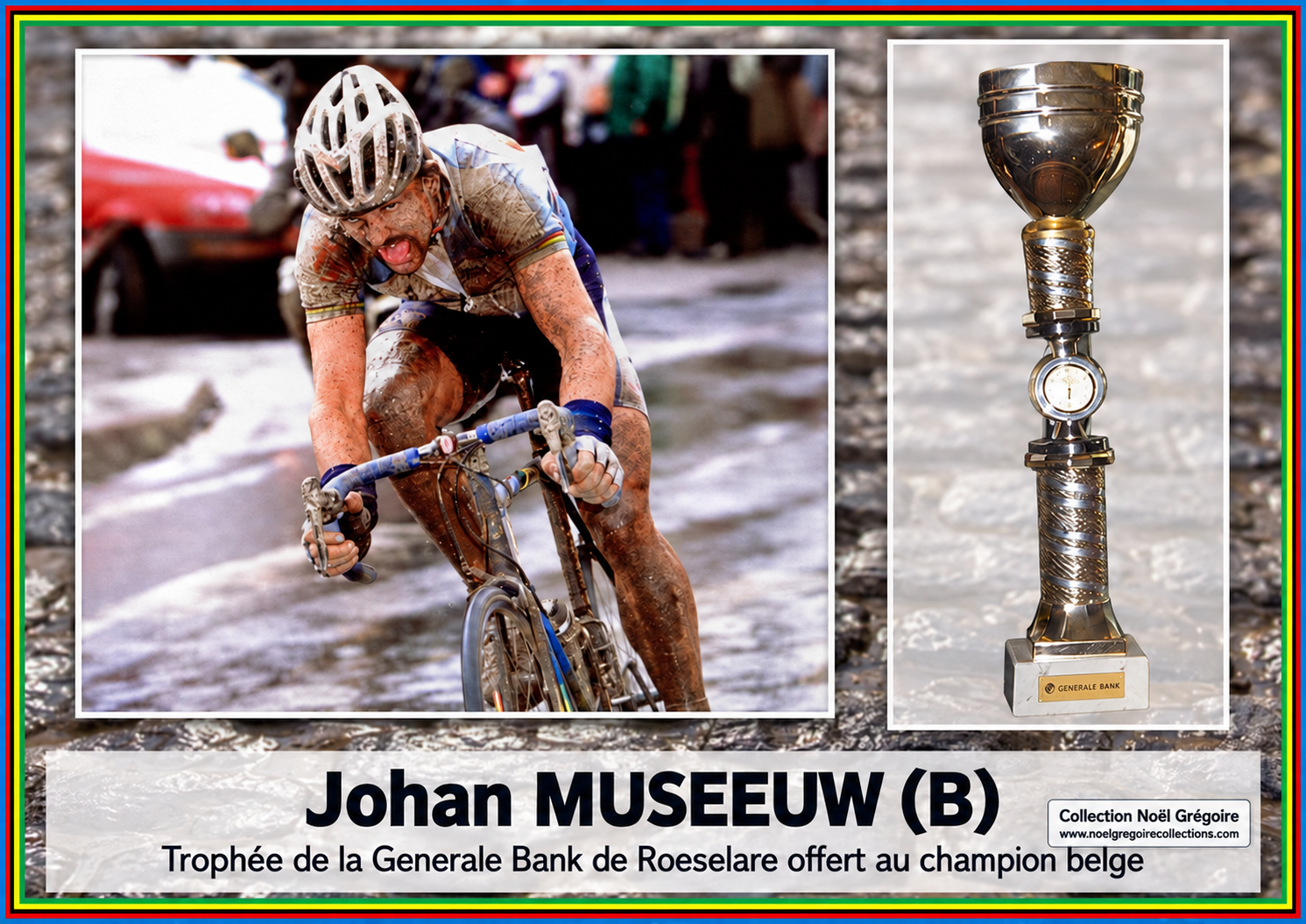
ITEM N° 211
Johan MUSEEUW (B)
(13.10.1965)
Trophy bearing the inscription ‘Generale Bank’
Born on 13 October 1965 in Varsenare, West Flanders, Johan Museeuw is a former Belgian professional cyclist. A professional from 1988 to 2004, he is regarded as one of the greatest classics specialists in the history of cycling.
Initially recognised for his sprinting abilities, he made his mark at the very highest level during the 1990 season. Riding for Lotto, he won two stages of the Tour de France, including the prestigious finish on the Champs-Élysées. He also finished second in the points classification for that edition. Over the seasons, Johan Museeuw transformed his profile from that of a sprinter into that of a formidable classics rider. Nicknamed the ‘Lion of Flanders’, he built up one of the most impressive lists of victories of his generation. He won the Tour of Flanders three times, in 1993, 1995 and 1998, as well as Paris–Roubaix in 1996, 2000 and 2002. His racing acumen, his power on the cobbles and his ability to hold on in the most gruelling conditions made him a leading figure in Belgian cycling. On 13 October 1996, on his thirty-first birthday, Johan Museeuw became world road champion in Lugano, Switzerland. This victory earned him the rainbow jersey and marked one of the high points of his career.
The item on display is a trophy awarded to Johan Museeuw which, according to the accompanying information, originates from Roeselare. It takes the form of a tall metal award comprising a rounded cup resting on a decorated column. The body of the trophy alternates between smooth surfaces and ringed sections that emphasise its verticality. A circular section, situated in the middle of the column, resembles the shape of a medal and lends the whole piece a sporting and honourable character. The trophy rests on a light-coloured rectangular plinth bearing the inscription ‘Generale Bank’. This reference likely denotes the bank that commissioned, presented or sponsored the awarding of this trophy. The stated provenance of Roeselare could correspond to a reception, a sporting event or a tribute organised in that city. However, no documents have yet been found to establish with certainty the exact date and circumstances of the trophy’s presentation.
Displayed in the Virtual Cycling Museum – Noël GREGOIRE Collections, this trophy stands as a tangible testament to the many honours received by Johan Museeuw. It keeps alive the memory of the ‘Lion of Flanders’, world champion and master of the cobbles, whose achievements left a lasting mark on Belgian cycling.

ITEM N° 214
Wilfried NELISSEN (B)
(05.05.1970)
His winner’s trophy from the 1994 Ridder "Ronde of Maastricht"
Wilfried Nelissen is a former Belgian cyclist. A professional during the 1990s, he was best known for his remarkable sprinting ability.
Nicknamed ‘Jerommeke’, he possessed a particularly powerful burst of speed in the final metres. His attacking style and ability to position himself well in bunch sprints enabled him to become one of the best Belgian sprinters of his generation. In 1992, he won the Grand Prix de l’Escaut and played a part in his Panasonic team’s victory in the team time trial at the Tour de France. The following season confirmed his rise to the very highest level. In 1993, Nelissen won the Circuit Het Volk, Le Samyn and three stages of the Tour of the Netherlands. In the Tour de France, he won the second stage and wore the yellow jersey for three days. The year 1994 was one of the most brilliant of his career. He won the Circuit Het Volk once again, became Belgian road champion and racked up stage victories, notably at the Four Days of Dunkirk, the Étoile de Bessèges, the Tour Méditerranéen and the Tour of Asturias. In 1995, Wilfried Nelissen retained his Belgian championship title. Further stage victories were added to his list of achievements, but several crashes and injuries eventually disrupted his career. He retired from professional cycling in the late 1990s.
In August 1994, Wilfried Nelissen won the tenth edition of the Ridder Ronde in Maastricht, the Netherlands. Established in 1985, the Ridder Ronde is a professional criterium held on the streets of Maastricht. Its name derives from the local Ridder brewery, which sponsored the event at the time.
The item on display is the trophy awarded to Wilfried Nelissen for his victory in the 1994 edition. A plaque affixed to its base bears the inscription: ‘Winnaar – 10th Ridder Ronde – Maastricht – 1994’. The trophy takes the form of a tall metal cup with a gold finish. Its slightly flared body is framed by two large, elegantly curved handles, the design of which adds a decorative touch to the whole.
Presented in the Virtual Cycling Museum – Noël GREGOIRE Collections, this trophy commemorates a victory achieved during the peak of Wilfried Nelissen’s career. It bears witness to the career of an explosive sprinter, twice Belgian professional champion and wearer of the yellow jersey in the Tour de France. The cup rests on a slender stem attached to a quadrangular plinth with a mineral-like appearance.

ITEM N° 216
Jan NEVENS (B)
(26.08.1958)
Trophy of unknown origin presented to Jan Nevens
Born on 26 August 1958 in Ninove, East Flanders, Jan Nevens is a former Belgian professional cyclist. A professional from 1980 to 1995, he stood out for his endurance, versatility and ability on hilly courses.
During his long professional career, Jan Nevens rode for several major teams, including Boston, Europ Décor, Splendor, Kwantum, Lotto, Sigma, Histor and Vlaanderen 2002. He took part in eight Tours de France between 1981 and 1993.
In 1986, he won a stage of the Tour de Romandie. Two years later, riding for the Sigma-Fina team, he enjoyed one of the finest seasons of his career. In February 1988, Jan Nevens won the general classification of the Tour Méditerranéen ahead of the French riders Charly Mottet and Luc Leblanc. This victory in an international race held on the roads of the south of France was his greatest success in a stage race at that time. A few months later, he also won a stage of the Tour of Asturias, at the summit of the Alto del Naranco. During the 1988 Tour de France, he finished second in the stage finishing in Limoges and came sixty-first in the general classification. His career was also marked by two stage victories in 1991, at the Tour of Trentino and the Tour de Suisse. On 12 July 1992, he won the eighth stage of the Tour de France in Koblenz, which had started in Valkenburg. This victory represented the highlight of his participation in the Tour de France.
The item on display is a trophy that belonged to Jan Nevens. In the absence of a legible inscription, a commemorative plaque or any accompanying documentation, the competition or ceremony to which it relates cannot currently be determined. However, the lack of precise identification means it should not be arbitrarily associated with any particular victory.
The central photograph shows Jan Nevens seated next to the trophy. It establishes a direct link between the cyclist and the object, whilst not enabling us to ascertain the exact circumstances of its presentation. It thus constitutes a valuable record of provenance.
On display in the Virtual Cycling Museum – Noël GREGOIRE Collections, this trophy preserves the memory of Jan Nevens’s long career. Despite its as yet undetermined origin, it serves as a reminder of the career of a consistent and courageous cyclist, winner of the Tour Méditerranéen and a stage of the Tour de France.
