

Race vehicle identification plates - 20
ITEM N° 709
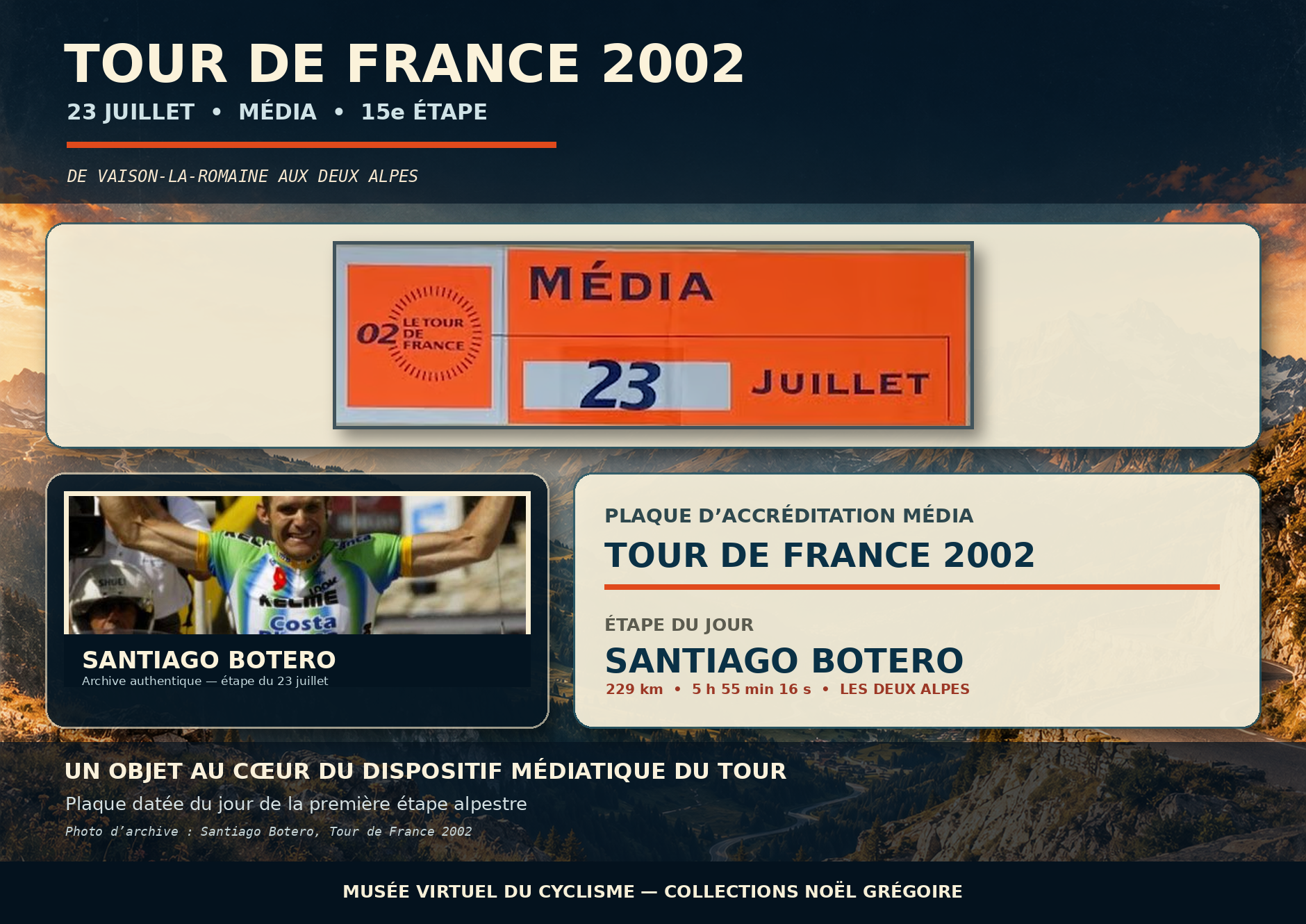
Media accreditation badge for the 2002 Tour de France
This badge relates to the 2002 Tour de France, the eighty-ninth edition of the Grande Boucle, which took place from 6 to 28 July. It belongs to the pool of accredited media representatives who follow the race on a daily basis to provide journalistic, photographic, radio and television coverage.
Orange in colour, the badge bears the logo of the 2002 Tour de France, the word ‘MÉDIA’ and the date 23 July. It was presumably intended to identify a vehicle authorised to travel in the vicinity of the race. Unlike the number plates of riders or team vehicles, it was therefore not associated with any particular winner.
23 July 2002 marked the fifteenth stage, contested between Vaison-la-Romaine and the resort of Les Deux Alpes. This first major Alpine stage took the riders along a 226.5-kilometre route, including the Prémol, Grimone, Croix-Haute, Banchet and Ornon passes, before the final climb to Les Deux Alpes.
Victory went to the Colombian Santiago Botero, a member of the Kelme–Costa Blanca team. Part of a breakaway group of seven riders, he launched his decisive attack eight kilometres from the finish and won solo in 5 hours 55 minutes 16 seconds. He finished 1 minute 51 seconds ahead of the Belgian Mario Aerts and 2 minutes 30 seconds ahead of Axel Merckx.
On display in the Virtual Cycling Museum – Noël Grégoire Collections, this plaque bears witness to the extensive media coverage surrounding the Tour de France. It preserves the memory of an Alpine stage marked by Santiago Botero’s victory, but also that of the many professionals tasked with recounting and broadcasting the legend of the Tour de France on a daily basis.
ITEM N° 710
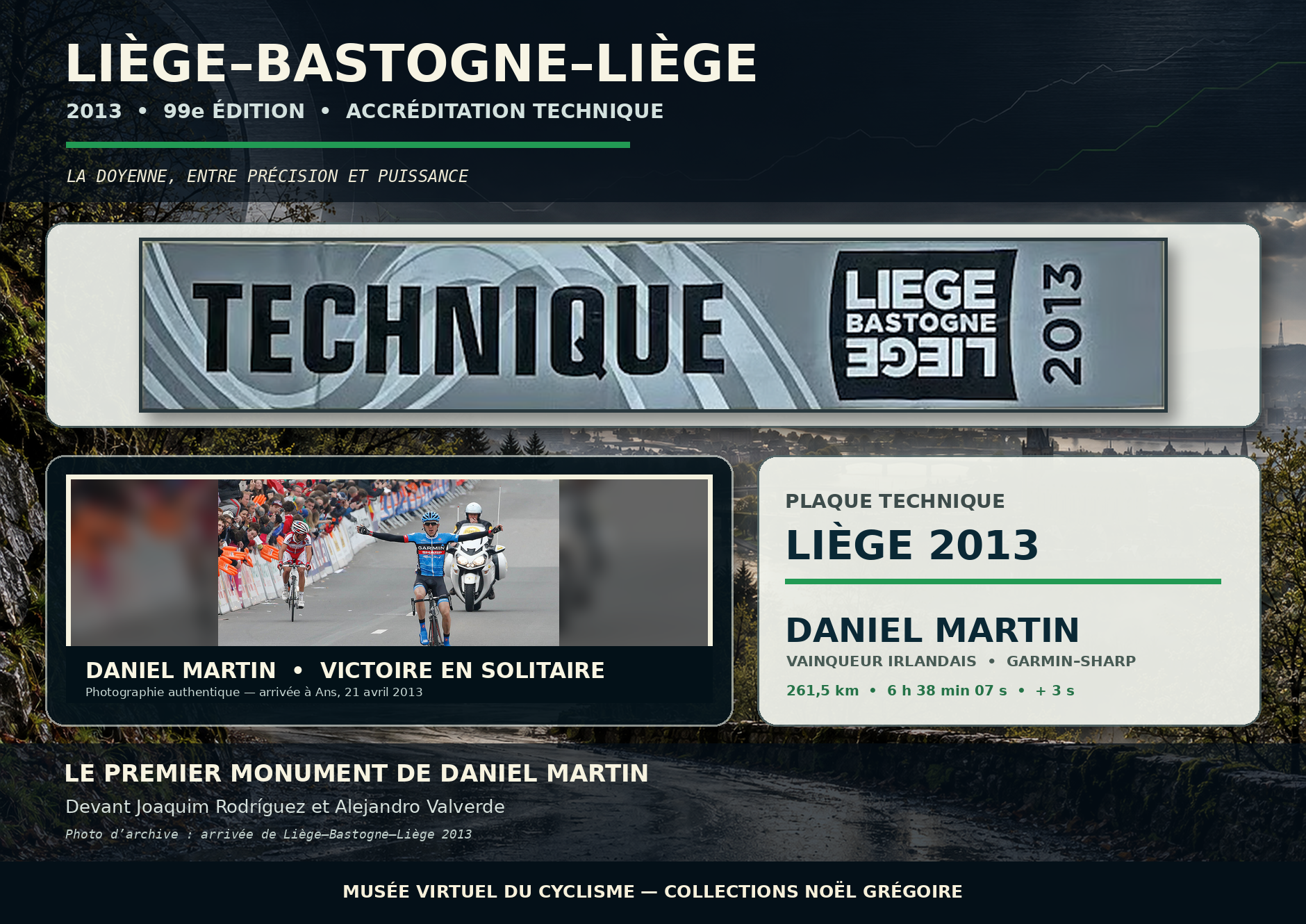
Technical accreditation badge for Liège–Bastogne–Liège 2013
This badge relates to Liège–Bastogne–Liège 2013, the ninety-ninth edition of the famous Ardennes classic, held on 21 April over a distance of 261.5 kilometres. Established in 1892 and nicknamed ‘La Doyenne’, the race is the oldest of the major cycling classics still held today.
Grey and silver in colour, the plate bears the word ‘TECHNIQUE’ in large letters, the Liège–Bastogne–Liège logo and the year 2013. It was used to identify an accredited vehicle assigned to the technical or logistical services essential to the smooth running of the race and the safety of its large convoy.
The 2013 edition was won solo in Ans by the Irishman Daniel Martin, a member of the Garmin–Sharp team. Following some excellent work by his team-mate Ryder Hesjedal, Martin caught up with Joaquim Rodríguez in the final kilometre, before pulling away from him in the final few hundred metres. Alejandro Valverde took third place.
Daniel Martin covered the 261.5 kilometres in 6 hours 38 minutes 07 seconds. He finished three seconds ahead of Joaquim Rodríguez and nine seconds ahead of Alejandro Valverde. This victory marked the first Monument of his career and the third Irish victory in ‘La Doyenne’, following Sean Kelly’s two wins in 1984 and 1989.
On display in the Virtual Cycling Museum – Noël Grégoire Collections, this plaque bears witness to the complex technical organisation required for a major international classic. It also preserves the memory of Daniel Martin’s major victory, achieved at the end of a perfectly controlled finale on the demanding roads of the Ardennes.
ITEM N° 711
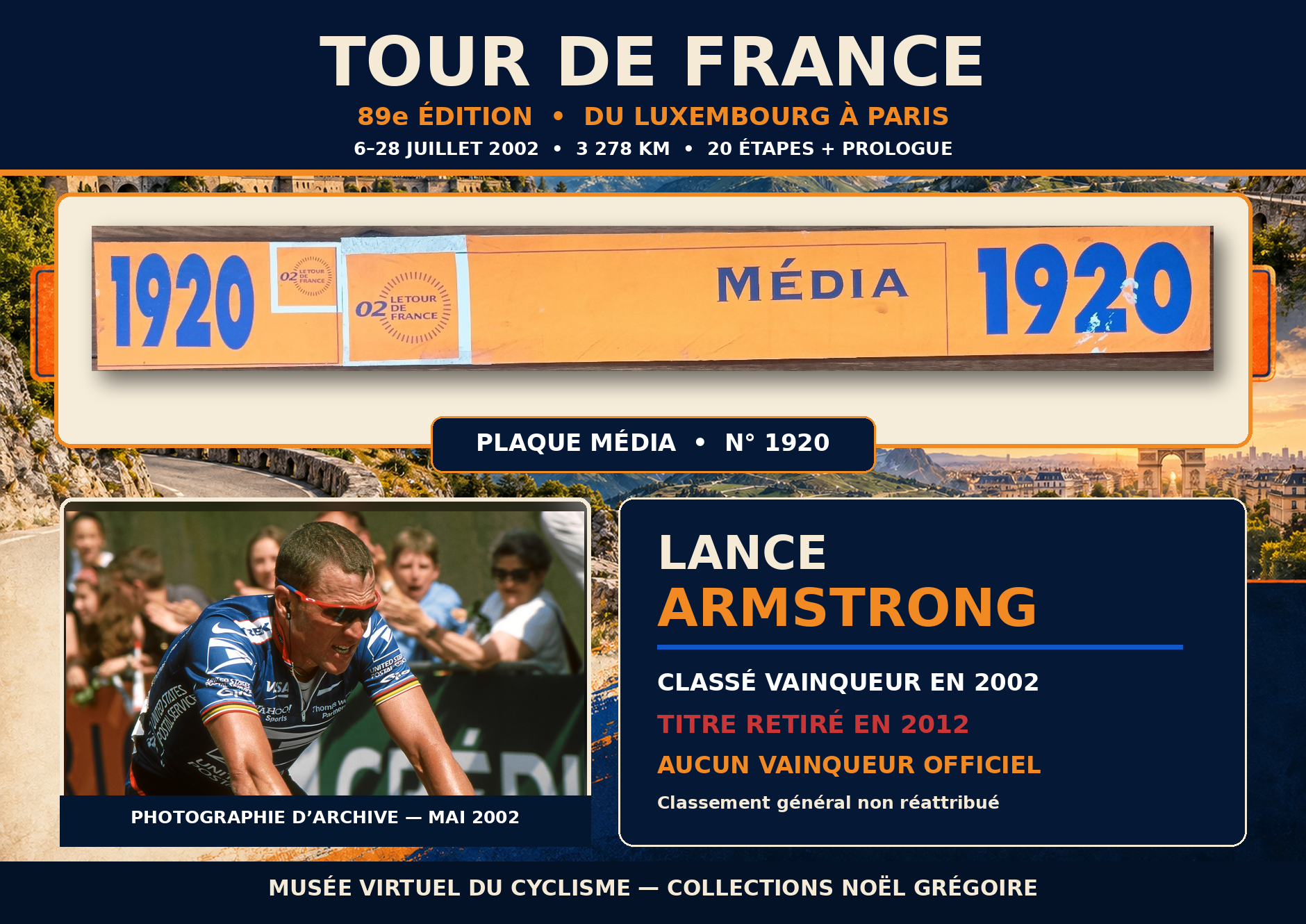
2002 Tour de France media badge
This badge relates to the 2002 Tour de France, the eighty-ninth edition of the Grande Boucle, which took place from 6 to 28 July. Starting in Luxembourg and finishing in Paris, the route comprised a prologue and twenty stages, covering a total distance of 3,278 kilometres.
The orange-coloured plate bears the emblems of the 2002 Tour de France, the word ‘Media’ and the number 1920, repeated at both ends. It was intended to identify an accredited vehicle belonging to the press or media authorised to follow the race within the official convoy.
At the end of the race, the American Lance Armstrong, a member of the US Postal Service team, was ranked first in the general classification ahead of the Spaniard Joseba Beloki and the Lithuanian Raimondas Rumšas. Robbie McEwen won the points classification, Laurent Jalabert the mountains classification and Ivan Basso the best young rider classification.
In 2012, Lance Armstrong was stripped of all his results achieved since August 1998, including his classification in the 2002 Tour de France. His title was not awarded to any other rider: this edition therefore officially remains without a winner.
On display in the Virtual Cycling Museum – Noël Grégoire Collections, this plaque bears witness to the extensive media coverage of the Tour de France. It also serves as a historical document recalling a significant, yet deeply controversial, period in the history of professional cycling.
