

The plate's cars - 2
ITEM N° 663
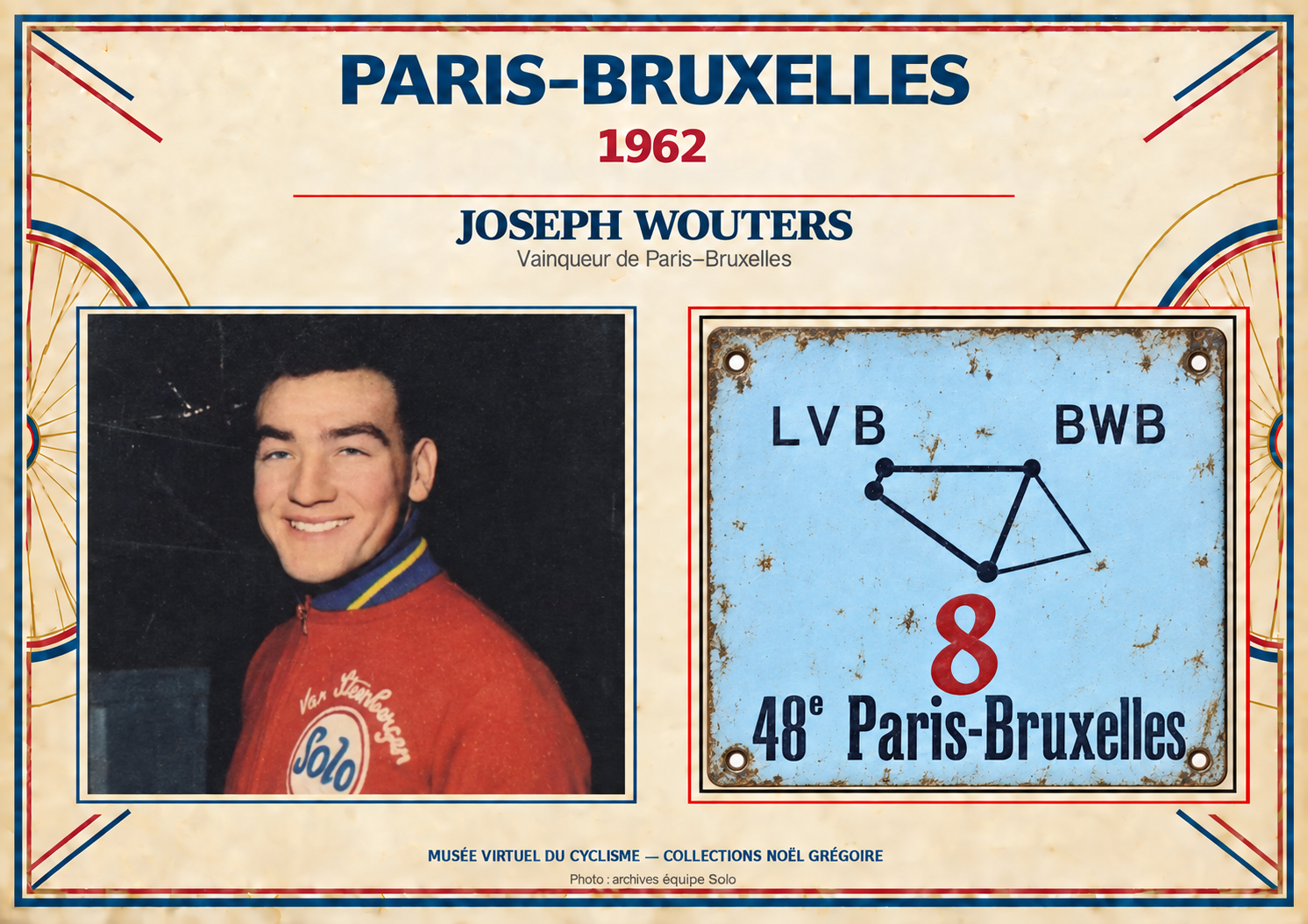
Number plate from a support vehicle for the 1962 Paris–Brussels race
This number plate relates to the Paris–Brussels, one of the oldest international classics in professional cycling. Established in 1893, this race linked the Paris region to the Belgian capital over a route of nearly 300 kilometres. Its length and cross-border nature made it one of the key events on the Franco-Belgian cycling calendar.
The plaque bears the initials ‘LVB’ and ‘BWB’, corresponding to the French and Dutch names of the Belgian cycling federation: Ligue vélocipédique belge and Belgische Wielrijdersbond. It also features a stylised drawing of a bicycle frame, the number 8 and the words ‘48th Paris–Brussels’. The perforations at its four corners suggest that it was likely intended to be affixed to an official vehicle or a support car involved in organising the race.
The inscription ‘48th Paris–Brussels’ links this plaque to the race held on 29 April 1962. That year, the riders covered 289 kilometres between Paris and Brussels. Victory went to the young Belgian Joseph ‘Jos’ Wouters, a member of the Solo–Van Steenbergen team. Results of the 1962 Paris–Brussels
The race was decided in a sprint finish between several riders who had finished in the same time. Jos Wouters prevailed over his compatriots Noël Foré and Martin Van Geneugden, after a race lasting 8 hours, 9 minutes and 15 seconds. Aged just twenty, he achieved one of the greatest feats of his career that day by winning a particularly gruelling international classic.
This success confirmed Wouters’ qualities in one-day races. A fast and resilient rider, he achieved several significant results in the Belgian classics and notably won the Brabantse Pijl in 1963. His victory in Paris–Brussels remains, however, the most prestigious result of his professional career.
On display in the Virtual Cycling Museum – Noël Grégoire Collections, this plaque commemorates Jos Wouters’ victory in the 1962 Paris–Brussels. Its wear and tear, mounting marks and bilingual inscriptions bear witness to its use and to the international organisation surrounding this great Franco-Belgian classic.
ITEM N° 664
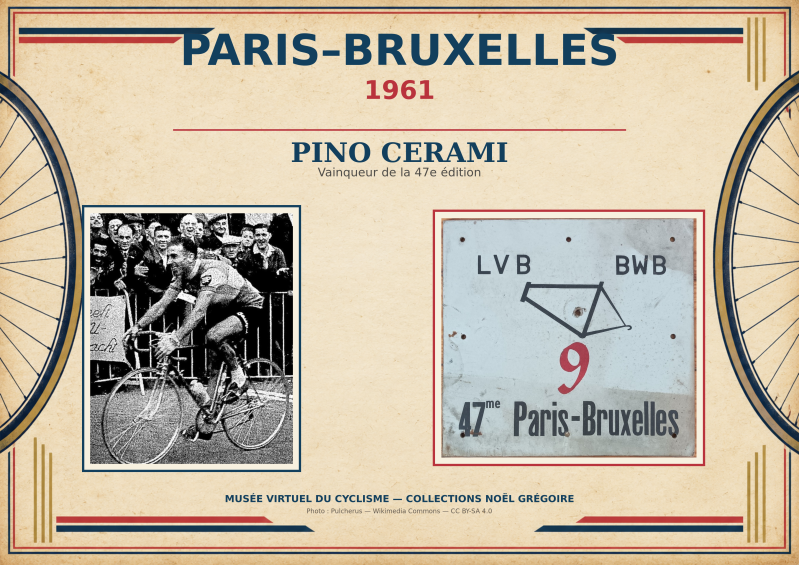
Number plate from a support vehicle for the 1961 Paris–Brussels race
This number plate relates to the Paris–Brussels race, a major Franco-Belgian classic established in 1893. Traditionally linking the Paris region to the Belgian capital, this race was one of the major events on the cycling calendar and favoured powerful riders capable of sustaining the pace over a long distance.
Made of metal, the plate bears the initials ‘LVB’ and ‘BWB’, corresponding to the French and Dutch names of the Belgian cycling federation: Ligue vélocipédique belge and Belgische Wielrijdersbond. It also features a stylised drawing of a bicycle, the red number 9 and the words ‘47th Paris–Brussels’. Its various mounting holes suggest that it was likely intended to identify an official vehicle or a support car forming part of the race convoy.
The 47th edition of Paris–Brussels took place on 23 April 1961, covering a distance of approximately 291 kilometres. The Belgian Pino Cerami, then a member of the Peugeot–BP–Dunlop team, won solo in the Belgian capital, 38 seconds ahead of Gilbert Desmet and Frans Schoubben.
Born in Italy in 1922 and naturalised as a Belgian, Pino Cerami was one of the finest classics specialists of his era. Winner of Paris–Roubaix and the Flèche Wallonne in 1960, he also won the Flèche Brabançonne and Paris–Brussels in 1961. In 1963, at the age of 41, he won another stage of the Tour de France, remaining for several decades the oldest stage winner in the race’s history.
On display in the Virtual Cycling Museum – Noël Grégoire Collections, this plaque is a valuable physical record of how the major classics were organised in the early 1960s. It serves as a reminder both of the indispensable role played by support vehicles and of Pino Cerami’s victory in the 1961 Paris–Brussels, one of the last major successes of his remarkable career.
ITEM N° 665
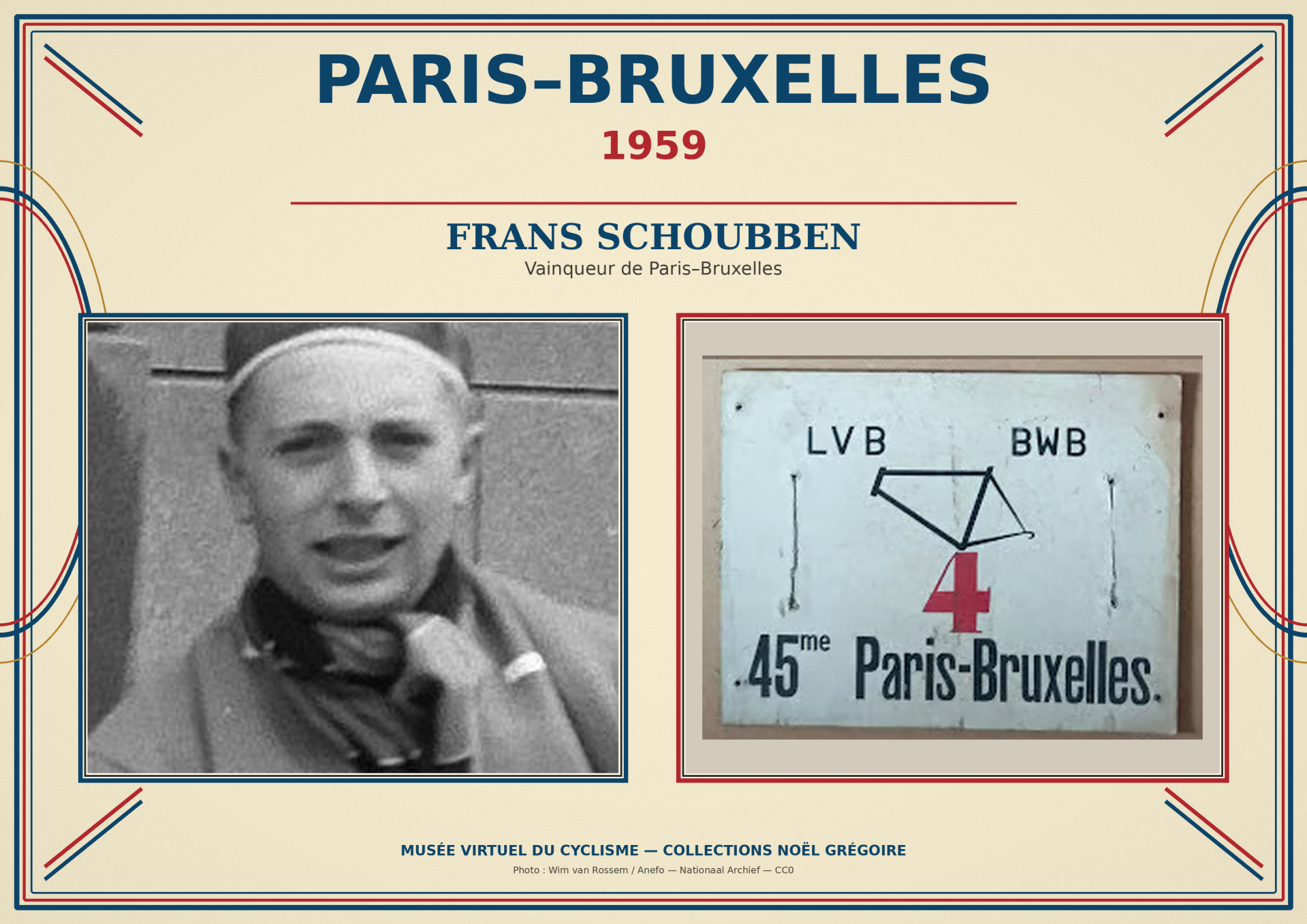
Number plate from a support vehicle at the 1959 Paris–Brussels race
This number plate relates to the Paris–Brussels, a major Franco-Belgian classic established in 1893. Traditionally linking the Paris region to the Belgian capital, this event was one of the most prestigious one-day races on the European cycling calendar.
Made of metal, the plate bears the initials ‘LVB’ and ‘BWB’, denoting the Belgian cycling federation in both national languages: Ligue vélocipédique belge and Belgische Wielrijdersbond. It also features a stylised bicycle, the red number 4 and the inscription ‘45th Paris–Brussels’. Its mounting holes and dimensions suggest that it was likely intended to identify an official vehicle or a support car in the race convoy.
The 45th edition of Paris–Brussels took place on 19 April 1959, over a distance of 287 kilometres. The Belgian Frans Schoubben, a member of the Peugeot–BP–Dunlop team, won the race in 8 hours, 16 minutes and 8 seconds. He finished 57 seconds ahead of his compatriot Willy Vannitsen, whilst the Spaniard Miguel Poblet completed the podium.
Born in Tongeren in 1933, Frans Schoubben was one of the finest Belgian classics riders of the late 1950s. His list of achievements includes, notably, the Tour of Limburg, the 1959 Paris–Brussels and several podium finishes in major Belgian races. This victory in Paris was one of the major successes of his professional career.
On display in the Virtual Cycling Museum – Noël Grégoire Collections, this plaque is a valuable record of the logistical organisation of the major post-war classics. It highlights the indispensable role of official vehicles in supporting the races and preserves the memory of Frans Schoubben’s victory in the 1959 Paris–Brussels.
