

The jerseys - 87
ITEM N° 659
POGAČAR Tadej (SLO) (21.09.1998)
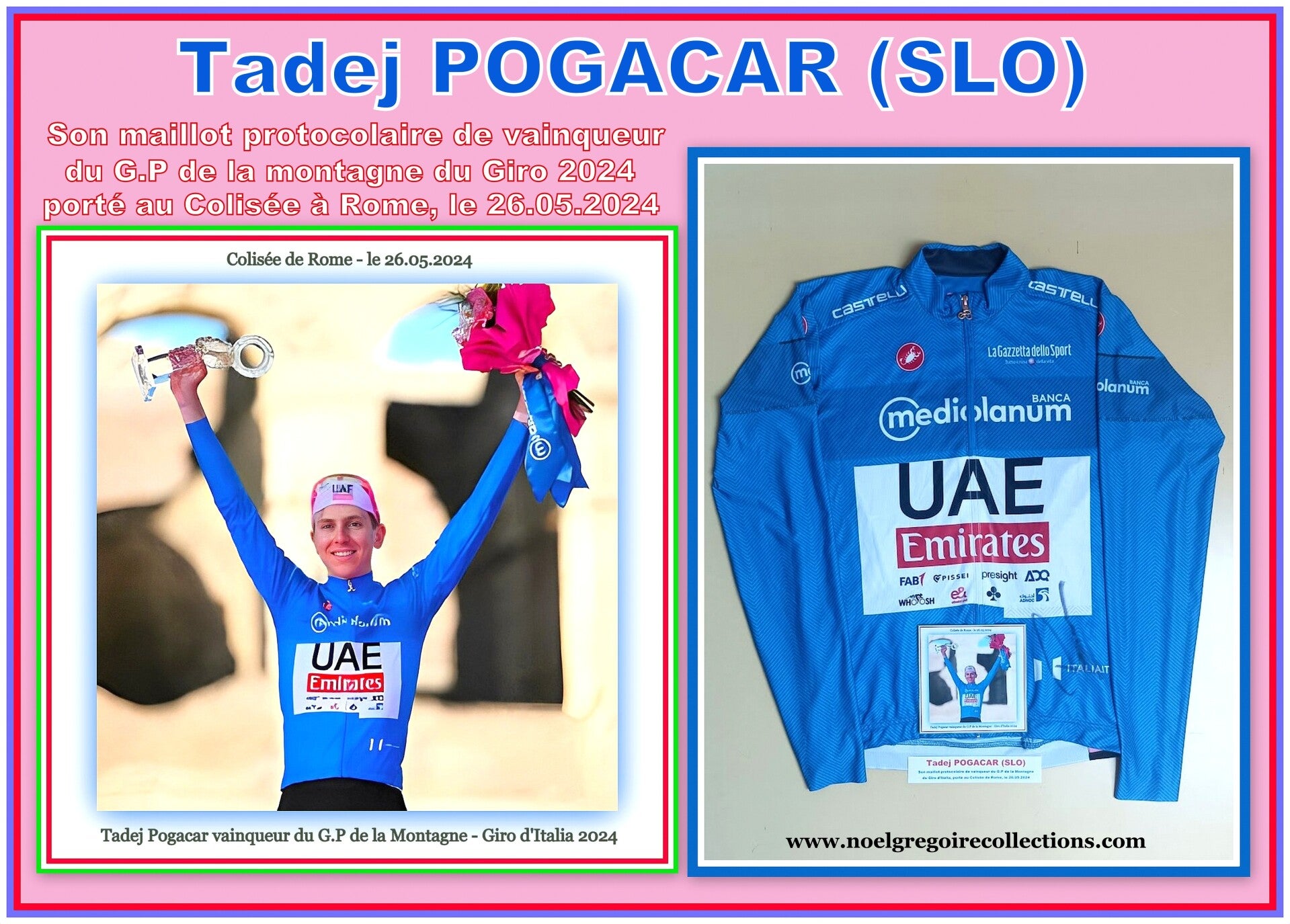
His official jersey as winner of the King of the Mountains classification – Giro 2024
On 26 May 2024, Slovenian champion Tadej Pogačar won the 107th edition of the Giro d’Italia in Rome, his first attempt at the race. After three weeks of exceptional dominance, he finished 9 minutes and 56 seconds ahead of Colombia’s Daniel Felipe Martínez and more than ten minutes ahead of Britain’s Geraint Thomas in the general classification.
Winner of six stages, Tadej Pogačar also claimed the King of the Mountains classification. His superiority on the climbs enabled him to win the climbers’ classification and receive the prestigious blue jersey, or Maglia Azzurra, during the official ceremony held at the Colosseum in Rome.
The jersey presented here, in the colours of Banca Mediolanum, also bears the logos of La Gazzetta dello Sport and UAE Team Emirates. It was worn by Tadej Pogačar on 26 May 2024, during the Giro’s final podium ceremony, at the end of the last stage contested through the streets of the Italian capital.
The signatures on the jersey reinforce the personal and historical significance of this item. It bears witness to the Slovenian champion’s dazzling dominance, as he wore the pink jersey for twenty days and emerged as the undisputed hero of that edition.
Housed within the Noël Grégoire Collections, this jersey is a precious memento of one of Tadej Pogačar’s most brilliant seasons. A few weeks later, he also won the Tour de France, achieving the first Giro–Tour double since Marco Pantani in 1998. He went on to become road world champion, thereby completing an exceptional Triple Crown.
ITEM N° 717
DIETZEN Reimund (D)
(29.05.1959)
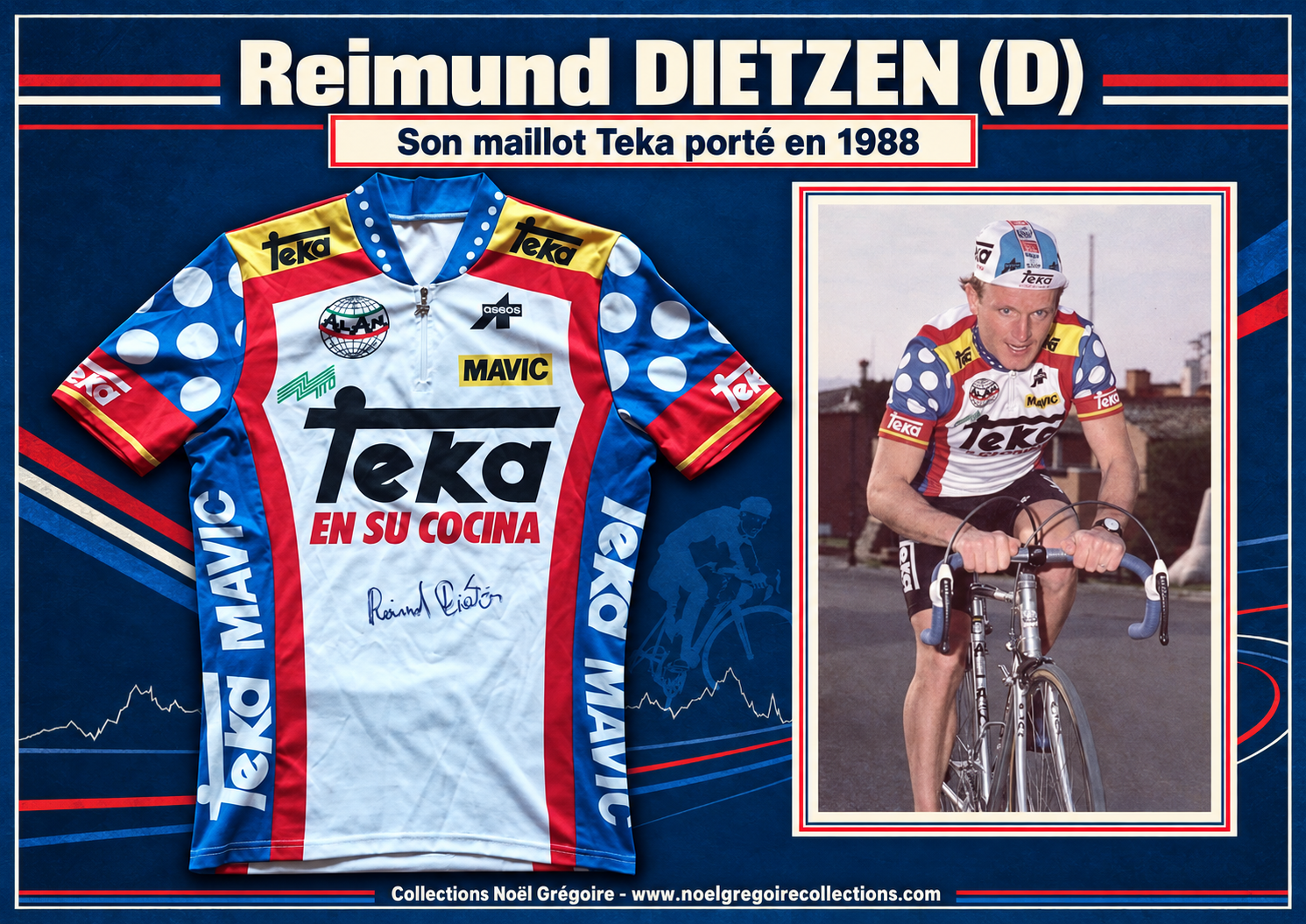
His Teka team jersey from 1988
Born in Trier, Germany, Reimund Dietzen was one of the finest German cyclists of his generation. An excellent climber and stage-race specialist, he turned professional in 1982 before joining the Spanish Teka team in 1983, for whom he rode until the end of his career. procyclingstats.com
His honours include two West German road championship titles, won in 1984 and 1986, as well as two national professional cyclo-cross titles. Particularly at home on Spanish roads, he won three stages of the Vuelta a España in 1984, 1986 and 1989, as well as the overall classifications of the Tour of Cantabria in 1985 and 1986.
The year 1988 was one of the most remarkable of his career. Riding for Teka, Dietzen won the Tour of Castile and León, having also claimed victory in a stage. A few weeks later, he finished second in the Vuelta a España, just 1 minute and 27 seconds behind the Irishman Sean Kelly. He thus equalled his second-place finish from the previous year and confirmed his place amongst the best Grand Tour riders of his era.
The jersey presented here is the kit worn by the Teka team in 1988. The front of the garment bears Reimund Dietzen’s handwritten signature. This dedication, clearly visible on the white fabric, enhances its personal character and documentary value. The slight creases and signs of wear have been preserved: they form part of the material history of this authentic cycling jersey.
Reimund Dietzen’s career was abruptly cut short by a serious crash in a poorly lit tunnel during the 1989 Vuelta a España.
Housed in the Noël Grégoire Collections, this jersey bears witness to the 1988 season, one of Reimund Dietzen’s most successful. His signature also makes it a memento directly associated with a champion who played a major role in the history of German cycling in the 1980s.
ITEM N° 718
DIETZEN Reimund (D)
(29.05.1959)
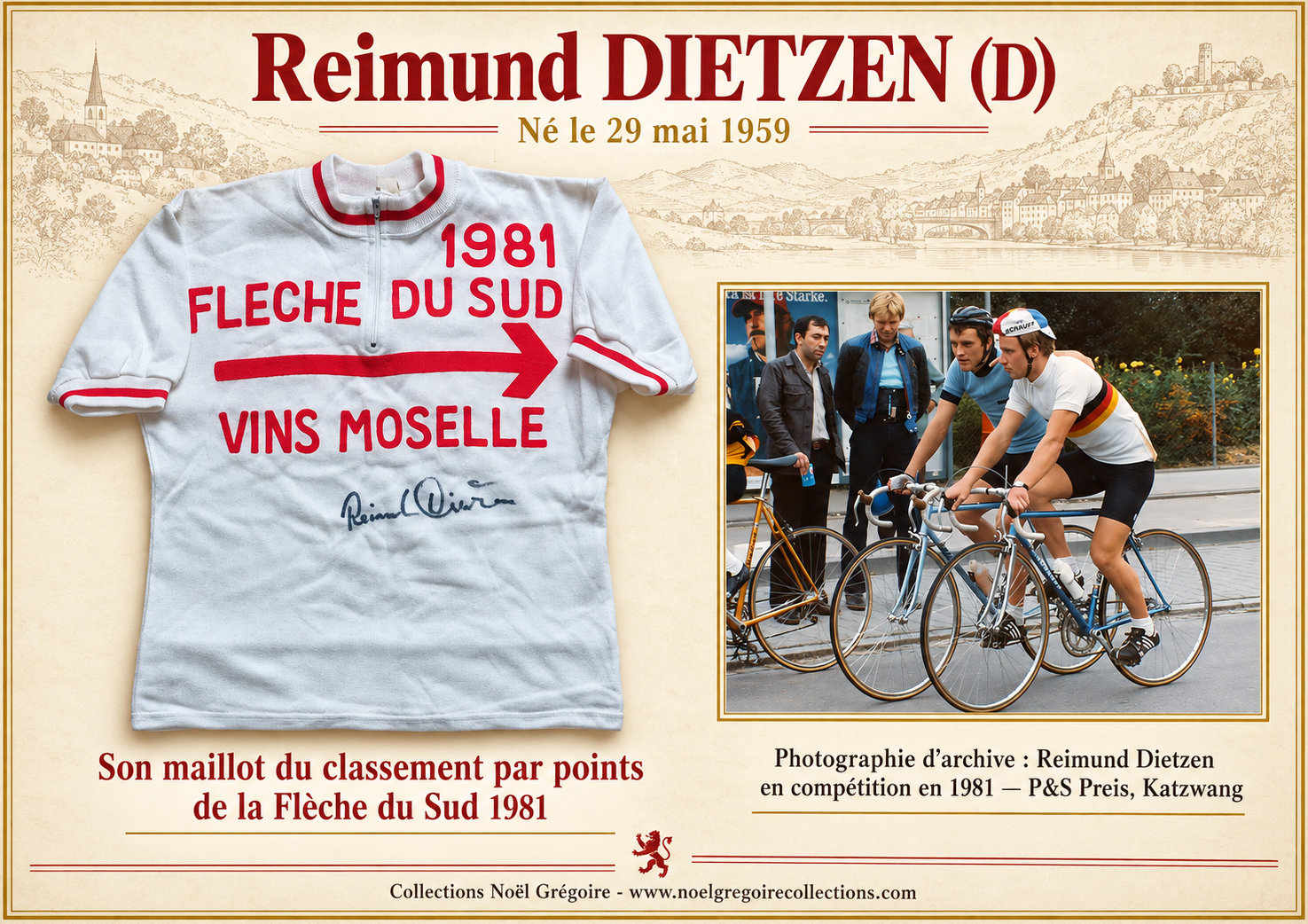
The jersey he wore at the 1981 Flèche du Sud
Reimund Dietzen was one of the finest German cyclists of the 1980s. Before turning professional, he made a name for himself in the amateur ranks, notably by winning the West German road and mountain championships in 1981. He also secured two stage victories in the Grand Prix Guillaume Tell and finished third in the amateur Paris–Roubaix.
Established in 1949, the Flèche du Sud is an international stage race held in Luxembourg. Long reserved for amateurs, it was a major event for young European cyclists. Its 32nd edition took place in 1981 and was won by the Swiss rider Jean-Louis Schneiter, ahead of the Greek Stelios Vascos and the Portuguese Francis Da Silva. Flèche du Sud, 32nd edition
The jersey presented here is attributed to Reimund Dietzen and, based on its provenance, is linked to his participation in the 1981 Flèche du Sud. However, no archives have yet been found to establish with certainty that this was the leader’s jersey in the general classification. This designation should therefore be used with caution.
Housed in the Noël Grégoire Collections, this jersey bears witness to Dietzen’s final years as an amateur, on the eve of his move to the professional ranks in 1982. It is a precious memento of the early career of a rider who would go on to become, notably, a two-time West German champion and twice runner-up in the Vuelta a España.
