

The pennants, scarves, plates & certficates - 7
ITEM N°434
Marc DEMEYER (B)
(19.04.1950 – 20.01.1982)
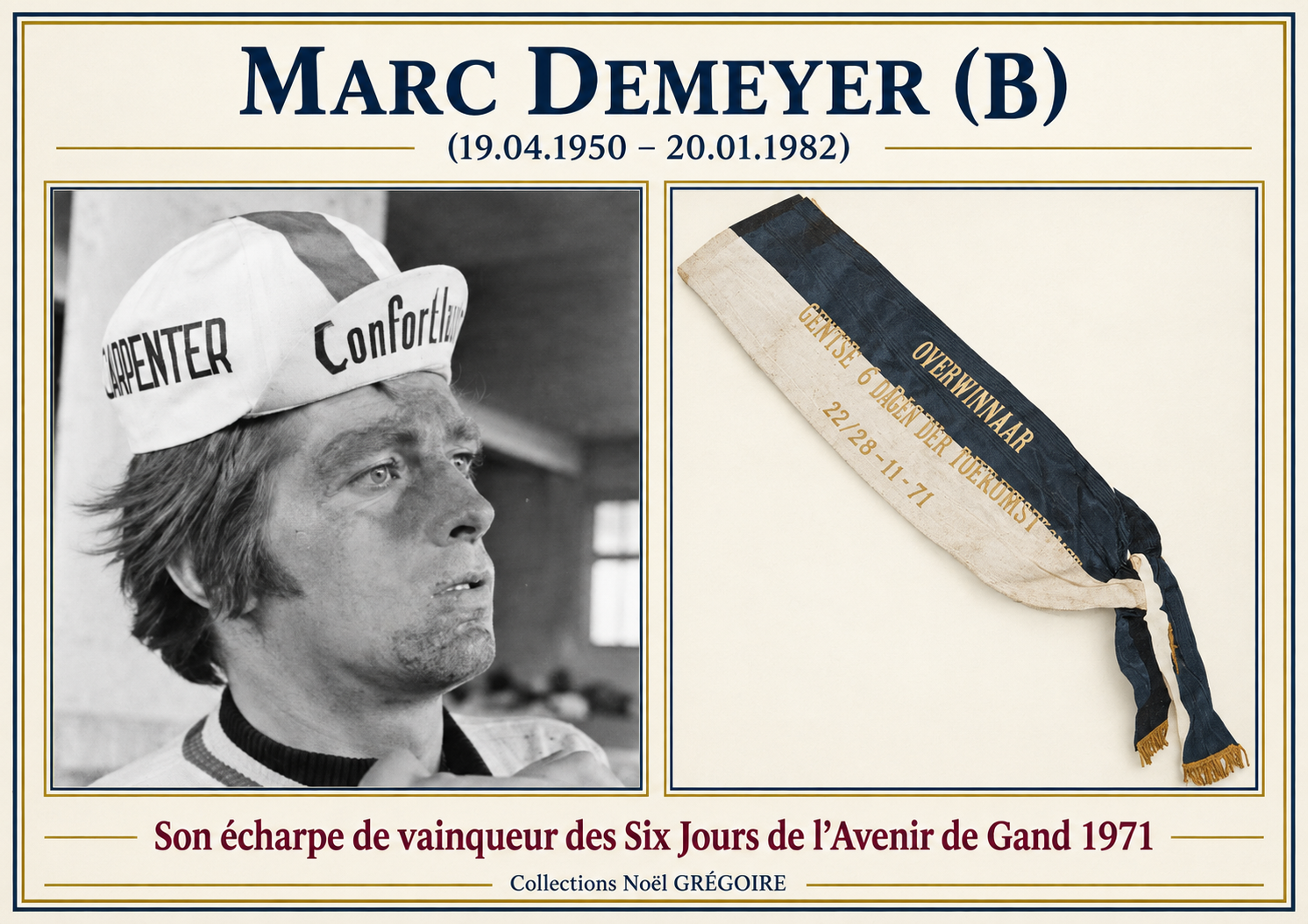
His winner’s sash from the 1971 Six Days of the Future of Ghent
Marc Demeyer was one of the most formidable Belgian cyclists of his generation. Originally from Avelgem, he distinguished himself from an early age through his endurance, his attacking style and his skills as a rider, both on the road and on the track.
Before turning professional in 1972, Marc Demeyer enjoyed a remarkable amateur season in 1971. In particular, he won the amateur Tour of Flanders and two stages of the Peace Race, confirming the qualities that would soon enable him to make his mark amongst the elite.
From 22 to 28 November 1971, he took part in the Six Days of the Future in Ghent, or Gentse Zes Dagen der Toekomst. Held at the Kuipke velodrome as a prelude to the professional Six Days, this competition was reserved for young riders and was contested in pairs. Partnered with the Dutch track cyclist Klaas Balk, Marc Demeyer won the overall classification ahead of the teams formed by Roland Boulard and Eric Demeyer, followed by Van Laethem and Daelemans.
The item on display is the winner’s sash presented to Marc Demeyer at the end of this event. Made from a dark fabric with a wide light-coloured band running across it, it bears the Dutch inscription ‘Overwinnaar Gentse 6 Dagen der Toekomst’ as well as the dates ‘22/28-11-71’. The creases, the wear and tear on the fabric and the fringes preserved at the ends bear witness to the age of this item. Presented in its original condition, the scarf is a rare tangible memento of the competitions reserved for young track cyclists during major cycling events.
The accompanying portrait shows Marc Demeyer during his career. This documentary photograph was not taken during the 1971 Six Days of the Future in Ghent, but it helps to convey the features of the rider to whom this scarf was awarded.
After turning professional, Marc Demeyer won Paris–Brussels in 1974, Paris–Roubaix in 1976 and the Tour of Flanders in 1977. He also won two stages of the Tour de France and two stages of the Giro d’Italia.
On display in the Virtual Cycling Museum – Noël GREGOIRE Collections, this scarf serves as a memento of Marc Demeyer and Klaas Balk’s victory at the 1971 Six Days of the Future of Ghent, a triumph that heralded the Belgian champion’s brilliant professional career.
ITEM N° 436
DEMEYER Marc (B)
(19.04.1950 – 20.01.1982) F
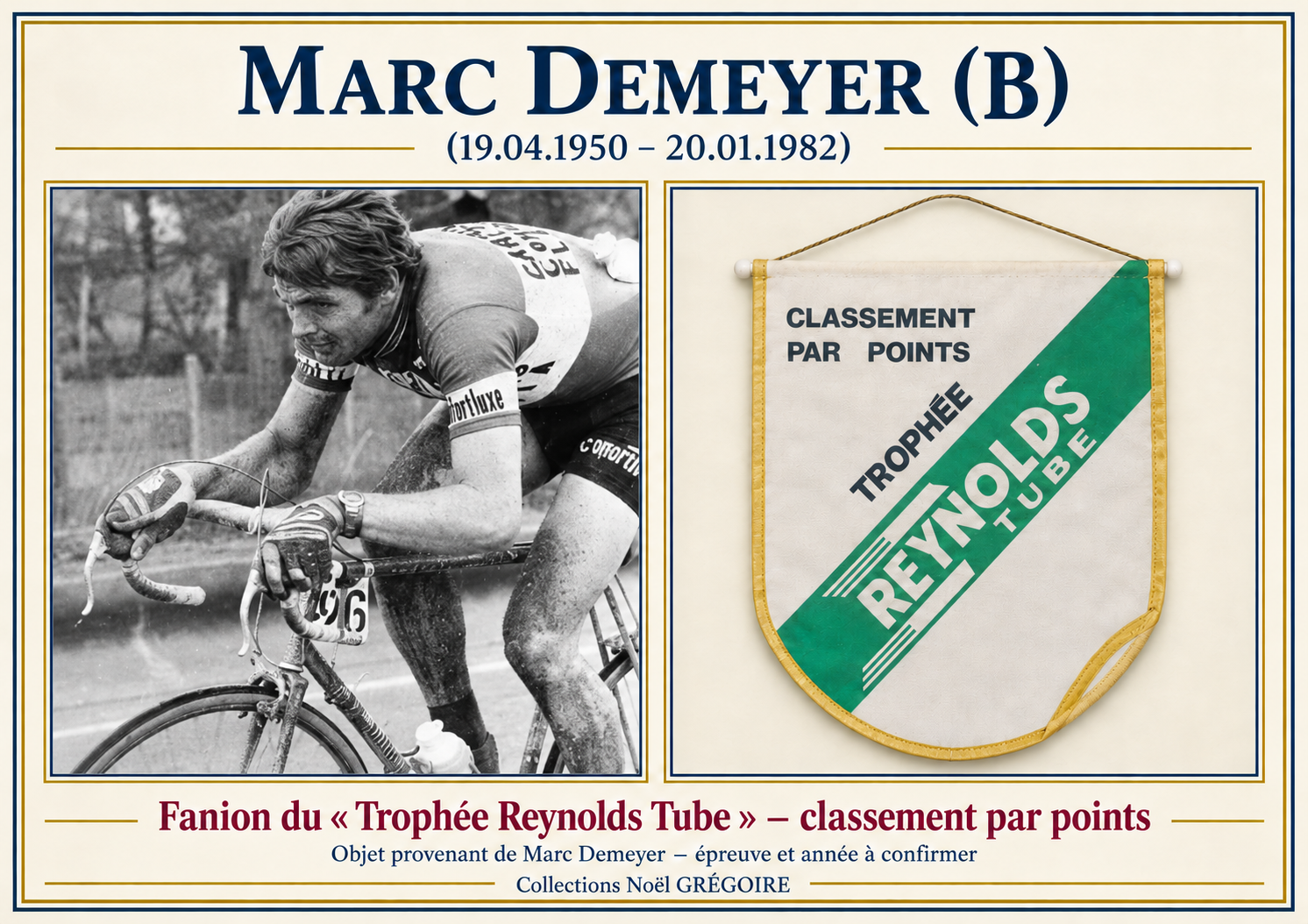
‘Reynolds Tube Trophy’ pennant Points classification
A native of Avelgem, Marc Demeyer was one of Belgium’s finest classics riders of the 1970s. A professional from 1972 to 1982, he was admired for his power, stamina and attacking style.
Marc Demeyer competed in six editions of the Tour de France. He won two stages there, in 1978 and 1979, as well as the ‘hot spots’ classification in 1973 and 1975. His list of achievements also includes two major victories in the cobbled classics. In 1976, he won Paris–Roubaix before claiming victory in the Tour of Flanders the following year.
The item on display is a pennant from the ‘Reynolds Tube Trophy’ associated with a points classification. Made from a light-coloured fabric edged with gold braid, it features a wide green band and the inscriptions ‘Reynolds Tube Trophy’ and ‘Points Classification’. The British company Reynolds was particularly well known in the world of cycling for manufacturing steel tubes for bicycle frames. Its name was also associated with the sponsorship of various cycling competitions and awards. The green stripe on the pennant evokes the colour traditionally associated with the points classification. Research indicates, in particular, that Reynolds sponsored the green jersey classification at the 1957 Tour de France. However, the pennant bears no date, no race name and no identifying details that would allow this attribution to be definitively confirmed.
This item comes from Marc Demeyer, but this provenance does not necessarily mean that it was presented to him as the winner. It may be an older award, a ceremonial pennant or a promotional souvenir that subsequently found its way into his personal collection.
Featured in the Virtual Cycling Museum – Noël GREGOIRE Collections, this pennant is an enigmatic artefact from the history of cycling sponsorship. Its precise origin and the race to which it relates remain to be confirmed.
ITEM N° 435
DEMEYER Marc (B)
(19.04.1950 – 20.01.1982)
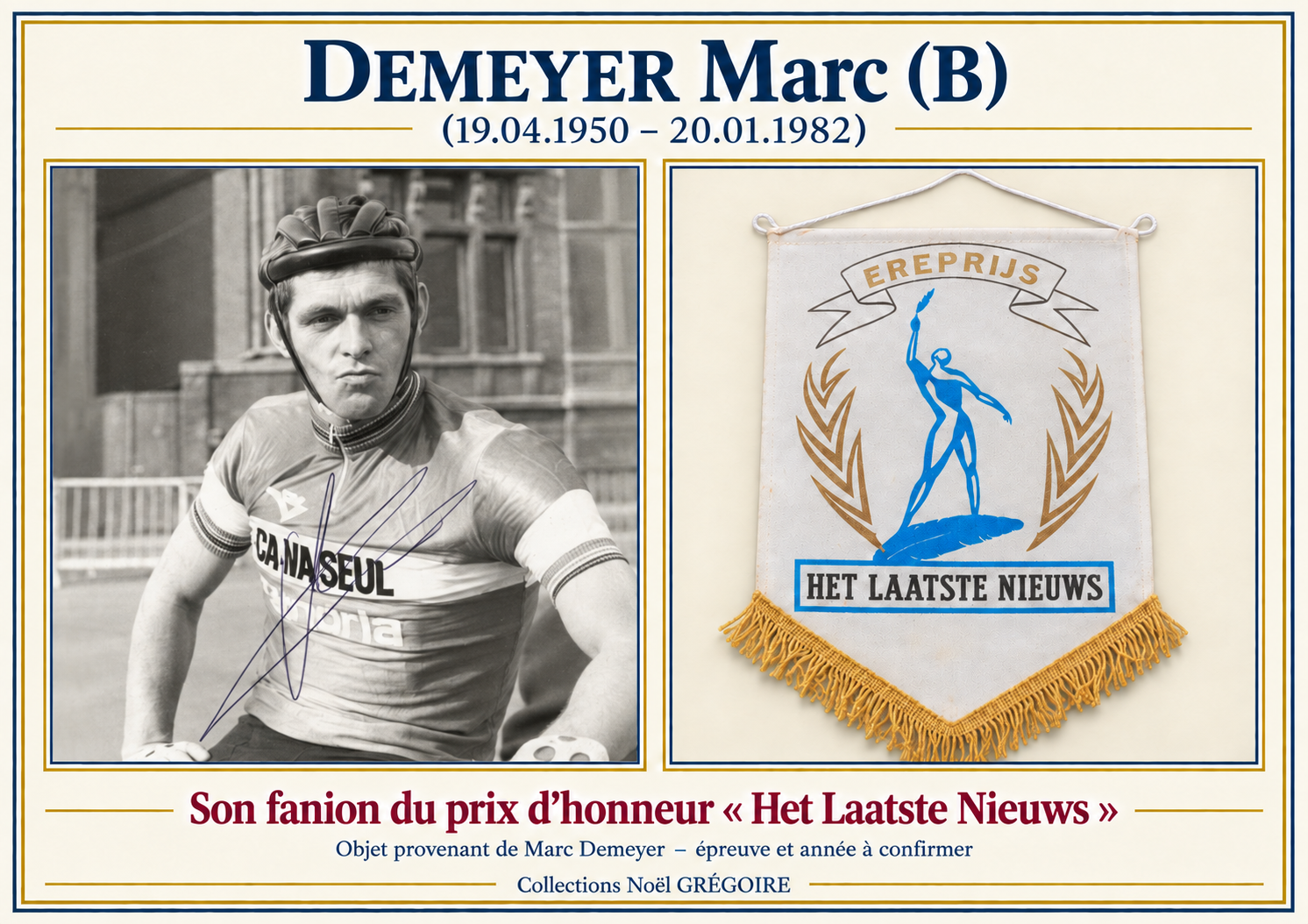
His ‘Het Laatste Nieuws’ “Prix d’Honneur” pennant
Marc Demeyer was one of the leading figures in Belgian cycling in the 1970s. A professional from 1972 to 1982, he stood out for his power, endurance and attacking style.
Particularly at home in gruelling races, Marc Demeyer won Paris–Roubaix in 1976 and the Tour of Flanders in 1977. These two prestigious victories established him as one of the finest specialists in the cobbled classics of his generation.
He also competed in six editions of the Tour de France. He won two stages there, in 1978 and 1979, as well as the ‘hot spots’ classification in 1973 and 1975.
The item on display is a pennant bearing the inscriptions ‘Ereprijs’ and ‘Het Laatste Nieuws’. The Dutch term ‘Ereprijs’ means ‘honorary prize’ or ‘honorary award’. Made from a light-coloured fabric, the pennant is adorned with a stylised blue figure surrounded by golden laurel branches. Its lower section, edged with fringes, bears the name of the Flemish daily newspaper Het Laatste Nieuws.
The presence of the newspaper’s name suggests that this award was likely presented or sponsored by the newspaper on the occasion of a sporting event. However, no date, venue or name of the event is indicated on the item.
The photograph shows Marc Demeyer in the thick of the action, under particularly gruelling conditions. His face, arms and kit, marked by splashes, illustrate the resilience and determination that characterised the Belgian champion.
This pennant came from Marc Demeyer, but the information currently available does not allow us to confirm that it was presented to him following a specific victory. Its exact origin therefore remains to be confirmed by a contemporary document or photograph.
Featured in the Virtual Cycling Museum – Noël GREGOIRE Collections, this pennant bears witness to the honorary awards once bestowed
