

The pennants, scarves, plates & certficates - 17
ITEM N°259
REYBROUCK Guido (B)
(25.12.1941)
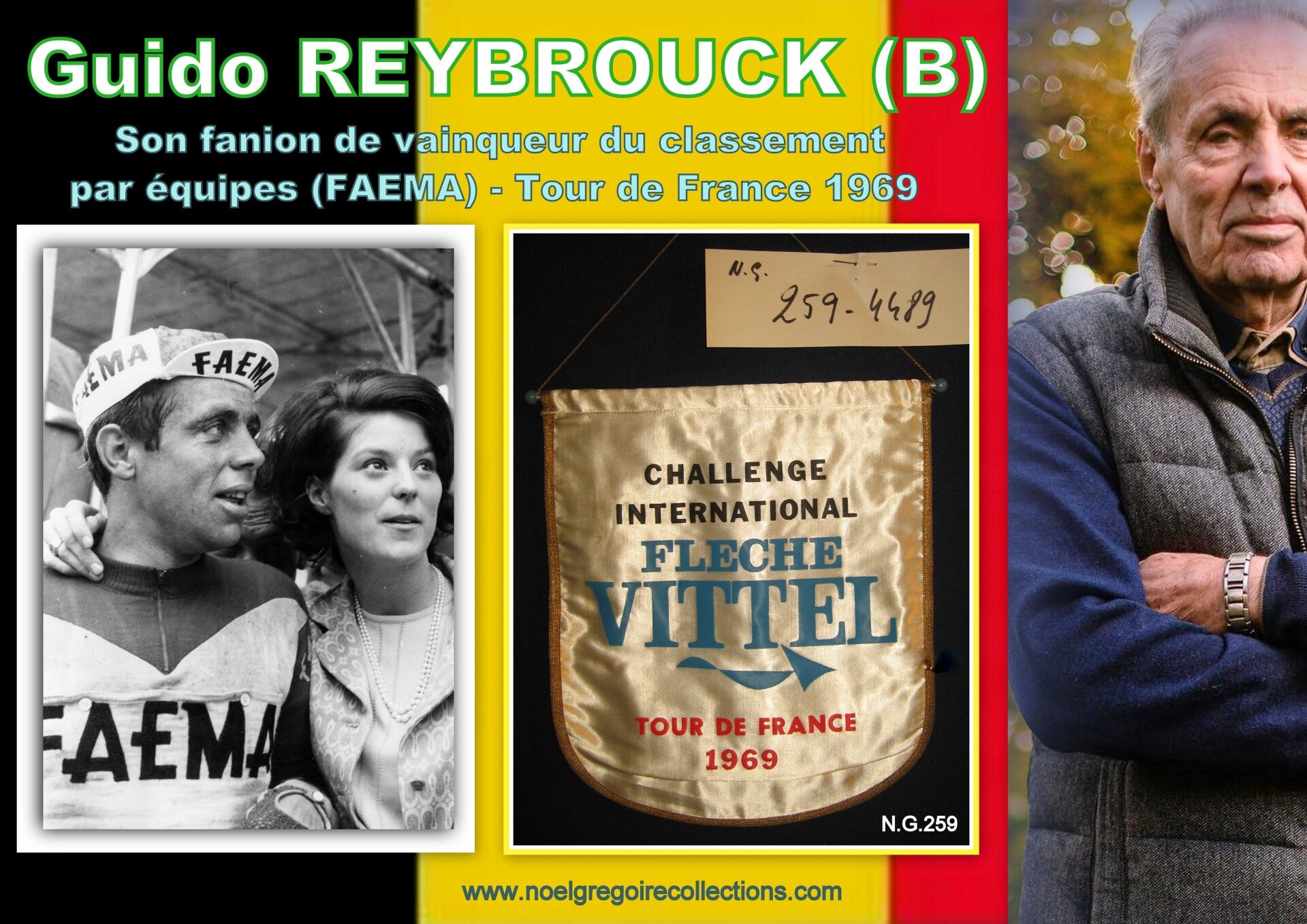
His pennant from the ‘Flèche Vittel’ International Challenge, won with the Faema team at the 1969 Tour de France
Born in Bruges on 25 December 1941, Guido Reybrouck was one of the finest Belgian sprinters of his generation. A professional from 1962 to 1973, he excelled both in the major classics and on the roads of the Grand Tours.
His list of achievements includes, notably, three victories in Paris–Tours, in 1964, 1966 and 1968, as well as the 1969 Amstel Gold Race and the 1964 Zurich Championship. Fast and powerful, he was particularly formidable in sprint finishes. Guido Reybrouck competed in six editions of the Tour de France between 1965 and 1972. He won six stages, including the 13th stage of the 1969 Tour between Aubagne and La Grande-Motte, whilst riding for the Faema team.
The 1969 Tour de France marked the definitive return of commercial teams to the Grande Boucle. The Belgian Faema team, built around Eddy Merckx, largely dominated that edition. It won the overall team classification ahead of the Peugeot–BP–Michelin team. This team classification was then linked to the ‘Flèche Vittel’ International Challenge, sponsored by the Vittel mineral water brand. The riders from the team leading the classification were distinguished by wearing a yellow cap. Guido Reybrouck contributed to this team victory alongside Eddy Merckx and their teammates from the Faema team.
The pennant shown here is made of ivory-coloured satin, edged with brown braid and suspended by a thin cord. Its rounded shape and understated design are typical of the promotional and ceremonial awards presented at the Tour during that period. This pennant is a team award. It therefore does not directly commemorate Guido Reybrouck’s personal stage victory, but rather Faema’s first place in the overall team classification of the 1969 Tour. Its provenance allows it to be personally associated with the Belgian rider, a member of the winning team.
The period photograph recalls the rider’s dual success during that Tour: an individual victory at La Grande-Motte and a team victory with his squad.
This item is a valuable testament to the involvement of commercial partners in the organisation of the Tour de France’s secondary classifications. It also highlights the remarkable dominance of the Faema team during the 1969 edition.
ITEM 470
SAMYN José (F)
(11.05.1946 – 28.08.1969)
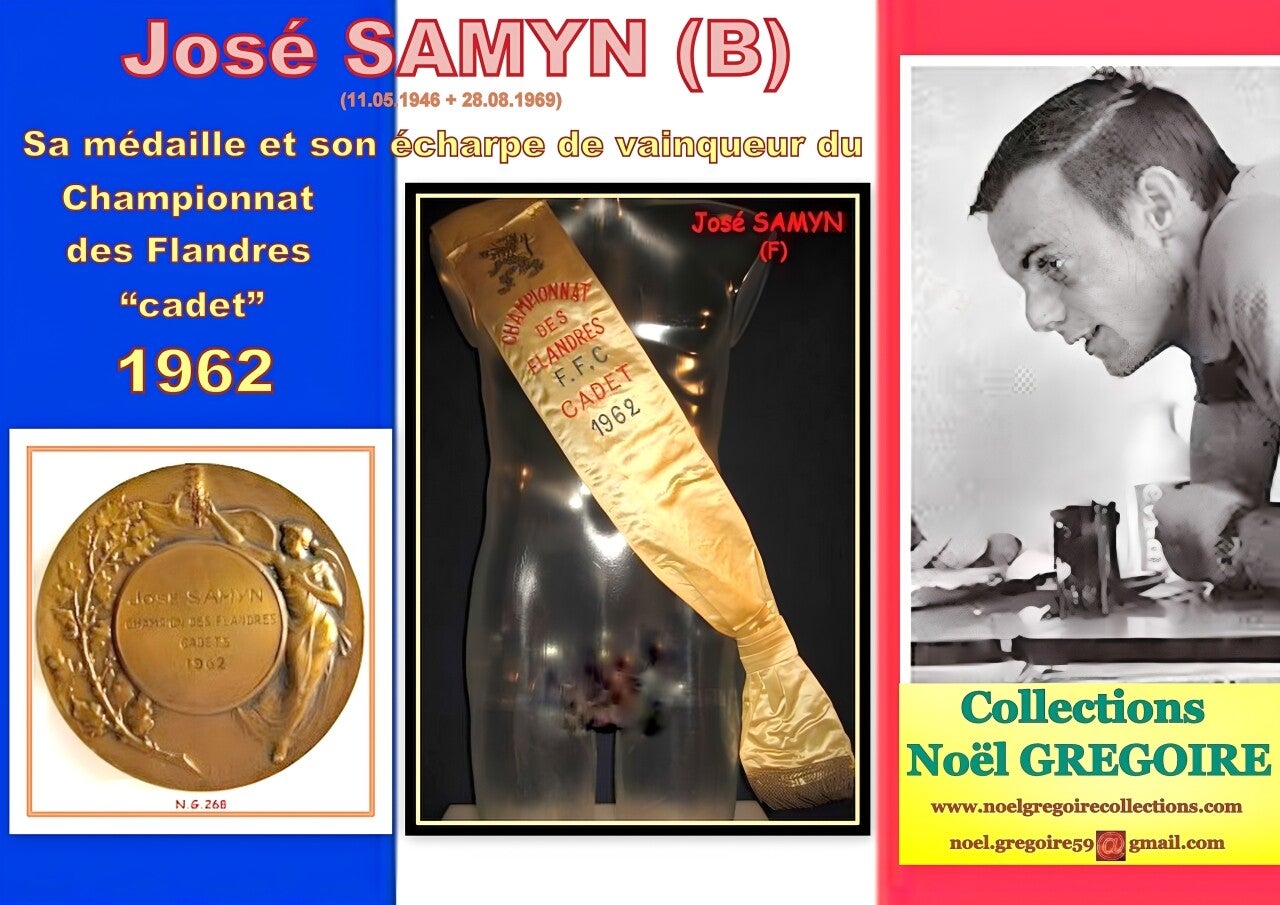
His medal and sash as F.F.C. Flanders champion, cadet category – 1962
Born in Quiévrain, Belgium, to a French father and a Belgian mother, José Samyn grew up in this border region where cycling played a major role. He began racing at a very young age alongside Belgian road cyclists before officially taking French nationality in 1964.
In 1962, aged just sixteen, he won the French Cycling Federation’s Flanders Championship in the cadet category. This regional victory was one of the first demonstrations of his competitive prowess.
The champion’s sash presented here is made of ivory-coloured satin. It bears the following inscriptions, embroidered in red: ‘CHAMPIONNAT DES FLANDRES – F.F.C. – CADET – 1962’. A heraldic emblem appears at the top. Worn over the shoulder during the awards ceremony, this sash publicly symbolised the title won by the young cyclist.
The commemorative medal accompanying the sash is adorned with sporting and botanical motifs. Its central medallion is engraved with the winner’s name: ‘José SAMYN – Champion of Flanders – Cadets – 1962’
Kept together, the medal and sash form a particularly precious personal collection. They document José Samyn’s early career, several years before he turned professional.
Following a brilliant amateur career, highlighted in particular by his title as French military champion in 1965, José Samyn turned professional in 1967 with the Pelforth–Sauvage–Lejeune team. That same year, he was the youngest rider in the Tour de France. On his first appearance in the Tour de France, he won the 11th stage between Briançon and Digne-les-Bains and finished the race in 17th place overall. He took part in a total of three editions of the Tour de France. His list of victories also includes the Grand Prix de Denain, a stage of Paris–Nice, the Circuit du Port de Dunkerque, the Grand Prix de Fayt-le-Franc and the general classification of the Tour de l’Oise. In 1968, he finished second in the Flèche Wallonne behind Rik Van Looy. His career was tragically cut short in August 1969. After suffering a fall during a criterium in Zingem, Belgium, José Samyn died a few days later from his injuries, aged just twenty-three.
The Grand Prix de Fayt-le-Franc remains to this day one of the main tributes paid to the young Franco-Belgian champion.
This sash and this medal thus serve as a reminder of the early successes of a rider who was destined for a great career. They bear witness both to José Samyn’s precocious talent and to a sporting career that was as remarkable as it was tragically short-lived.
.
ITEM N° 591
STABLINSKI Jean (F)
(21.05.1932 – 22.07.2007)
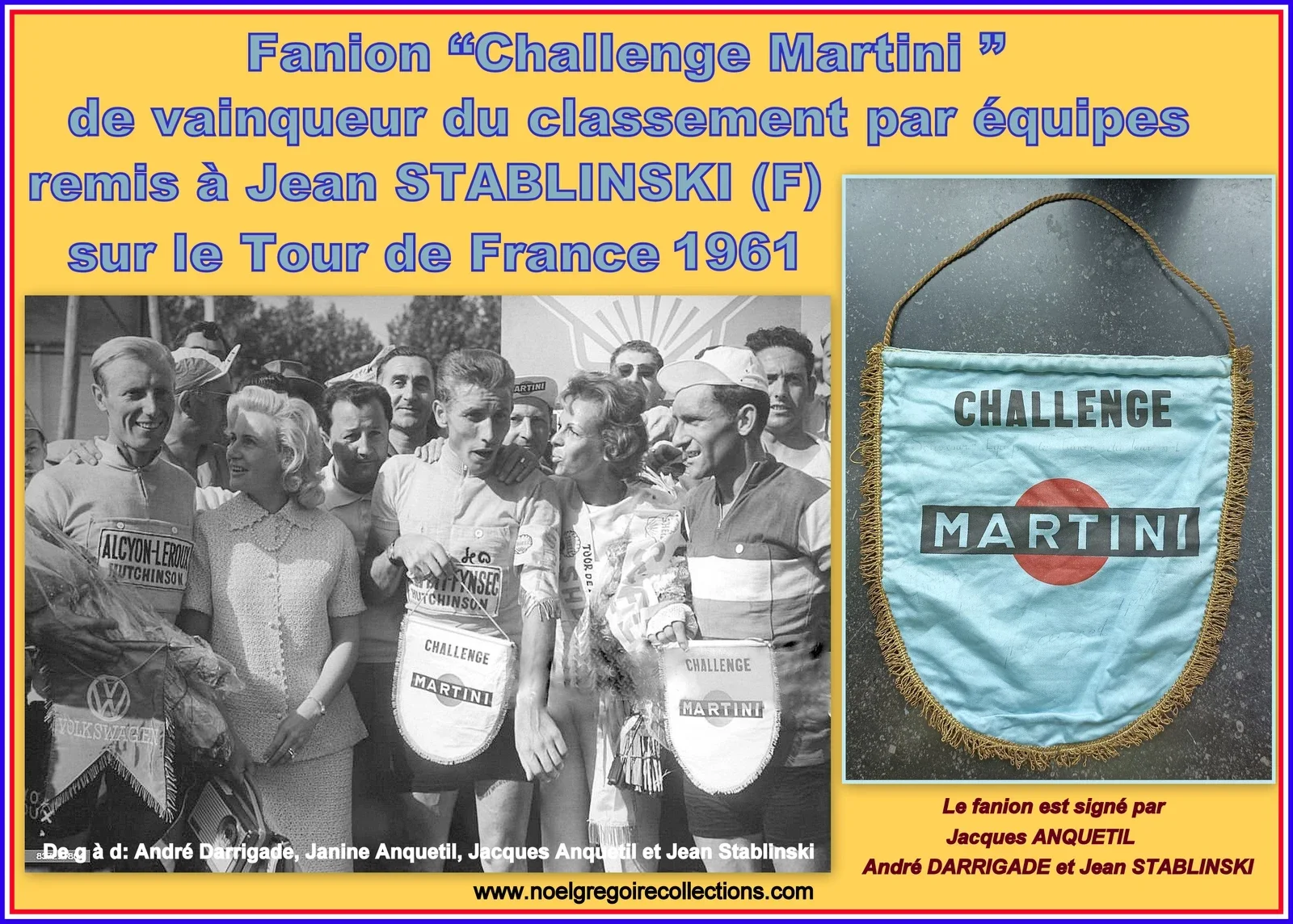
His Martini Challenge pennant, won with the French team at the 1961 Tour de France
Born Jean Stablewski in Thun-Saint-Amand, in the Nord department, Jean Stablinski was one of the leading figures in French cycling during the 1950s and 1960s. Nicknamed ‘the Wizard’ for his tactical acumen, he was also Jacques Anquetil’s loyal team-mate and lead-out man.
The 1961 Tour de France was still contested by national and regional teams. Stablinski was part of the powerful French squad led by Marcel Bidot, alongside Jacques Anquetil, André Darrigade and Henry Anglade, amongst others. The French team dominated that edition: Anquetil won the general classification, Darrigade the points classification, and the national team the Martini Challenge, the commercial name for the team classification.
In 1961, this classification was based on points. At each stage, the times of the three best riders from each team were added together; the team with the best total scored one point towards the final classification.
Jean Stablinski also contributed to the French success by winning the sprint finish on the 7th stage, between Belfort and Chalon-sur-Saône, covering a distance of 214.5 kilometres.
The pennant is made of light blue satin, edged with a gold fringe. Its design features the emblem of the sponsor Martini: a red disc set behind a black cartouche bearing the brand name. Presented to Jean Stablinski as a member of the victorious French team, this item represents a collective reward rather than a memento linked solely to his stage victory. The pennant bears handwritten inscriptions attributed to Jacques Anquetil, André Darrigade and Jean Stablinski. Subject to authentication, these signatures enhance its historical and documentary value.
The period photograph features, amongst others, André Darrigade, Janine Anquetil, Jacques Anquetil and Jean Stablinski. Anquetil and Stablinski are each shown holding a Martini Challenge pennant, probably during a ceremony organised to celebrate the French victory.
During his career, Jean Stablinski competed in twelve Tours de France and won five stages. His honours also include the 1958 Vuelta a España, four French championship titles and the 1962 Road World Championship.
Bearing the inventory number N.G.591, this pennant bears witness to the collective triumph of the French team in the 1961 Tour and to the vital role played by Jean Stablinski alongside Jacques Anquetil.
