

The water bottles, caps, musettes and gloves - 16
ITEM N° 754
"De Rosa" promotional water bottle
A presence in cycling since the 1970s
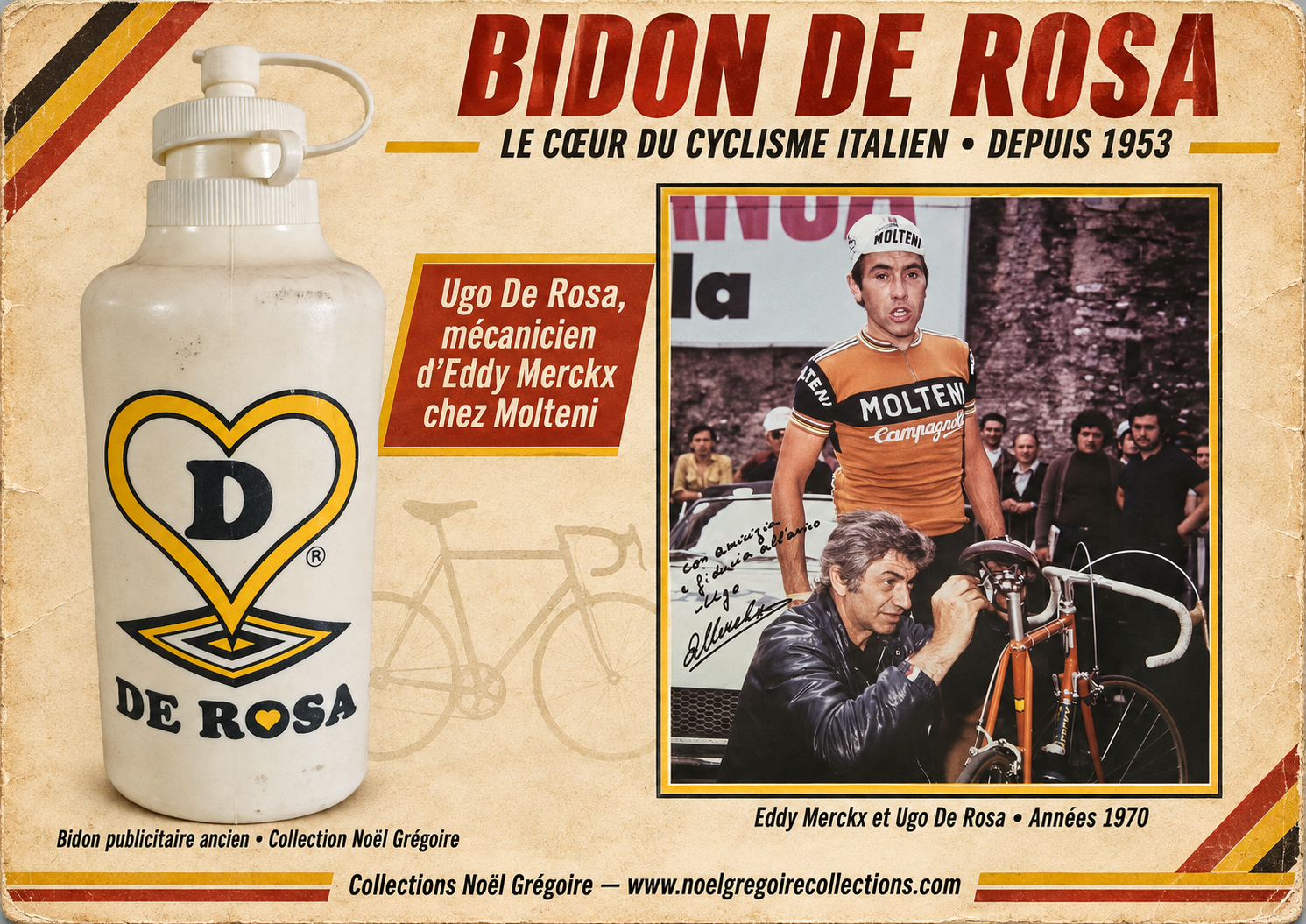
This vintage water bottle bears the famous De Rosa emblem: a stylised heart encircling the letter ‘D’. Its generous shape, attached cap and flexible plastic are characteristic of the equipment used by cyclists during the 1970s and 1980s. Its patina and signs of wear bear witness to its age.
Founded in Milan in 1953 by Ugo De Rosa, the company gradually established itself as one of Italy’s leading names in the artisanal manufacture of competition frames. Its bespoke creations were used by numerous champions, including Rik Van Looy, Gianni Motta, Eddy Merckx and Francesco Moser.
In the early 1970s, Eddy Merckx chose Ugo De Rosa as his mechanic for the Molteni team. Their close collaboration led to constant improvements in the geometry and construction of the Belgian champion’s bicycles. The heart motif, which first appeared on a professional team’s bikes in 1973, subsequently became De Rosa’s international trademark.
Active from 1958 to 1976, the Molteni team remains inextricably linked to Eddy Merckx’s greatest victories. Wearing his famous havana and black jersey, the ‘Cannibal’ won numerous Grand Tours, classics and world championships. This period contributed significantly to the international prestige of De Rosa and Italian cycling expertise.
On display in the Virtual Cycling Museum – Noël GREGOIRE Collections, this water bottle is a valuable testament to the history of De Rosa and its collaboration with Eddy Merckx and the legendary Molteni team.
ITEM N° 755
"Ovomaltine" promotional water bottle – 1970s
A presence in cycling since the 1930s
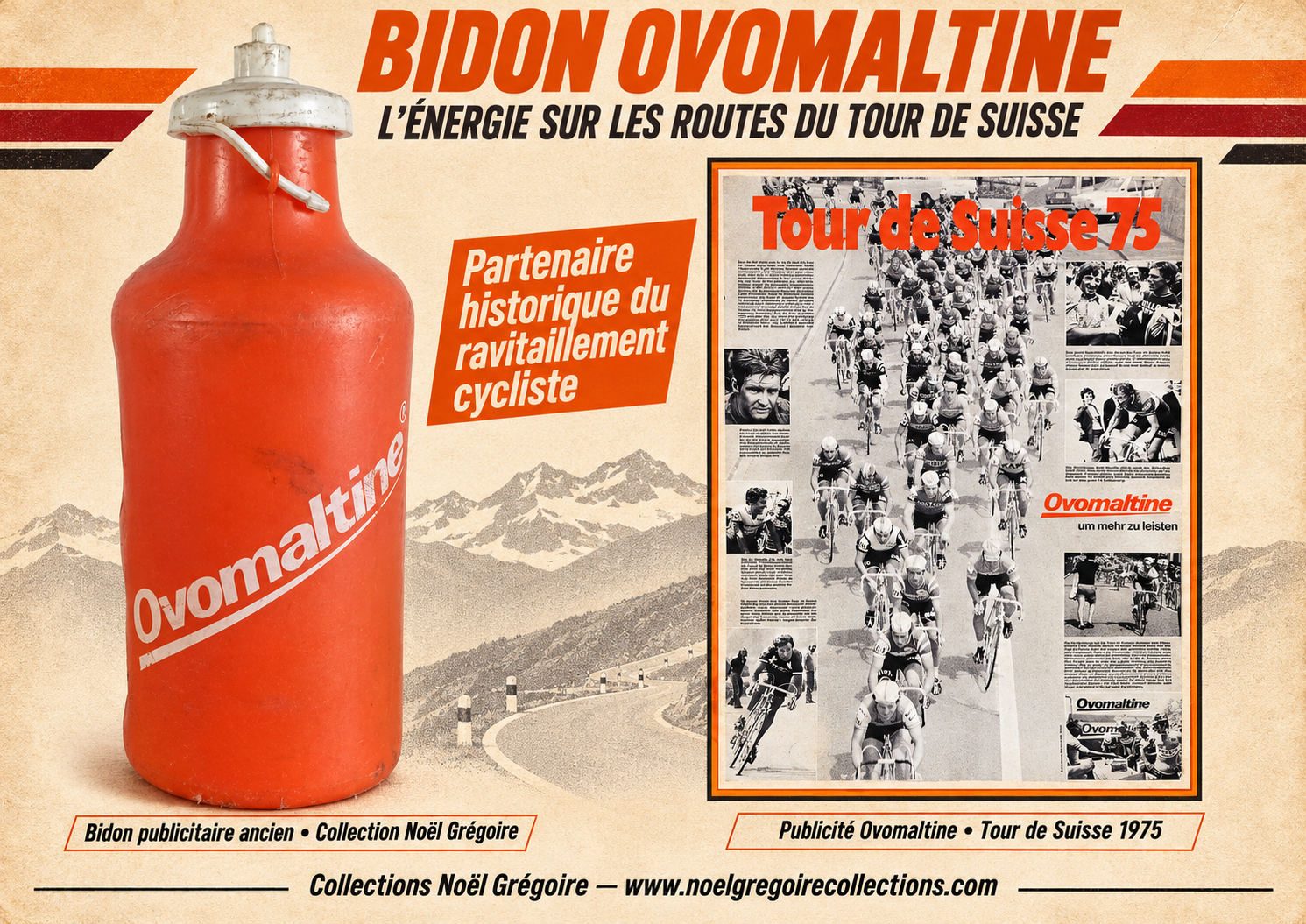
This vintage orange plastic water bottle bears the name ‘Ovomaltine’ in large, slanted white letters. Its highly visible colour and simple design are in keeping with the advertising identity adopted by the famous Swiss drink during the 1970s.
The bottle has a flexible, large-capacity body, a rounded shoulder and a narrow neck. Its translucent cap is secured by a clip to prevent it from being lost whilst filling or refuelling. Scratches, dents and signs of wear bear witness to its long history of use.
Created in Switzerland in 1904 by the Wander company, Ovomaltine is a malt-based preparation designed as a nutritious and fortifying drink. From very early on, the brand associated its image with physical exertion, sporting competitions and athletes’ nutrition.
Ovomaltine was present at numerous cycling events, notably the Tour de France from the 1930s onwards and, for over fifty years, the Tour de Suisse. The brand helped to provide refreshments for riders and support staff whilst distributing illustrated posters depicting the main stages of the race.
An advert for the 1975 Tour de Suisse shows the peloton and several champions of the era beneath the Ovomaltine logo. This documentation confirms the significant role played by the brand in the world of Swiss professional cycling during the period likely corresponding to this water bottle.
On display in the Virtual Cycling Museum – Noël GRÉGOIRE Collections, this water bottle is a remarkable physical testament to Ovomaltine’s presence in sports nutrition and on the routes of major European cycling events.
ITEM N° 756
"Enervit" promotional water bottle from the early 1980s
A presence in cycling since the late 1970s
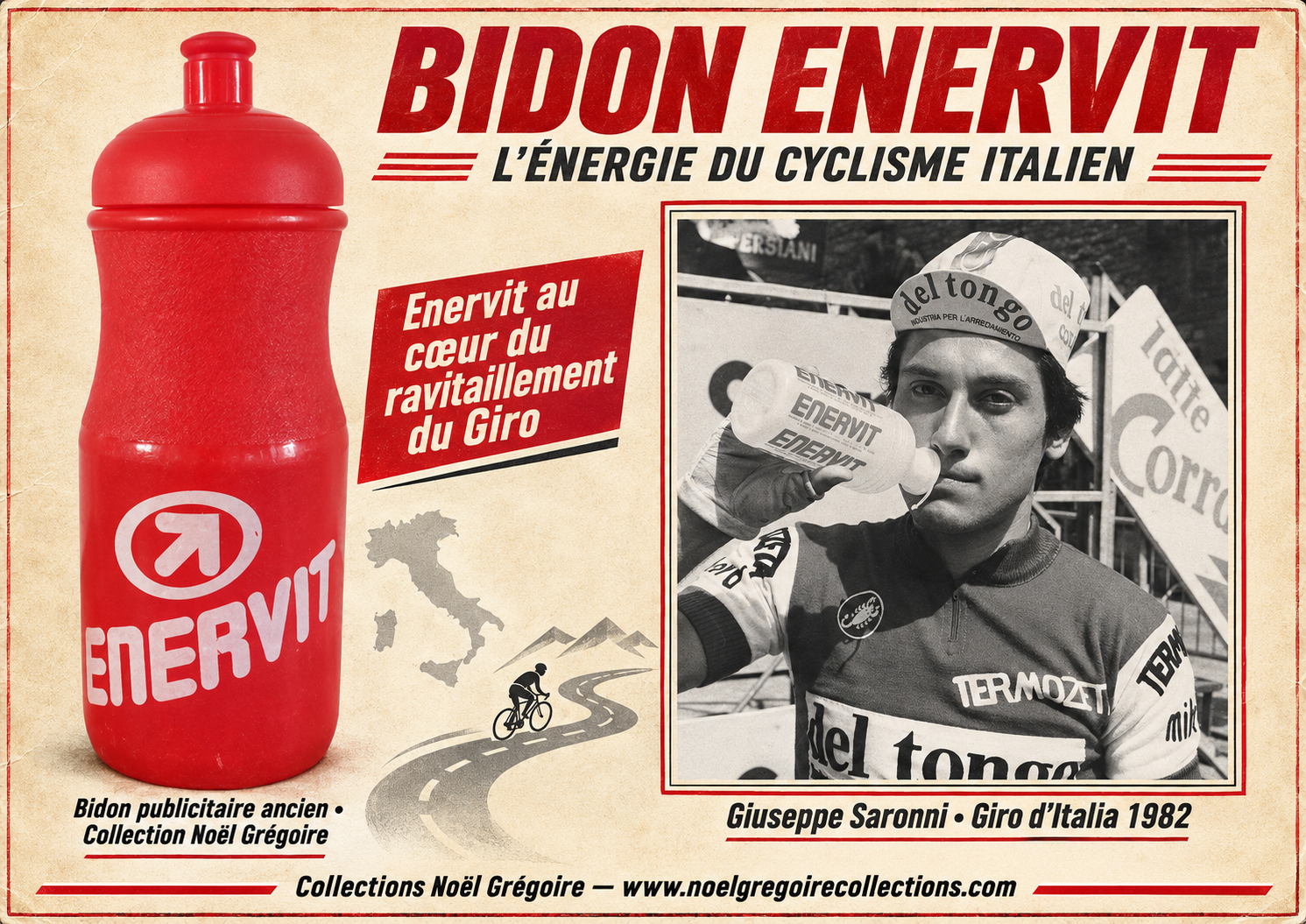
This vintage red plastic water bottle bears the name ‘Enervit’ along with the brand’s old white logo. Its bright colour and highly visible design reflect the branding used by the Italian company during the 1980s.
The bottle has a curved body, with a textured central section that makes it easy to grip. Its domed cap and mouthpiece allow the cyclist to drink quickly whilst riding. Its compact shape is characteristic of the water bottles used in the professional peloton at that time.
Developed in Italy under the leadership of Dr Paolo Sorbini, Enervit specialised in the study of sports nutrition. From the late 1970s onwards, its team of doctors, researchers and nutritionists supported riders in the Giro d’Italia, turning the race into a veritable testing ground for scientific experimentation.
A photograph taken at the 1982 Giro shows Giuseppe Saronni, then a rider for the Del Tongo team, drinking from a water bottle clearly bearing the Enervit logo. In 1984, the Enervit Team also played a part in the preparations for Francesco Moser’s hour record in Mexico City, set at the historic distance of 51.151 kilometres.
The slight marks and signs of wear on this item bear witness to its age. However, in the absence of any documentation establishing its specific provenance, it cannot be attributed with certainty to Giuseppe Saronni, to a particular team or to a specific edition of the Giro.
Featured in the Virtual Cycling Museum – Noël GRÉGOIRE Collections, this water bottle is a remarkable testament to the development of sports nutrition and to Enervit’s presence in Italian professional cycling in the early 1980s.
