

Unusual objects- 4
ITEM N° 087
DEKKER Erik (NL)
(21.08.1970)
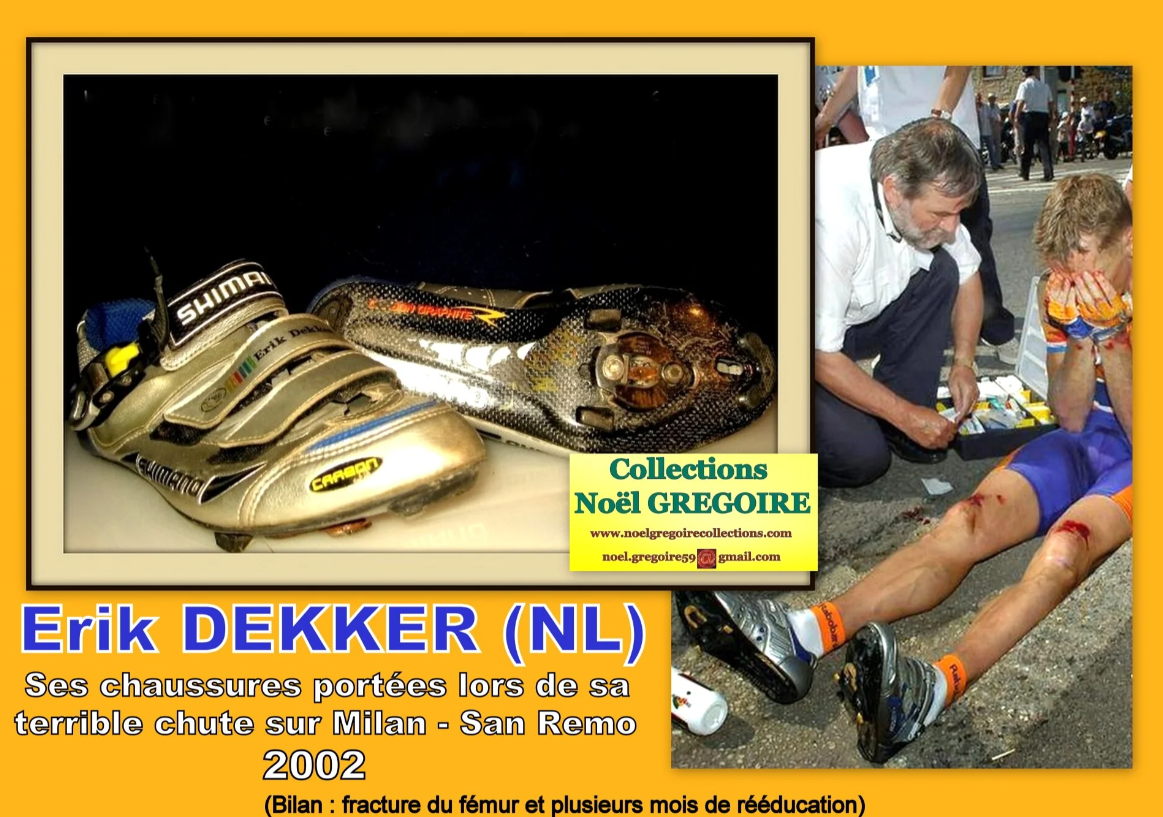
The shoes he was wearing when he crashed during the 2002 Milan–San Remo
A professional cyclist from 1992 to 2006, Erik Dekker was one of the finest representatives of Dutch cycling of his generation. A specialist in breakaways and the classics, he won four stages of the Tour de France, the Clásica de San Sebastián in 2000, the Amstel Gold Race and the World Cup in 2001, and then Tirreno–Adriatico in 2002.
On 23 March 2002, whilst competing in Milan–San Remo for Rabobank, Erik Dekker suffered a violent crash. Seriously injured in the hip, he was forced to undergo a long period of convalescence and rehabilitation, which disrupted much of his season. Cyclingnews
The Shimano shoes shown here were worn at the time of this accident. Silver in colour, they feature three straps and rigid carbon-fibre soles. Erik Dekker’s name and the Dutch flag appear on one of the straps. The numerous scuff marks, wear on the sole and visible damage around the cleats bear witness to the severity of the crash.
Preserved in their original condition, these shoes do not commemorate a victory, but rather the risks to which riders are exposed in the major classics, contested at very high speeds on roads that are sometimes treacherous.
On display in the Virtual Cycling Museum – Noël Grégoire Collections, these historic shoes are a striking testament to Erik Dekker’s career and evoke the courage required to return to competition after a serious accident.
ITEM N° 120
GARNIER Henri (B)
(19.09.1908 – 04.01.2003)
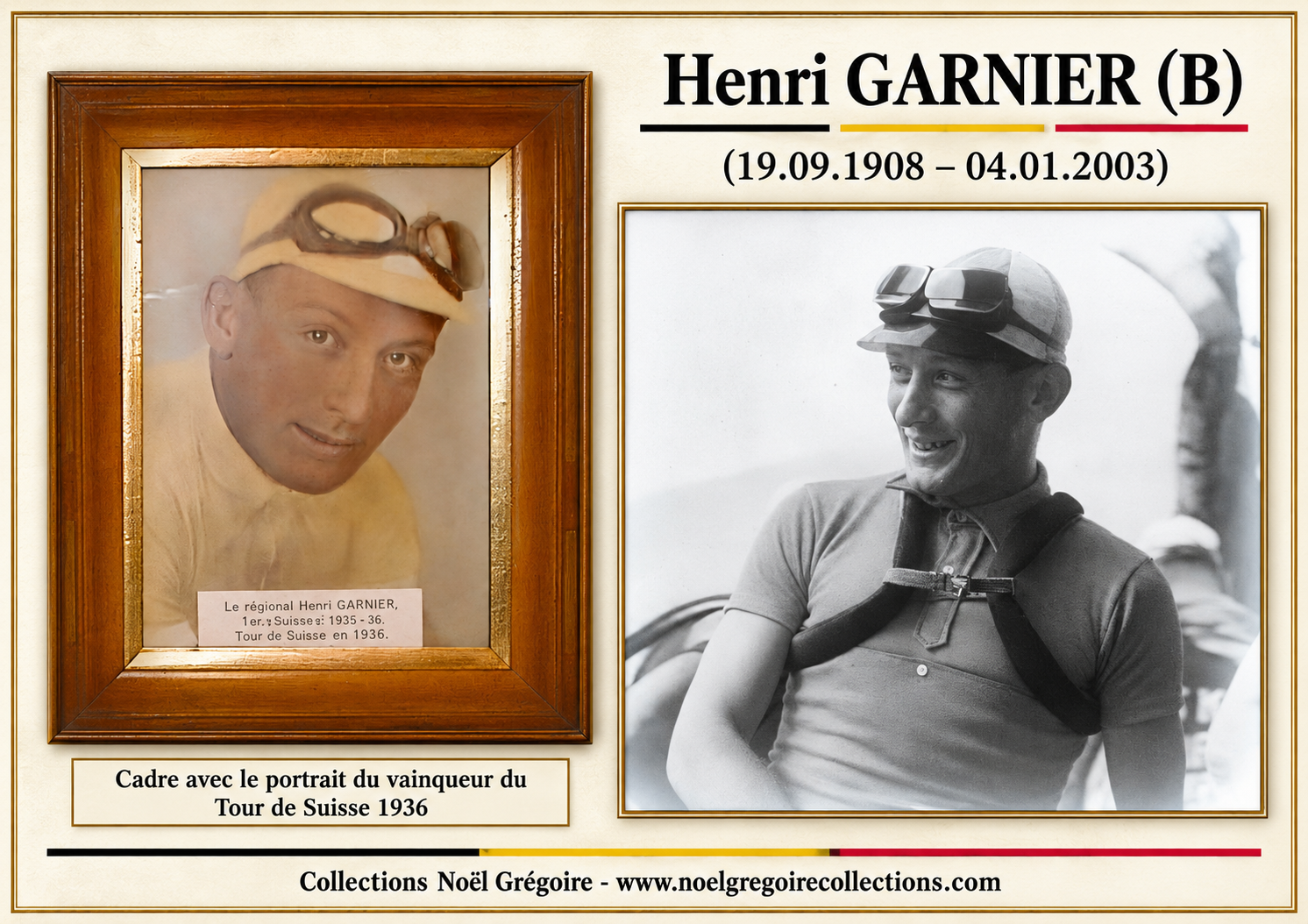
Framed portrait of the winner of the 1936 Tour de Suisse
Born in Feschaux, in the province of Namur, Henri Garnier was a professional cyclist from 1933 to 1937. A strong road rider and a solid climber, he distinguished himself mainly in the major stage races held in Belgium and Switzerland.
After finishing third in the 1935 Tour de Suisse, Henri Garnier won the following edition in spectacular fashion, held from 20 to 27 June 1936. Winner of the first stage, he also claimed the mountains classification and the overall classification, finishing more than seven minutes ahead of his compatriot Gustaaf Deloor. This victory remains the greatest achievement of his career.
Henri Garnier also competed in the 1935 Tour de France as part of the Belgian national team. He achieved several creditable results in the Tour of Belgium and went on to finish eighth in the Flèche Wallonne and tenth in Liège–Bastogne–Liège in 1937, the final year of his professional career.
The frame shown here contains an old portrait of Garnier wearing a light-coloured cap topped with his cycling glasses. A small caption at the bottom of the image recalls his performances in the Tour de Suisse in 1935 and 1936. The wooden frame, enhanced by a gilded inner border, contributes to the popular and commemorative character of this piece.
Held in the Noël Grégoire Collections, this portrait is a valuable tribute to a Belgian cyclist who is now somewhat forgotten, but whose name remains inscribed on the roll of honour of one of Europe’s most important stage races.
ITEM N° 121
GARNIER Henri (B)
(19.09.1908 – 04.01.2003)
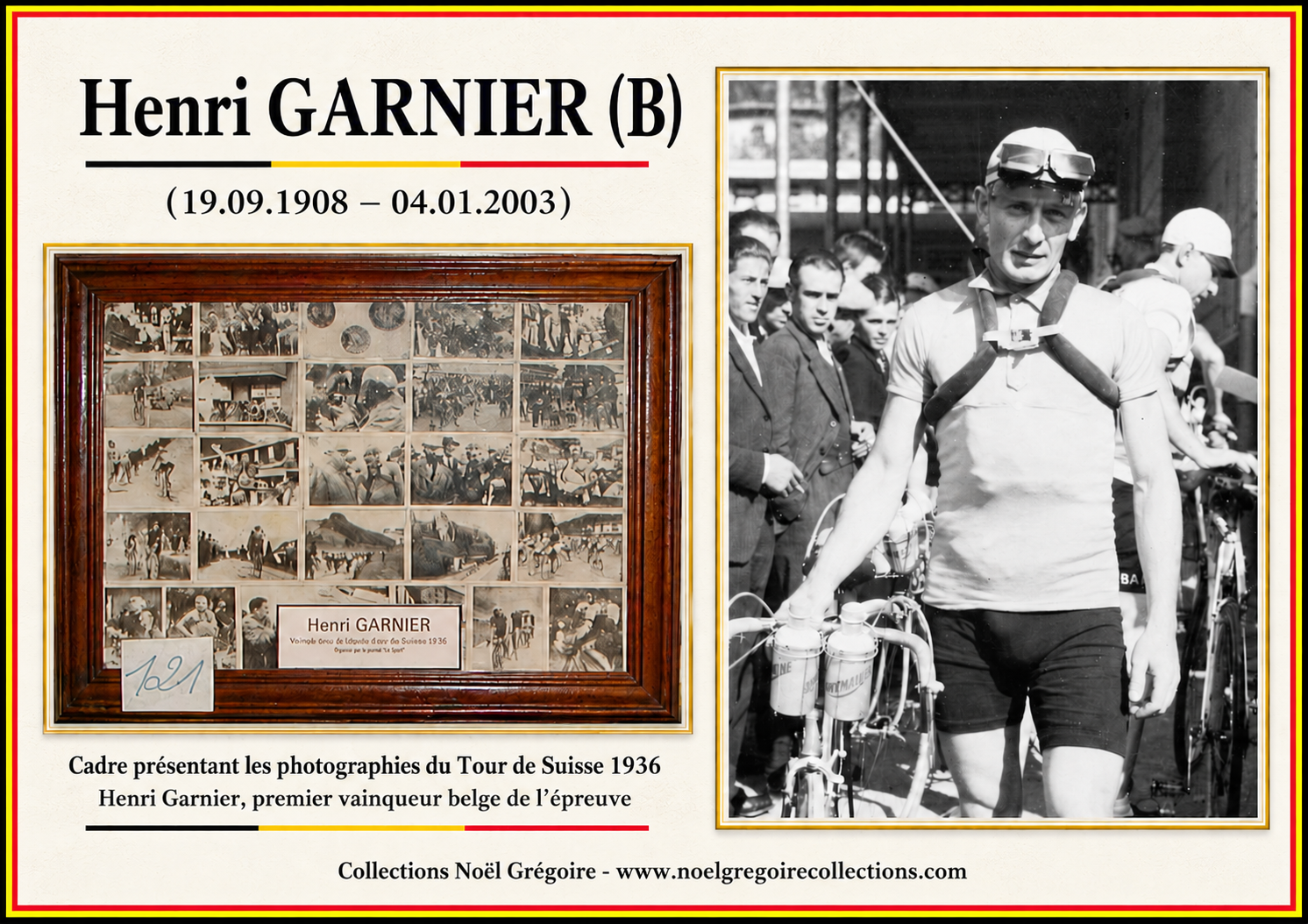
Photographic mosaic of the 1936 Tour de Suisse
This frame brings together a remarkable series of photographs chronicling Henri Garnier’s victory in the 1936 Tour de Suisse. Arranged in the form of a mosaic, the various photographs capture the key stages of the race: mountain passes, the peloton in action, checkpoints, refreshment stops, finishes and moments of rest.
Held from 20 to 27 June over seven stages and more than 1,650 kilometres, this fourth edition of the Tour de Suisse saw Henri Garnier become the race’s first Belgian winner. He triumphed on the very first stage before going on to win the general classification and the King of the Mountains classification. In the final standings, he finished 7 minutes and 20 seconds ahead of his compatriot Gustaaf Deloor.
At the centre of the composition is a plaque bearing the name of Henri Garnier, commemorating his success in the 1936 edition organised by the Swiss newspaper *Le Sport*. The combination of these numerous images within a single frame transforms the piece into a veritable visual narrative of his victory. The signs of ageing visible on the prints and the frame reinforce its historical character.
Born in Feschaux in 1908, Henri Garnier competed for only a few seasons as a professional, from 1933 to 1937. His career was relatively short, but his success in Switzerland secured him a special place in the history of Belgian cycling. He had already distinguished himself in this race by finishing third in the general classification in 1935.
Housed within the Noël Grégoire Collections, this mosaic is much more than a mere sporting memento: it preserves, image by image, the memory of Henri Garnier’s greatest victory and the atmosphere of the stage races of the 1930s.
